

The reporting that sparked this guide: USCIS Processing Times and Updates for 2026 (USCIS)
What This News Means for Immigrants in Orlando and Across Florida
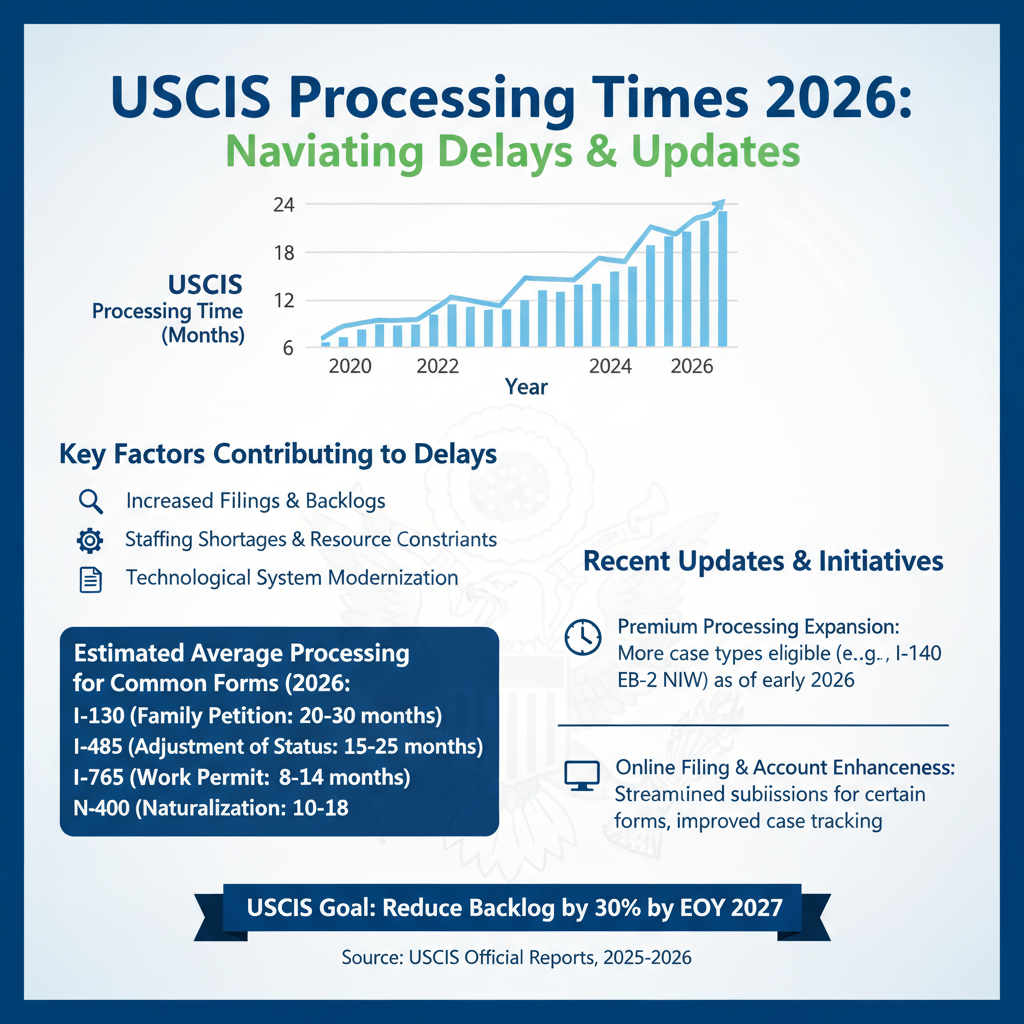
For immigrants and their families residing in Orlando, across Central Florida, and throughout the Sunshine State, updates to USCIS official website processing times are not just statistics; they are deeply personal. These figures dictate the timeline for family reunification, career opportunities, and the path to permanent residency or citizenship. As we navigate 2026, understanding these changes is paramount to planning your future.
Why this news is showing up now
USCIS processing times are in a constant state of flux. They are influenced by a multitude of factors, including the volume of applications received, staffing levels at various service centers and field offices (like the Orlando USCIS Field Office), changes in immigration policy, and technological advancements (or lack thereof). Every quarter, USCIS reviews and updates these times based on historical data and current operational capacity. The "news" you're seeing now reflects the latest adjustments for 2026, providing a snapshot of the current landscape. These updates are crucial because they set expectations and inform applicants when they can reasonably expect a decision on their case. Policy shifts, such as those impacting specific visa categories or application types, can cause significant swings in these posted times, making regular monitoring essential for anyone with an active application.
How it can affect Florida residents
Florida, with its vibrant multicultural communities and significant immigrant population, is particularly sensitive to USCIS processing time fluctuations. For residents of Orlando, Kissimmee, Tampa, Miami, and other cities along the I-4 corridor and beyond, these updates can have direct, tangible impacts:
- Family Reunification: Delays in processing Form I-130, Petition for Alien Relative, mean longer waits for families to be together. For instance, a spouse or child awaiting a visa may face extended separation from their loved ones in Orlando.
- Employment Stability: Delays in employment authorization documents (EADs) filed on Form I-765 can lead to job loss or inability to start new employment, impacting the livelihoods of many in the state, particularly in sectors reliant on immigrant labor.
- Travel and Re-entry: Longer waits for Form I-131, Application for Travel Document (Advance Parole), can restrict international travel, affecting those with family abroad or business commitments.
- Path to Citizenship: Naturalization applications (Form N-400) taking longer can delay civic participation and the enjoyment of full rights as a U.S. citizen for residents of Orange County and surrounding areas.
- Uncertainty and Stress: The emotional toll of prolonged waits and uncertainty cannot be overstated. Knowing current processing times, even if discouraging, allows for better planning and mental preparation.
Important: While processing times are federal, the specific workload and efficiency of the Orlando USCIS Field Office or the service center handling your application can significantly influence your personal timeline. Imigrar understands these local nuances and helps clients navigate them effectively.
Need Help? Our Orlando immigration team is ready to assist. Call +1 786-791-3106 for a free consultation, or message us online. Se Habla Español.
What USCIS Processing Times Are (and Why It Matters)
USCIS processing times refer to the period it takes for U.S. Citizenship and Immigration Services to process an application or petition from the date of receipt to the date of decision (approval, denial, or request for more evidence). These times are publicly available on the USCIS website and are updated regularly.
A plain-English definition
Think of USCIS processing times as the estimated wait time for your immigration application, similar to waiting in line at the DMV or for a package delivery. When you submit a form to USCIS, it enters a queue. The "processing time" is USCIS's best estimate of how long it will take for them to get to your application, review it, and make a decision. These times are not guarantees; they are averages or ranges based on how long similar cases have taken in the past. They can vary greatly depending on the type of application, the specific service center or field office handling it, and even the complexity of your individual case.
Key terms you need to know
Navigating USCIS processing requires understanding several key terms:
- Receipt Date: The date USCIS officially receives your application. This is typically the start date for calculating your processing time.
- Priority Date: For certain visa preference categories (e.g., family-based or employment-based), this is the date your petition (Form I-130 or Form I-140) was properly filed with USCIS. Your visa number becomes available only when your Priority Date is current according to the U.S. Department of State's Visa Bulletin.
- Case Status Online: USCIS's online tool where you can enter your Receipt Number to check the status of your application.
- Service Request: An inquiry you can make with USCIS if your application is outside the normal processing times.
- Visa Bulletin: A monthly publication by the Department of State that lists the availability of immigrant visas for various preference categories and countries. If your Priority Date is not "current" in the Visa Bulletin, you cannot apply for Adjustment of Status or receive an immigrant visa, even if your underlying petition is approved.
- Adjustment of Status (AOS): The process of applying for lawful permanent resident status (a Green Card) while physically present in the United States, typically using Form I-485.
- Consular Processing: The process of applying for an immigrant visa at a U.S. embassy or consulate abroad, typically used by those outside the U.S.
- Request for Evidence (RFE): A notice from USCIS asking for additional documents or information to support your application.
- Notice of Intent to Deny (NOID): A notice from USCIS indicating their intent to deny your application unless you provide specific information or evidence.
Understanding these terms is critical because they directly impact when you can expect your case to move forward, when you can travel, work, or eventually become a citizen. A delay in one stage, such as the initial petition, can ripple through all subsequent stages, affecting your entire immigration journey in Florida.
Current Immigration Law: The Foundation Governing Processing
USCIS processing times are not arbitrary; they are deeply rooted in the framework of U.S. immigration law, primarily the Immigration and Nationality Act (INA). The INA, along with subsequent legislative amendments and regulatory changes, sets the rules for who can immigrate, under what conditions, and in what numbers. These legal parameters directly influence the volume and complexity of applications USCIS receives, which in turn affects processing times.
Federal requirements
The INA establishes various visa categories (e.g., family-sponsored, employment-based, diversity lottery) and often imposes annual numerical limits on most of these categories. For example, specific family preference categories have caps on the number of visas issued worldwide each fiscal year, with further per-country limits. These caps lead to backlogs, especially for high-demand categories and countries, creating the need for a Priority Date system managed through the Visa Bulletin.
USCIS is an agency within the Department of Homeland Security (DHS) and operates under federal statutes and regulations. While there are some statutory timelines for certain application types (e.g., some asylum applications or naturalization under specific circumstances), for many common forms like Form I-130, Form I-485, and Form I-765, there are no strict federal mandates on how quickly they must be processed. This administrative flexibility allows USCIS to manage its workload but also contributes to the variability and potential for long delays.
Key federal requirements impacting processing include:
- Annual Visa Quotas: Limits on green cards for family and employment categories, leading to extensive waits for many nationalities.
- Eligibility Criteria: Each form and visa type has specific eligibility requirements (e.g., relationship proof for Form I-130, continuous residence for Form N-400). Meeting these criteria perfectly can expedite processing; errors or omissions cause delays.
- Admissibility Standards: All applicants for permanent residency must be admissible to the U.S., meaning they must not have certain criminal records, health issues, or other disqualifying factors. This often requires background checks and security clearances, which can significantly extend processing times.
- Funding and Resources: USCIS is largely fee-funded. Fluctuations in fee revenue, congressional appropriations, and staffing levels directly impact the agency's ability to process cases efficiently.
For detailed information on specific forms and their requirements, always refer to the USCIS Forms page.
Florida-specific considerations
While immigration law is federal, its implementation and impact can vary regionally. For Florida residents, especially those in the Orlando metropolitan area, several factors come into play:
- Orlando USCIS Field Office: This local office handles interviews for Form I-485 (Adjustment of Status) and Form N-400 (Naturalization) applicants residing in its jurisdiction. The local office's specific workload, staffing, and interview scheduling capacity directly affect the wait times for these critical steps.
- High Volume of Applicants: Florida is a major destination for immigrants from various countries, leading to a consistently high volume of applications filed by its residents. This can put additional strain on local field offices and the national service centers that process applications originating from Florida.
- State-level Support Services: While not directly affecting USCIS processing, Florida's state and local policies regarding immigrant support services, access to driver's licenses, or professional licensing can indirectly influence an immigrant's ability to maintain status, respond to RFEs, or secure employment while waiting.
- Legal Community Expertise: Orlando boasts a robust legal community specializing in immigration law, like Imigrar. Our local knowledge of the Orlando USCIS Field Office procedures, common local challenges, and regional trends can be invaluable in preparing and managing your application.
Reminder: No matter where you are in Florida, your immigration journey is governed by federal law. However, having an attorney familiar with the local environment can provide a significant advantage.
Navigating complex immigration laws? Imigrar's expert team in Orlando can help. Call +1 786-791-3106 for a free consultation. Se Habla Español.
How to Navigate USCIS Processing Times: A Complete Step-by-Step Guide
Understanding and managing USCIS processing times is crucial for anyone with an active immigration application. Here’s a detailed guide on how to stay informed and proactive.
1) Understand Your Application Type and Service Center
Before you can check anything, you need to know exactly what type of application you filed (e.g., Form I-130, Form I-485, Form N-400). You also need to identify which USCIS service center or field office is handling your case. This information is typically found on your Receipt Notice (Form I-797C). For example, petitions might go to the Nebraska Service Center or Texas Service Center, while Adjustment of Status interviews often occur at your local Orlando USCIS Field Office.
- Required Documents/Information:
- Your Receipt Notice (Form I-797C), which contains your 13-digit Receipt Number (e.g., EAC-XX-XXX-XXXXX, WAC-XX-XXX-XXXXX, LIN-XX-XXX-XXXXX, SRC-XX-XXX-XXXXX, IOE-XX-XXX-XXXXX).
- Knowledge of the specific form number you filed (e.g., Form I-130, Form I-485, Form I-765).
2) Locate Your Receipt Number and Check USCIS Online Tools
Once you have your Receipt Number, you can use USCIS's online tools to track your case. This is your primary resource for up-to-date information.
a. USCIS Case Status Online:
Go to the USCIS Case Status Online page and enter your 13-digit Receipt Number. This will show you the latest action taken on your case (e.g., "Case Was Received," "Request for Evidence Sent," "Card Was Produced"). It does not typically give you an estimated completion date but provides real-time status updates.
b. USCIS Processing Times Tool:
Visit the USCIS Processing Times page. Here, you will select your form type and the service center or field office indicated on your Receipt Notice. The tool will then display a range of processing times for similar cases.
- Required Documents/Information:
- Your Receipt Number.
- Access to the internet.
3) Interpret the Processing Times Data
The processing times tool provides estimates, not guarantees. It usually shows a range (e.g., "6.5 Months to 10 Months") or a "cycle time" based on 80% of completed cases. If your application falls within this range, it is considered "normal processing." If your Receipt Date is older than the left side of the range, your case is likely still within normal processing. If your Receipt Date is older than the right side of the range, your case might be "outside normal processing times."
Warning: These are estimates. Individual cases can take longer due to RFEs, background checks, or other complexities. Do not make critical life decisions solely based on the posted times without consulting legal counsel.
- Key Data Points to Note:
- "As of" Date: This indicates when the data was last updated. Always check the most recent update.
- "Receipt Date for a Case Inquiry": This is the date you should compare your Receipt Date against to determine if your case is outside normal processing times.
4) Monitor the Visa Bulletin (if applicable)
If you are applying for an immigrant visa or Adjustment of Status in a preference category (e.g., family-sponsored F2A, F1, F3, F4, or employment-based), your application cannot be approved until your Priority Date is "current" in the monthly Visa Bulletin published by the U.S. Department of State. Even if your Form I-130 is approved, your green card cannot be issued until your Priority Date is current. This is a common source of long waits for many families in Orlando and worldwide.
- Required Information:
- Your Priority Date (from your Form I-130 Receipt Notice or approval).
- Your visa category and country of chargeability.
5) When to File an "Outside Normal Processing Times" Inquiry
If your Receipt Date is older than the "Receipt Date for a Case Inquiry" listed on the USCIS Processing Times page for your specific form and service center, you may be eligible to submit an "e-Request" online. This initiates an inquiry into your delayed case. USCIS aims to respond to these inquiries within 15 days. If you are a resident of Orlando or Central Florida, this is the first formal step to take for a delayed case.
- Required Documents/Information:
- Your Receipt Number.
- Your personal details (name, date of birth).
- The date your case went outside normal processing times.
6) Prepare for Interviews and RFEs
Even during a long wait, stay prepared. Many applications, particularly Form I-485 and Form N-400, require an interview at your local field office, such as the Orlando USCIS Field Office. You might also receive an RFE or NOID. Responding promptly and accurately to these is critical to avoid further delays or denial.
- Preparation Checklist:
- Keep copies of all submitted documents.
- Maintain original supporting documents.
- Gather updated evidence (e.g., recent pay stubs, tax returns, marriage certificates, birth certificates, medical exam results on Form I-693).
- Review your application thoroughly.
- Practice potential interview questions.
7) Seek Legal Counsel for Complex Cases or Delays
If your case is significantly delayed, you've received an RFE or NOID, or you find the process overwhelming, it's wise to consult an experienced immigration attorney. An attorney can help you:
- Review your application for potential issues.
- File accurate inquiries with USCIS.
- Respond to RFEs or NOIDs effectively.
- Prepare you for interviews.
- Explore alternative options or strategies.
- Escalate your case if necessary, including contacting congressional offices or pursuing litigation (Mandamus actions) in extreme circumstances.
Imigrar's team in Orlando specializes in navigating these complexities for Florida residents.

Practical Steps You Can Take Today
While you cannot control USCIS processing times, you can control your preparedness and proactive measures. Here’s an actionable checklist:
- Keep Organized Records: Create a physical and digital folder for all immigration documents. Include copies of every form you submitted, all Receipt Notices, correspondence from USCIS, and all supporting evidence. This is invaluable if you need to respond to an RFE or inquire about your case.
- Update Your Address Promptly: If you move, even within Orlando or to another part of Florida, you must update your address with USCIS within 10 days of moving by filing Form AR-11 online or by mail. Failure to do so can result in missed notices, RFEs, or interview appointments, leading to significant delays or even denial.
- Monitor Your Case Status Online Regularly: Make it a habit to check your case status on the USCIS Case Status Online tool at least once a month. This helps you catch any updates, RFEs, or interview notices as soon as they are posted.
- Understand Your Current Immigration Status: Be aware of the expiration dates of your current visa, EAD, or other immigration benefits. Plan ahead to file for extensions if necessary, typically within a 90-day window before expiration. Allowing your status to lapse can have severe consequences.
- Prepare for Potential RFEs: Anticipate what additional evidence USCIS might request. For example, if you filed a family-based petition, continue to gather joint financial documents, photos, and other proof of a bona fide relationship. Having these ready can significantly reduce response time if an RFE is issued.
- Financial Planning: Long processing times can impact your ability to work or travel. Plan your finances accordingly, especially if your EAD is nearing expiration or you are awaiting approval for an employment-based green card.
- Consult with an Attorney for Proactive Planning: A qualified immigration attorney can help you review your application, identify potential pitfalls, and develop a strategy to mitigate delays. They can also advise on proactive steps tailored to your specific situation.
Document preparation guidance
Thorough and accurate document preparation is key to avoiding RFEs and delays:
- Completeness: Ensure every question on every form is answered accurately and completely. Leaving blanks or providing inconsistent information is a common reason for RFEs.
- Legibility: If filling out forms by hand, write clearly


