


The reporting that sparked this guide: Green Card Interview Preparation Tips (Immigration Law)
What This News Means for Immigrants in Orlando and Across Florida
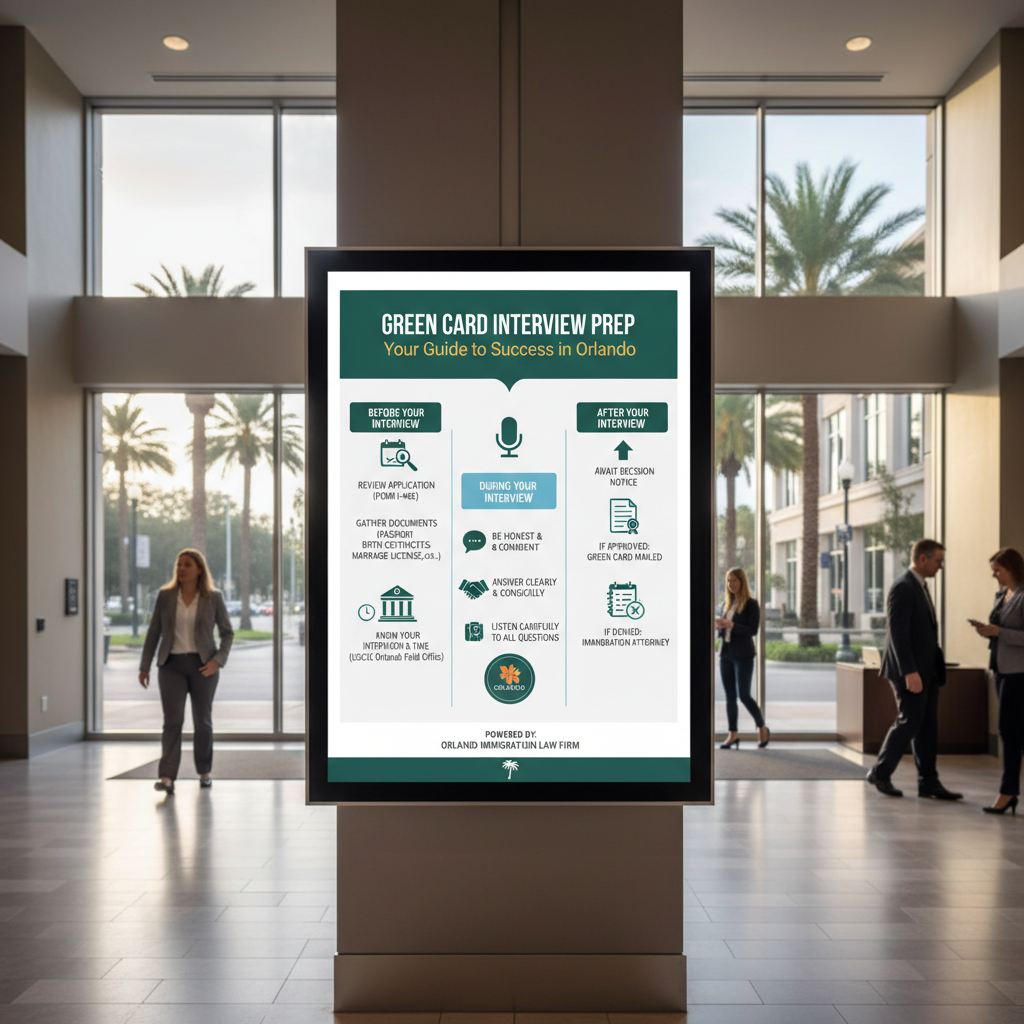
The journey to obtaining a Green Card, also known as lawful permanent residency, is a pivotal moment for countless individuals and families seeking to build a new life in the United States. A critical step in this process for many is the Green Card interview with U.S. Citizenship and Immigration Services (USCIS). While the interview itself is not new, the emphasis on thorough preparation and understanding its nuances remains a constant and trending topic within immigration law circles. News and discussions around Green Card interview preparation consistently highlight its importance, reflecting the ongoing need for applicants to be well-informed and ready for this decisive meeting.
Why this news is showing up now
The "news" about Green Card interview preparation is perennially relevant because the interview is a mandatory step for most individuals applying for Adjustment of Status (AOS) to become lawful permanent residents. USCIS officers conduct these interviews to verify the information provided in your application, ensure you meet eligibility criteria, and confirm that no grounds of inadmissibility apply to your case. With changes in immigration policies, processing backlogs, and evolving security measures, the scrutiny applied during these interviews can intensify, making comprehensive preparation more critical than ever. Furthermore, the sheer volume of applications means that countless individuals are always approaching this stage, driving a continuous demand for reliable guidance and support.
For example, as of March 2026, USCIS continues to process a significant number of applications, and while some interviews may be waived (particularly for employment-based cases or minor children), the vast majority of family-based applicants will still face an interview. This consistent demand for processing means that the need for excellent preparation advice remains high.
How it can affect Florida residents
Florida is home to a vibrant and diverse immigrant population, with many individuals and families pursuing Green Card status. For residents of Orlando, Central Florida, and indeed, across the entire state, understanding how to effectively prepare for a Green Card interview is paramount. The Orlando USCIS Field Office, located at 6680 Corporate Centre Blvd, Orlando, FL 32822, serves a large geographical area, handling numerous Adjustment of Status interviews daily. What this means for Florida residents is that local knowledge, understanding the specific procedures of the Orlando office, and having access to experienced local legal counsel can be invaluable.
Moreover, Florida's diverse demographics mean that applicants come from various backgrounds, often with unique circumstances. Whether you're in Orange County, along the I-4 corridor, or elsewhere in the state, the principles of good preparation apply universally. However, local attorneys are better positioned to advise on any regional trends or specific requirements that may arise from the local USCIS field office. Being prepared helps avoid unnecessary delays, Requests for Evidence (RFEs), or even denials, which can have profound impacts on families residing in Florida.
Need Help? Navigating the Green Card interview process can be complex. Our Orlando immigration team is ready to assist. Call +1 786-791-3106 for a free consultation, or message us online. Se Habla Español.
What Green Card Interview Preparation Is (and Why It Matters)
The Green Card interview is a critical juncture in the immigration process, designed to ensure that an applicant seeking permanent residency in the United States genuinely qualifies under U.S. immigration law. It's not just a formality; it's an opportunity for a USCIS officer to verify the information you've submitted, clarify any discrepancies, and assess your eligibility in person. Failing to prepare adequately can lead to significant setbacks, including delays, Requests for Evidence (RFEs), or even denial of your application.
A plain-English definition
Simply put, a Green Card interview is a meeting with an immigration officer from USCIS. During this meeting, the officer will ask you questions about your application, your background, your relationship (if applying based on marriage), and your intentions in the U.S. Their main goal is to confirm that everything you've stated in your application forms is true and accurate, and that you meet all the legal requirements to become a lawful permanent resident. For those applying for Adjustment of Status within the U.S., this interview typically takes place at a local USCIS field office, such as the one in Orlando. If you are applying from outside the U.S. through Consular Processing, your interview will be at a U.S. embassy or consulate in your home country.
Key terms you need to know
- Green Card: The common name for a Permanent Resident Card, which proves that you are authorized to live and work permanently in the United States.
- USCIS (U.S. Citizenship and Immigration Services): The government agency responsible for processing immigration applications and conducting Green Card interviews.
- Adjustment of Status (AOS): The process of applying for lawful permanent resident status (a Green Card) while physically present in the United States. This is contrasted with Consular Processing, which happens abroad.
- Consular Processing: The process of applying for an immigrant visa at a U.S. embassy or consulate in a foreign country, which allows you to enter the U.S. as a permanent resident.
- Sponsor: The U.S. citizen or lawful permanent resident who files a petition on behalf of the applicant (the Beneficiary). For family-based petitions, this is typically a spouse, parent, or adult child.
- Beneficiary: The immigrant applicant who is seeking a Green Card.
- Form I-130, Petition for Alien Relative: The initial form filed by a U.S. citizen or LPR to establish a qualifying relationship with a foreign relative.
- Form I-485, Application to Register Permanent Residence or Adjust Status: The main application form filed by an individual seeking to adjust their status to a lawful permanent resident while in the U.S.
- Form I-864, Affidavit of Support: A legally binding document signed by the sponsor, promising to financially support the immigrant and ensure they do not become a public charge.
- Form I-693, Report of Medical Examination and Vaccination Record: A document completed by a USCIS-approved civil surgeon, certifying that the applicant has undergone a medical examination and met vaccination requirements.
- Priority Date: The date USCIS receives your immigrant petition (e.g., Form I-130). This date determines your place in the visa queue for numerically limited categories.
- Field Office: A local USCIS office where interviews are conducted. For applicants in Central Florida, this is typically the Orlando USCIS Field Office.
- Request for Evidence (RFE): A notice from USCIS asking for additional documents or information to support your application.
- Notice of Intent to Deny (NOID): A notice from USCIS indicating their intention to deny your application, providing you an opportunity to respond before a final decision.
Current Immigration Law: The Foundation
The legal framework for obtaining a Green Card is primarily established by the Immigration and Nationality Act (INA), specifically sections related to eligibility for permanent residency and grounds of inadmissibility. Understanding these foundational laws is crucial for appreciating the purpose and scope of your Green Card interview.
Federal requirements
The core requirements for obtaining a Green Card are outlined in various sections of the INA. For Adjustment of Status, the primary statute is INA Section 245(a), which allows certain noncitizens who are physically present in the United States to apply for lawful permanent residence if they meet specific criteria. Key federal requirements include:
- Eligibility through a qualifying petition: You must have an approved or concurrently filed immigrant petition (e.g., Form I-130 for family-based, Form I-140 for employment-based, or special immigrant petitions).
- Admissibility: You must be "admissible" to the United States. INA Section 212 lists various grounds of inadmissibility, including health-related grounds, criminal grounds, security and related grounds, public charge grounds, and misrepresentation. During the interview, the officer will assess if any of these apply to you.
- Lawful Entry (for AOS): Generally, you must have been inspected and admitted or paroled into the U.S. to adjust status under INA 245(a).
- Good Moral Character: While not explicitly a requirement for all Green Card categories, USCIS officers consider an applicant's moral character, especially concerning criminal history or fraudulent activities.
- Financial Support: For most family-based and some employment-based categories, an Affidavit of Support (Form I-864) is required to demonstrate that the applicant will not become a "public charge." This is a significant focus during interviews.
- Medical Examination: Applicants must undergo a medical examination by a USCIS-approved civil surgeon to ensure they are not inadmissible on health-related grounds. The results are submitted on Form I-693.
Important: The interview is the officer's final opportunity to ensure all these federal requirements are met and that there are no red flags that could lead to inadmissibility or denial. Always consult the USCIS official website for the most up-to-date information on laws and regulations.
Florida-specific considerations
While immigration law is federal, the practical application often involves local USCIS field offices. For applicants in Florida, particularly those in the Orlando area, your interview will likely be scheduled at the Orlando USCIS Field Office. While the federal requirements remain consistent nationwide, familiarity with the local office's procedures can be helpful. For instance, knowing the security protocols, parking availability, and general flow of interviews at the Orlando office can reduce stress on the day of your interview. There are no state-specific laws that govern Green Card eligibility or the interview process; all rules are federal. However, the sheer volume of cases processed in Florida means that the state's immigrant community is deeply intertwined with these federal processes, making local legal guidance particularly valuable.
Need Assistance with Your Green Card Application? Imigrar serves clients nationwide from our Orlando office, ensuring your application is compliant with all federal laws. Contact us at +1 786-791-3106 for a free consultation. Se Habla Español.
How to Prepare for Your Green Card Interview: A Complete Step-by-Step Guide
Preparing for your Green Card interview is a multi-faceted process that requires meticulous attention to detail. This comprehensive guide will walk you through the essential steps to ensure you are fully ready for this crucial meeting.
1) Understand Your Case Type and Review Your Application
Before anything else, you must thoroughly understand the specifics of your Green Card application. Are you applying through a family member (e.g., spouse, parent, child), or is it employment-based? Are you adjusting status within the U.S. (Form I-485) or undergoing consular processing abroad? The type of case dictates the focus of the interview.
- Action: Retrieve and carefully re-read every form you submitted (e.g., Form I-130, Form I-485, Form I-864, Form I-765, Form I-131), along with all supporting documents.
- Focus: Identify any potential inconsistencies, unclear answers, or areas where you might need to provide further explanation. Ensure that the information in your application aligns with your current situation.
- Required Documents (for review):
- Copies of all submitted USCIS forms (e.g., Form I-130, Form I-485, Form I-864, Form I-693).
- All previously submitted supporting evidence (e.g., birth certificates, marriage certificates, financial records, proof of relationship).
2) Gather and Organize All Required Documents
This is arguably the most critical step. You must bring all original documents that were submitted as copies with your application, plus any new evidence that has become available since you filed. USCIS officers will often want to see the originals and may ask for additional evidence.
- Action: Create a well-organized binder or folder system. Separate originals from copies. Label each section clearly for easy access.
- Focus: Do not just bring what was requested; bring anything that could support your case, especially for marriage-based applications. Think about proof of ongoing shared life.
- Required Documents (originals and copies, organized):
- Interview Appointment Notice: The official letter from USCIS.
- Government-Issued Photo Identification: Passport, driver's license, or state ID.
- Passports: Your current passport and any previous passports with visas or entry stamps.
- Birth Certificates: For both applicant and petitioner (if applicable).
- Marriage Certificate: If applying based on marriage.
- Divorce Decrees or Death Certificates: For any previous marriages of either spouse.
- Medical Examination Report: Form I-693, sealed in an envelope from the civil surgeon, if not already submitted or if expired (valid for 2 years from the date of the civil surgeon's signature).
- Financial Documents: Sponsor's most recent tax returns (IRS transcripts preferred), W-2s, 1099s, pay stubs, employment verification letter, bank statements (supporting Form I-864).
- Proof of Relationship (for marriage-based): Joint bank accounts, joint utility bills, joint leases/mortgages, joint insurance policies, photos together, travel itineraries, affidavits from friends/family, children's birth certificates.
- Police Clearance Certificates: From any country you've lived in for 6 months or more since age 16.
- Education and Employment History: Diplomas, transcripts, employment letters, pay stubs.
- Arrest Records/Court Dispositions: If you have any criminal history, bring certified copies of all arrest and court disposition records, even for minor incidents.
- Photos: Passport-style photos if specifically requested or if you haven't submitted them recently.
- Any RFEs or NOIDs: Copies of these and your responses.
- Translation Certificates: If any documents are not in English, ensure they are accompanied by a certified English translation.
3) Prepare for Interview Questions
The questions can range from simple biographical details to very personal inquiries, especially in marriage-based interviews. The goal is to verify your identity, application details, and eligibility.
- Action: Review common interview questions for your specific case type. Practice answering them truthfully, clearly, and concisely.
- Focus: For marriage-based cases, expect detailed questions about your relationship: how you met, your wedding, daily life, future plans, and even intimate details. Be consistent with your spouse's answers if they are also present.
- Common Question Areas:
- Personal Information: Name, date of birth, place of birth, parents' names, addresses.
- Immigration History: How you entered the U.S., previous visas, any prior immigration applications.
- Criminal History: Any arrests, citations, or convictions.
- Security Questions: Affiliation with terrorist organizations, participation in genocide, etc. (from Form I-485).
- Relationship Details (marriage-based): How you met, first date, proposal, wedding details, living arrangements, daily routines, shared experiences, future plans, children.
- Financial Support: Questions about the sponsor's income and assets.
- Tip: Don't memorize answers verbatim, but be familiar enough with your application and life details to answer naturally and consistently.
4) Practice Your English (If Applicable) and Understand Interpreter Rules
Unless you are exempt from the English language requirement (e.g., due to age and length of residency), you are expected to communicate in English. If you need an interpreter, plan accordingly.
- Action: If your English isn't fluent, practice common phrases and questions. If you require an interpreter, ensure you bring a reliable, unbiased, and fluent third-party interpreter (not your spouse or petitioner).
- Focus: The interpreter must be at least 18 years old, fluent in both English and your native language, and not an attorney or representative involved in your case. They will need to sign an interpreter's oath.
- Reminder: USCIS officers are trained to detect inconsistencies. If you use an interpreter, ensure they accurately translate everything you say and everything the officer says.
5) Know What to Expect on Interview Day
Being mentally prepared for the day itself can significantly reduce stress.
- Action: Plan your commute to the Orlando USCIS Field Office. Arrive at least 30 minutes before your scheduled time to allow for parking, security, and check-in.
- Focus: Dress professionally, as if for a job interview. Be polite, respectful, and honest. Answer all questions truthfully and directly, but do not volunteer unnecessary information. If you don't understand a question, politely ask the officer to repeat or rephrase it.
- What Happens:
- Arrival: Go through security, check in at the front desk.
- Waiting Room: You'll wait to be called.
- The Interview: The officer will call your name, swear you in, and begin asking questions. They will review your documents.
- Potential Outcomes:
- Approval: You may receive immediate approval, or a decision notice will be mailed later.
- RFE: The officer may request additional documents or information.
- Continued: The officer may need more time or consultation with a supervisor.
- NOID: Notice of Intent to Deny, giving you a chance to respond.
- Important: Your attorney (if you have one) can be present and advise you during the interview, but generally cannot answer questions on your behalf.
6) Follow Up After the Interview
Your responsibility doesn't necessarily end when you leave the USCIS office.
- Action: If you were asked to submit additional documents (RFE), do so promptly and exactly as requested. If your case is approved, monitor your mail for your Green Card.
- Focus: If you don't hear anything within the expected timeframe, you can check your case status online using the receipt number on your appointment notice at USCIS Case Status Online.
- Documents (if requested):
- Specific documents outlined in the RFE notice.
- A cover letter referencing your case number and RFE.
Practical Steps You Can Take Today for Interview Success
Proactive preparation is key to a smooth Green Card interview. Here’s an actionable checklist to help you get started immediately:
- Review Your Entire Application Package: Go through every page of your Form I-485, Form I-130, and all supporting documents. Make sure you remember every detail, date, and answer you provided.
- Gather All Original Documents: Start compiling your original birth certificates, marriage certificates, passports, and any other document you submitted. Create a dedicated folder or binder for these.
- Prepare Answers to Common Questions: Write down potential questions and draft concise, truthful answers. Practice speaking them aloud. For marriage-based cases, discuss answers with your spouse to ensure consistency on factual matters.
- Discuss with Your Spouse/Sponsor (if applicable): If your spouse or sponsor will attend the interview with you, review your application and potential questions together. Ensure you both have a clear understanding of the information provided and are consistent in your responses regarding your relationship.
- Dress Professionally: Plan your attire for the interview day. First impressions matter.
- Plan Your Travel: If your interview is at the Orlando USCIS Field Office, research parking options, traffic patterns, and public transport well in advance. Aim to arrive at least 30-45 minutes early.
- Check USCIS Processing Times: While this won't change your interview date, it helps set realistic expectations for when you might hear a decision post-interview. Visit USCIS Processing Times.
- Consider Legal Counsel: Even if you started your application alone, having an attorney review your case and prepare you for the interview can significantly boost your confidence and chances of success.
Document preparation guidance
Organizing your documents is not just about having them; it's about having them accessible. Imagine the officer asking for your spouse's birth certificate – you should be able to find it within seconds.
- Create a Master Checklist: List every document you need, both originals and copies.
- Use a Binder with Dividers: Label dividers clearly (e.g., "Applicant's Originals," "Petitioner's Originals," "Financial Documents," "Relationship Evidence," "Medical Exam").
- Originals and Copies: Keep originals in one section and a complete set of copies in another. Never give up an original document unless specifically instructed and you have a copy.
- Chronological Order: For documents like bank statements or utility bills, arrange them in chronological order.
- Translations: Ensure all non-English documents have certified English translations attached.
Timeline expectations
The timeline for Green Card interviews varies widely based on the USCIS field office, your case type, and current processing backlogs.
- Interview Scheduling: After filing Form I-485, it can take anywhere from a few months to over a year to receive your interview notice. For Orlando, current processing times can be checked on the USCIS website.
- Interview Day: The interview itself typically lasts 20-45 minutes, though it can be shorter or much longer depending on the complexity of your case.
- Decision Post-Interview: Some applicants receive immediate approval, while others may wait days, weeks, or even months for a decision. If an RFE is issued, you usually have 87 days to respond.

How Imigrar Helps Immigrants in Orlando Prepare for Their Green Card Interview
At Imigrar, we understand that the Green Card interview can be a source of immense stress and anxiety. Our mission, "Keep Families Together," drives us to provide compassionate, expert legal support to immigrants in Orlando, across Florida, and nationwide. We specialize in transforming apprehension into confidence, guiding you through every facet of the interview preparation process.
Our experience and expertise
Our team of dedicated immigration attorneys possesses extensive experience in handling a wide range of Green Card applications, from complex marriage-based cases to intricate employment-based petitions. We are intimately familiar with the procedures and expectations of the Orlando USCIS Field Office, as well as other field offices across the country. Our expertise includes:
- Comprehensive Case Review: We meticulously review your entire application package, identifying any potential weaknesses or areas that might require additional documentation or explanation.
- Document Organization and Preparation: We provide detailed guidance on how to organize your evidence effectively, ensuring you have all necessary originals and copies readily available for the officer.
- Personalized Interview Preparation: We conduct mock interviews tailored to your specific case type. This includes practicing common and challenging questions, helping you formulate clear and consistent answers, and preparing you for the officer's line of questioning.
- Legal Representation at the Interview: While not mandatory, having an experienced attorney from Imigrar accompany you to your interview can provide invaluable peace of mind. We can clarify questions, address legal issues, and ensure your rights are protected throughout the process.
- Addressing Complex Issues: If your case involves past immigration violations, criminal history, or other potential inadmissibility issues, we develop strategies to address these concerns effectively and, if necessary, prepare waiver applications.
- Post-Interview Support: Whether it's responding to an RFE or appealing a denial, we stand by you until


