


As an immigrant striving for U.S. citizenship, staying informed about changes to the naturalization process is crucial. At Imigrar, we understand that every update can bring questions and concerns. That's why we're committed to providing the most accurate, timely, and actionable information to help you navigate your path to citizenship, especially with significant changes on the horizon for the **Naturalization Test** in 2026.
Need Help? The naturalization process can be complex, especially with impending changes. Our Orlando immigration team is ready to assist you in understanding the new requirements and preparing thoroughly. Call +1 786-791-3106 for a free consultation, or message us online. Se Habla Español.
The Reporting That Sparked This Guide
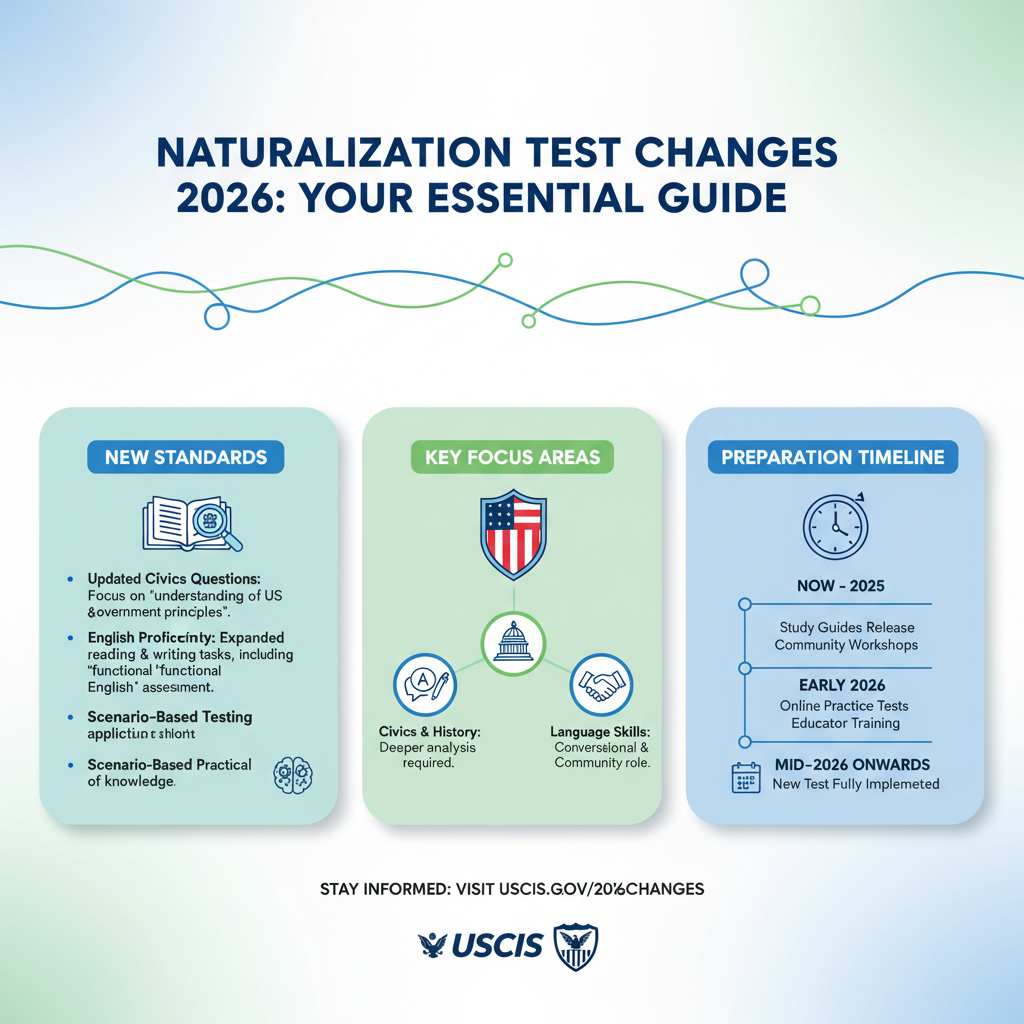
Recent news indicates that the **Naturalization Test** is set to undergo significant changes in 2026. This vital update stems from efforts by U.S. Citizenship and Immigration Services (USCIS) to modernize the test and ensure that future citizens have a comprehensive understanding of U.S. history, government, and civics.
Naturalization Test Changes Coming in 2026 (Citizenship)
What This News Means for Immigrants in Orlando and Across Florida
The impending changes to the **Naturalization Test** are not just abstract policy shifts; they have very real and direct implications for individuals and families pursuing U.S. citizenship, particularly for those residing in Orlando, Central Florida, and throughout the state.
Why this news is showing up now
The discussion around changes to the **Naturalization Test** isn't new. USCIS periodically reviews and updates the test to ensure its effectiveness and relevance. The most recent significant revision occurred in 2020 under the previous administration, which introduced a longer, more complex civics test. However, that version was subsequently reverted to the 2008 version in early 2021 due to concerns about its difficulty and potential barriers to naturalization. Since then, USCIS has been working on a new redesign. This current news reflects the culmination of a pilot program and research initiated by USCIS to develop a more standardized and potentially more interactive test format. The goal is to create a test that is fair, comprehensive, and accurately assesses an applicant's knowledge of U.S. civics. The 2026 timeline provides a window for development, public feedback, and implementation.
How it can affect Florida residents
While the **Naturalization Test** is a federal requirement, its impact is felt locally. For residents of Orlando, Orange County, and the broader Central Florida region, these changes mean that preparation for citizenship will need to adapt. If you are planning to apply for naturalization in the next few years, or if your application process extends into 2026, you will likely encounter these new test requirements. This could involve studying different types of questions, preparing for a conversational format, or adapting to new assessment methods for the civics portion. The Orlando USCIS Field Office, like all others nationwide, will implement these new testing procedures uniformly. Therefore, understanding these changes early allows you to adjust your study plan and strategy, ensuring you are fully prepared when your interview date arrives. At Imigrar, we serve clients not just in Orlando but across Florida and nationwide, and we are already preparing to guide our clients through these upcoming adjustments.
What Naturalization Test Changes Are (and Why They Matter)
The prospect of changes to the **Naturalization Test** can feel daunting, but understanding what they entail is the first step toward successful preparation. These changes are significant because the test is a critical hurdle in the path to becoming a U.S. citizen.
A plain-English definition
The **Naturalization Test** is part of the application process for lawful permanent residents (Green Card holders) to become U.S. citizens. It consists of two main components: an English test and a civics test. The English test assesses your ability to read, write, and speak basic English. The civics test evaluates your knowledge of U.S. history, government, and civics. The upcoming "changes" refer primarily to the civics test portion. Instead of simply being asked specific questions from a list, the proposed new format aims for a more conversational approach. This could mean that civics questions are integrated into the interview, requiring you to explain concepts rather than just recite facts. There might also be new types of questions, such as identifying prominent figures or places from photos, to assess a broader range of civic knowledge. Essentially, it's a shift from rote memorization to demonstrating a more integrated understanding of American civics.
Key terms you need to know
- Naturalization: The process by which a foreign citizen or national becomes a citizen of the United States.
- USCIS: U.S. Citizenship and Immigration Services, the federal agency that oversees lawful immigration to the United States. They administer the naturalization process and the test.
- Naturalization Test: The two-part examination (English and civics) required for most naturalization applicants.
- English Test: Evaluates an applicant's ability to read, write, and speak basic English. This portion is generally not expected to change significantly.
- Civics Test: Evaluates an applicant's knowledge of U.S. history, government, and civics. This is the primary area for the upcoming changes.
- Form N-400, Application for Naturalization: The official form filed with USCIS to apply for U.S. citizenship.
- Lawful Permanent Resident (LPR) / Green Card Holder: An individual who has been granted the privilege of permanently residing in the United States. This is a prerequisite for naturalization.
- Oath of Allegiance: The final step in the naturalization process, where an applicant formally pledges loyalty to the United States.
- Good Moral Character: A legal requirement for naturalization, generally meaning adherence to laws and demonstrating positive community involvement.
- INA (Immigration and Nationality Act): The body of law that governs immigration and nationality in the United States.
These changes matter because they require a different approach to preparation. Simply memorizing the current 100 civics questions might not be sufficient for the new test. Applicants will need to develop a deeper understanding of the concepts behind the questions and be able to articulate them in English. This shift aims to ensure that new citizens not only know facts but also understand the principles that underpin U.S. democracy. For immigrants and their families in Orlando, proactive preparation for these changes is essential to a smooth and successful naturalization journey.
Considering naturalization in the next few years? The upcoming changes make expert guidance more important than ever. Imigrar is here to help you understand the current and future requirements. Call us at +1 786-791-3106 for a free consultation. We serve clients nationwide from our Orlando office. Se Habla Español.
Current Immigration Law: The Foundation for Naturalization
Even with upcoming changes, the fundamental legal framework for naturalization remains the same. The **Immigration and Nationality Act (INA)** provides the legal basis for who can become a U.S. citizen. Understanding these foundational requirements is crucial before diving into the specifics of the test itself.
The primary statute governing naturalization is **INA § 316**, which outlines the general requirements for eligibility. Specifically, **INA § 312** addresses the English language and civics knowledge requirements, which are the focus of the upcoming test changes. The current test is derived from these statutory mandates.
Federal requirements
To be eligible for naturalization, applicants must generally meet several federal requirements, as outlined by USCIS:
- Age: Be at least 18 years old at the time of filing **Form N-400**.
- Lawful Permanent Residency: Be a lawful permanent resident (Green Card holder) for at least 5 years (or 3 years if married to a U.S. citizen and meet specific criteria).
- Continuous Residency: Have resided continuously in the U.S. for at least 5 years (or 3 years) immediately preceding the filing of **Form N-400**.
- Physical Presence: Have been physically present in the U.S. for at least half of the required continuous residency period (e.g., 30 months for 5-year residents, 18 months for 3-year residents).
- Residency in State/USCIS District: Have resided for at least 3 months in the state or USCIS district where the application is filed. For Orlando residents, this means residing in the jurisdiction of the Orlando USCIS Field Office.
- Good Moral Character: Demonstrate **good moral character** for the statutory period (5 or 3 years) leading up to the application and until the Oath of Allegiance. This is a critical requirement and can be impacted by criminal history, tax issues, or other legal violations.
- English Language Proficiency: Be able to read, write, and speak basic English. There are certain exemptions for age and length of permanent residency (e.g., the 50/20 or 55/15 exemptions).
- Knowledge of U.S. History and Government (Civics): Pass the civics test. This is the area undergoing changes.
- Attachment to the Constitution: Demonstrate an attachment to the principles and ideals of the U.S. Constitution. This is usually affirmed during the interview and through the Oath of Allegiance.
All these requirements are uniformly applied across the United States by USCIS. You can find detailed information on these requirements and the application process on the USCIS official website.
Florida-specific considerations
While naturalization laws are federal, the application process involves interaction with local USCIS offices. For individuals living in Central Florida, including Orlando, Kissimmee, and surrounding areas like Orange County, Seminole County, and Osceola County, your naturalization interview will typically be scheduled at the Orlando USCIS Field Office. This office serves a large and diverse immigrant community along the I-4 corridor and beyond.
Florida does not have its own specific naturalization laws; however, state-level issues can impact your federal application. For instance, any criminal history in Florida, no matter how minor, must be accurately disclosed on your **Form N-400** and could affect your **good moral character** determination. Similarly, Florida tax records are relevant for proving continuous residency and good moral character. Furthermore, access to English language classes, civics education programs, and legal assistance from firms like Imigrar are local considerations that can significantly aid your application process.
Understanding both the overarching federal requirements and how they are applied and supported in your local Florida community is key to a successful naturalization journey. We assist clients from all over Florida, ensuring their applications are tailored to meet both federal standards and local procedural nuances.
How to Prepare for the Naturalization Test Changes: A Complete Step-by-Step Guide
Preparing for U.S. naturalization requires diligence, especially with the upcoming test changes. This step-by-step guide will walk you through the process, focusing on how to prepare for both the current requirements and the anticipated shifts in 2026.
1) Understand the Current Test vs. Proposed Changes
Before you begin studying, it's crucial to know what you're currently facing and what might change. The **current civics test** consists of 100 questions, and during the interview, the USCIS officer will ask you up to 10 questions from this list. You must answer 6 correctly to pass. The English test involves reading one of three sentences correctly, writing one of three sentences correctly, and demonstrating your ability to speak English during the interview itself.
The **proposed changes for 2026** primarily focus on the civics test. USCIS is exploring a more conversational format where civics questions might be woven into a discussion about your application or personal history. This could involve open-ended questions that require you to explain concepts (e.g., "What is the rule of law?" and then asking you to provide an example) rather than just reciting a fact. There may also be a component that asks you to identify historical figures or landmarks from photographs. The English test is generally expected to remain similar. This means preparation should go beyond rote memorization to a deeper understanding and ability to articulate civic principles.
- Action: Review the current 100 civics questions and answers available on the USCIS official website.
- Action: Monitor USCIS announcements for pilot program results and specific details about the 2026 test format.
2) Verify Your Eligibility and Gather Core Documents
The first practical step is to confirm you meet all naturalization eligibility requirements. This includes age, duration of lawful permanent residency (typically 5 years, or 3 years if married to a U.S. citizen), continuous residency, physical presence, and **good moral character**. Begin collecting all necessary documents that prove your eligibility.
- Required Documents (General):
- Your Green Card (Form I-551, Permanent Resident Card)
- All passports (current and expired)
- State identification (e.g., Florida Driver's License or ID card)
- Marriage certificate (if applicable, for 3-year residency rule)
- Divorce decrees or death certificates for previous spouses (if applicable)
- Birth certificates of children
- Tax returns for the past 5 years (or 3 years)
- Proof of selective service registration (for males aged 18-26)
- Court disposition records for any arrests or convictions, even if expunged (Important: Do NOT omit any criminal history)
- Proof of payment of child support or alimony (if applicable)
- Travel records outside the U.S.
Reminder: Gather original documents, but submit only copies unless USCIS specifically requests originals. Keep all originals for your interview.
3) File Form N-400, Application for Naturalization
Once you've confirmed eligibility and gathered your documents, the next step is to complete and file **Form N-400**. This is a lengthy and detailed application that asks for extensive personal, residential, employment, and travel history, as well as questions related to your **good moral character** and attachment to the U.S. Constitution.
- Required Documents (with Form N-400 submission):
- Completed and signed **Form N-400**
- Two passport-style photos (if filing by mail; usually not required for online filing)
- Copy of the front and back of your Green Card
- Check or money order for the filing fee and biometric services fee (or a Fee Waiver, **Form I-912, Request for Fee Waiver**, if eligible).
- Copies of any court disposition documents related to arrests or citations.
- Action: Double-check all answers for accuracy and consistency with your supporting documents. Incomplete or incorrect forms can lead to delays or denial.
- Action: Consider filing online through the USCIS official website for potentially faster processing and immediate confirmation.
4) Prepare for the English Test (Reading, Writing, Speaking)
While the focus is on civics changes, the English test remains a core component. Your ability to communicate effectively in English is paramount, especially if the civics test becomes more conversational. The officer will assess your speaking ability throughout the interview.
- Reading: Practice reading simple sentences aloud. USCIS provides a vocabulary list for the reading test.
- Writing: Practice writing simple sentences dictated to you. USCIS provides a vocabulary list for the writing test.
- Speaking: Engage in conversations in English. Practice answering questions about your **Form N-400** application, your life in the U.S., and basic civics concepts. This is where a conversational civics test could seamlessly integrate.
Tip: Attend English as a Second Language (ESL) classes, join conversation groups, or practice with English-speaking friends and family. For those in Orlando, many community colleges and non-profits offer free or low-cost ESL programs.
5) Master the Civics Test (Current and Future)
This is where the most significant preparation for the 2026 changes will occur. Until 2026, continue to study the current 100 civics questions and answers diligently. However, also broaden your understanding.
- Current Test Preparation:
- Download the official "Civics Test Study Guide" from USCIS.
- Use flashcards, mobile apps, and online quizzes.
- Practice answering all 100 questions until you can easily recall the answers.
- Future Test Preparation (for 2026 changes):
- Understand Concepts: Don't just memorize answers. Understand *why* we have three branches of government, *what* the Bill of Rights protects, or *how* a law is made.
- Practice Explaining: Practice articulating answers in your own words. For example, instead of just saying "freedom of speech," be able to explain what that freedom means and why it's important.
- Stay Informed: Follow current events and basic U.S. political structures. This will help with a conversational test.
- Visual Recognition: If photo-based questions are introduced, familiarize yourself with images of presidents, national monuments, and important historical documents.
- Action: Consider taking a civics course or working with a tutor who can help you grasp the underlying concepts rather than just memorizing facts.
6) Attend Your Naturalization Interview
After filing **Form N-400** and attending your biometrics appointment, USCIS will schedule your naturalization interview. For residents of Orlando and Central Florida, this will typically be at the Orlando USCIS Field Office. During the interview, an officer will review your application, test your English and civics knowledge, and ask questions to confirm your eligibility and **good moral character**.
- Interview Preparation:
- Review your entire **Form N-400** application thoroughly.
- Bring all original documents you submitted copies of, plus any updated documents (e.g., new tax returns, updated travel records).
- Dress professionally and arrive on time.
- Be honest and truthful in all your answers.
- Practice answering potential questions about your application, even personal ones, in a clear and concise manner.
- Warning: Any discrepancy between your application and your interview answers, or any undisclosed information, can lead to denial.
7) Take the Oath of Allegiance
If your application is approved after the interview, you will receive a notice for the Oath of Allegiance ceremony. This is the final step where you officially become a U.S. citizen.
- Ceremony Day:
- Return your Green Card (Form I-551) at the ceremony.
- Take the Oath of Allegiance.
- Receive your Certificate of Naturalization.
- Action: Once you receive your Certificate of Naturalization, apply for a U.S. passport and register to vote!
Practical Steps You Can Take Today
Even with the 2026 changes looming, there are concrete actions you can take right now to set yourself up for success. Proactive preparation is your best defense against unexpected hurdles.
Actionable Checklist (5+ items):
- Start Studying the Current 100 Civics Questions: Even if the test format changes, the core content of U.S. history and government will remain relevant. Mastering the current questions provides a strong foundation. USCIS study materials are available on their USCIS Forms page under "Citizenship."
- Improve English Proficiency: Focus on all four areas: reading, writing, speaking, and listening. A stronger grasp of English will not only help with the current test but will be invaluable for a potentially more conversational 2026 test.
- Gather All Necessary Documents: Begin compiling your Green Card, passports, tax returns for the last 5 years (or 3 years if married to a U.S. citizen), marriage certificates, divorce decrees, birth certificates of children, and any court disposition records. Organize them neatly.
- Monitor USCIS Announcements: Regularly check the USCIS official website for updates regarding the **Naturalization Test** changes, pilot program results, and official implementation dates.
- Consult an Immigration Attorney: This is perhaps the most critical step. An experienced attorney, like those at Imigrar, can assess your eligibility, help you prepare **Form N-400** accurately, advise on potential issues (especially regarding **good moral character**), and provide tailored guidance for the current and upcoming test formats.
- Practice Interview Skills: Even if the civics test changes, the interview portion of naturalization will always require you to answer questions about your application. Practice speaking clearly, confidently, and honestly.
- Address Any Potential Issues: If you have any criminal history, unpaid taxes, or significant periods outside the U.S., discuss these with an attorney immediately. These can impact your **good moral character** and eligibility.
Document Preparation Guidance
- Organization is Key: Create a system for your documents – binders, folders, or digital files. Label everything clearly.
- Copies, Not Originals (Initially): When submitting your application, send copies unless USCIS specifically requests originals. Keep your original documents safe for the interview.
- Translations: Any document not in English must be accompanied by a certified English translation.
- Accuracy: Ensure all information on your documents matches what you put on **Form N-400**. Discrepancies can raise red flags.
Timeline Expectations
The **Naturalization** process can take anywhere from 6 months to over 2 years, depending on your local USCIS Field Office workload, the complexity of your case, and national processing backlogs. You can check current processing times for the Orlando USCIS Field Office and other locations on the
You may also be interested in: Navigating the new H-1B visa lottery changes for FY2027 is crucial. Discover what these updates mean for your work visa application and how Imigrar ca... Prepare confidently for your Green Card interview with Imigrar's expert advice. Learn what to expect, gather documents, and ensure a smooth path to pe... Navigate the complexities of family-based immigration with Imigrar's expert guide. Learn how to petition for loved ones, understand requirements, and ... Navigate the complex world of family-based immigration petitions with Imigrar's expert guide. Learn step-by-step how to sponsor relatives for a Green ...Related Articles


