


The journey to a new life in the United States is often marked by anticipation, hope, and sometimes, considerable waiting. For immigrants and their families in Orlando, across Florida, and nationwide, understanding USCIS processing times is paramount. As we move through 2026, staying informed about the latest updates from U.S. Citizenship and Immigration Services (USCIS) is more crucial than ever.
At Imigrar, an immigration law firm rooted in Orlando, Florida, our mission is to "Keep Families Together." We understand the anxiety that comes with long processing times and the need for clear, actionable information. This comprehensive guide will break down the latest USCIS processing time updates for 2026, explain what they mean for you, and provide practical steps to navigate your immigration journey successfully.
The reporting that sparked this guide: USCIS Processing Times and Updates for 2026 (USCIS)
What This News Means for Immigrants in Orlando and Across Florida
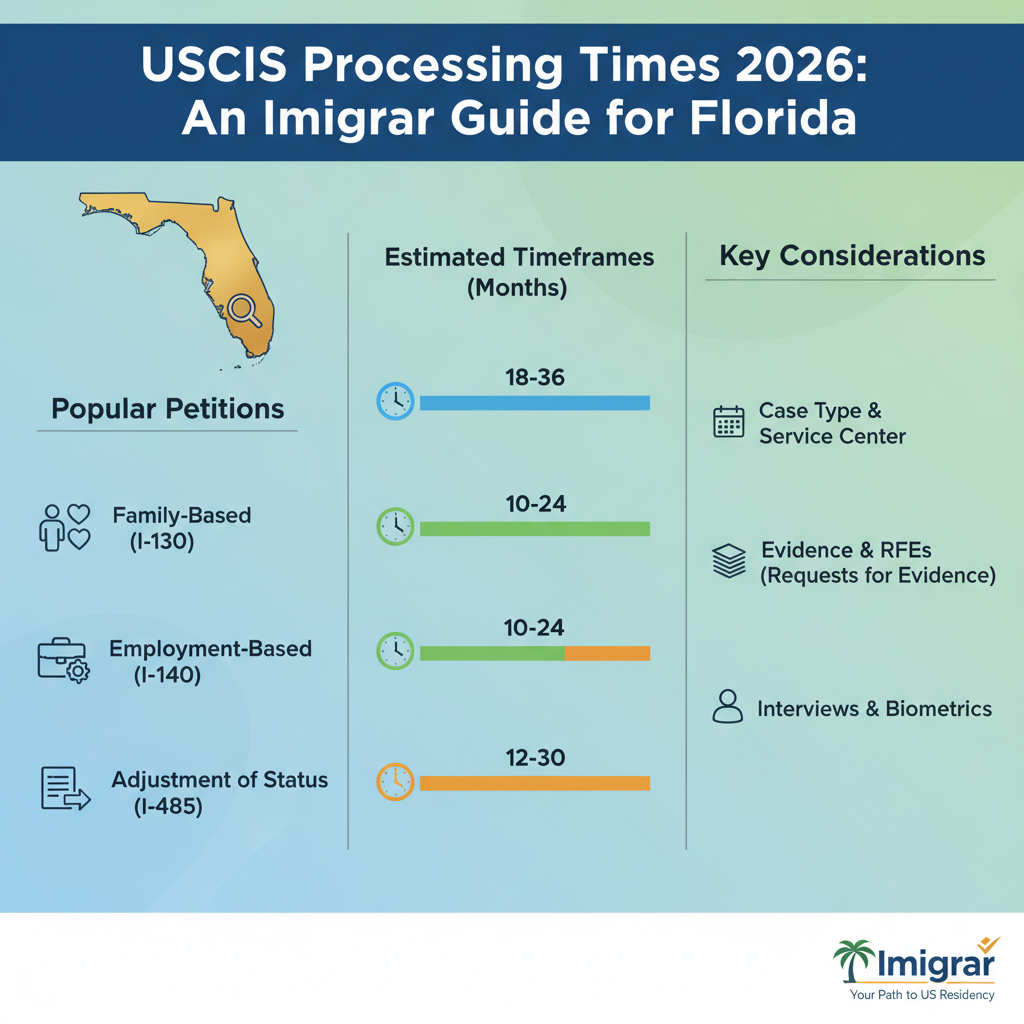
Why this news is showing up now
USCIS processing times are a dynamic and frequently discussed topic within the immigration community, and for good reason. They reflect the agency's workload, staffing levels, budget, and evolving policy priorities. News about processing times surfaces constantly because they directly impact the lives of millions, determining when families can reunite, when individuals can work, and when new citizens can be sworn in.
In 2026, discussions around USCIS processing times continue to be prominent due to several ongoing factors:
- Lingering Backlogs: The COVID-19 pandemic, coupled with increased application volumes and operational adjustments, created significant backlogs across various application types. While USCIS has made efforts to reduce these, many still persist.
- Resource Allocation: USCIS primarily relies on application fees for funding. Fluctuations in application submissions and fee structures can impact staffing and resource allocation, directly affecting processing speeds.
- Policy Changes: New administrations or legislative actions can introduce new priorities or processes that temporarily shift resources, leading to changes in processing times for specific forms or categories.
- Technological Modernization: USCIS is continually working to modernize its systems. While intended to improve efficiency in the long run, these transitions can sometimes cause temporary delays or adjustments as new systems are implemented.
- Increased Demand: The consistent demand for immigration benefits, including family petitions, employment-based visas, and naturalization applications, keeps the processing queues robust.
These factors combine to make USCIS processing times a constant point of concern and a trending news item for those navigating the U.S. immigration system.
How it can affect Florida residents
Florida, particularly the Orlando metropolitan area and the I-4 corridor, is a vibrant hub for immigrant communities from around the globe. This means that changes or delays in USCIS processing times have a direct and significant impact on countless individuals and families residing here.
- Family Reunification Delays: For Orlando families sponsoring relatives, a delay in processing Form I-130 (Petition for Alien Relative) or Form I-485 (Application to Register Permanent Residence or Adjust Status) can mean months or even years of separation. This affects families waiting for spouses, children, or parents to join them in Orange County or other Florida counties.
- Employment and Economic Impact: Individuals waiting for Form I-765 (Application for Employment Authorization) or employment-based green cards may face prolonged periods of inability to work legally, impacting their financial stability and contributing to the local economy. Businesses in Central Florida that rely on immigrant workers can also feel the ripple effect.
- Uncertainty and Stress: Long and unpredictable processing times create immense stress and uncertainty. Immigrants in Florida may put life plans on hold, unable to purchase homes, pursue higher education, or travel internationally without fear of jeopardizing their status.
- Local Field Office Impact: The Orlando USCIS Field Office handles many interviews and local adjustments of status. Increased backlogs or procedural changes at this specific office can directly translate to longer wait times for residents in Orlando, Kissimmee, Sanford, and surrounding areas.
- Expiration of Documents: Delays can mean that supporting documents, such as medical exams (Form I-693), affidavits of support, or even passports, might expire before a case is adjudicated, requiring costly and time-consuming renewals.
- Increased Demand for Legal Services: When processing times are lengthy or confusing, the demand for experienced legal counsel, like that offered by Imigrar, increases. Our Orlando immigration team helps clients understand their status, inquire about delays, and prepare for potential issues.
Important: Staying informed and taking proactive steps is crucial. Don't assume your case is progressing smoothly just because you haven't heard anything. Proactive monitoring and, when necessary, intervention, are key.
Need Help? Our Orlando immigration team is ready to assist. Call +1 786-791-3106 for a free consultation, or message us online. Se Habla Español.
What USCIS Processing Times Are (and Why They Matter)
A plain-English definition
Simply put, USCIS processing times refer to the estimated duration it takes for U.S. Citizenship and Immigration Services to process and make a decision on an immigration application or petition. When you submit a form to USCIS, it enters a queue. The processing time is an estimate of how long it will take for your application to move through that queue, from the day USCIS receives it to the day they issue a decision.
These times are not fixed guarantees; they are averages based on how long it took to process similar cases in the recent past. They can fluctuate widely depending on the type of form, the specific service center or field office handling the case, the complexity of the individual application, and USCIS's overall workload and priorities.
Why do they matter so much? Because these waiting periods directly impact your life. Whether you're waiting for authorization to work, permission to travel, a green card, or U.S. citizenship, the processing time determines when you can move forward with your plans, reunite with family, or achieve stability in the U.S.
Key terms you need to know
Navigating USCIS processing times requires understanding a few critical terms:
- Receipt Date: This is the date USCIS officially received your application. It's usually stamped on your Form I-797C, Notice of Action (your receipt notice). This is your starting point for tracking processing times.
- Priority Date: For certain visa categories (especially family-sponsored and employment-based green cards), this is the date your petition (e.g., Form I-130 or Form I-140) was properly filed with USCIS. This date determines your place in line for a visa. You cannot apply for a green card (Adjustment of Status or Consular Processing) until your priority date becomes "current" according to the monthly Visa Bulletin published by the U.S. Department of State.
- Processing Time Range: USCIS publishes estimated processing times as a range (e.g., "10.5 to 13 months"). This indicates that 80% of cases for that form type at that office were completed within that timeframe.
- Case Status Online: This is an online tool where you can enter your receipt number to check the latest status of your specific application. You can find it at USCIS Case Status Online.
- Service Request (e-Request): If your case falls outside the normal processing time range, you can submit an online inquiry to USCIS. This is often the first step to take when your case seems stuck.
- Adjustment of Status (AOS): The process of applying for a green card from within the United States, typically using Form I-485. This is common for those already residing legally in the U.S.
- Consular Processing: The process of applying for an immigrant visa through a U.S. embassy or consulate abroad. This is for individuals outside the U.S.
- Request for Evidence (RFE): A notice from USCIS asking for additional documents or information to support your application. Responding promptly and thoroughly is critical.
- Notice of Intent to Deny (NOID): A notice from USCIS indicating that they intend to deny your application unless you provide additional information or clarification within a specified timeframe. This is a serious notice requiring immediate attention.
- Field Office vs. Service Center: USCIS has multiple service centers that handle mail-in applications (e.g., California, Nebraska, Texas, Vermont) and numerous field offices (like the Orlando USCIS Field Office) that handle interviews, local adjustments, and naturalization applications. Processing times vary significantly between them.
Understanding these terms empowers you to better track your application and know when to take action.
Current Immigration Law: The Foundation Governing Processing Times
USCIS processing times are not arbitrary; they are dictated by a complex framework of federal immigration laws and regulations, coupled with operational realities. The primary legal authority is the Immigration and Nationality Act (INA), as amended.
Federal requirements
The INA establishes the various categories of visas and immigration benefits, sets annual numerical limits for certain categories, and outlines the eligibility criteria and procedural requirements for each. While the INA doesn't typically dictate exact processing times, it mandates certain procedures that USCIS must follow, influencing the duration of processing:
- Visa Quotas: Many visa categories, especially family-sponsored (beyond immediate relatives) and employment-based, are subject to annual numerical limitations (INA §201-203). This creates backlogs, especially for high-demand countries, leading to long waits for a Priority Date to become current, regardless of how quickly USCIS physically processes the paperwork. The Visa Bulletin dictates these waiting periods.
- Eligibility Checks: USCIS is legally required to conduct thorough background checks, security screenings, and verify eligibility criteria for every applicant. This involves inter-agency collaboration (e.g., FBI, Department of State) and can be a significant factor in processing delays.
- Application Forms and Documentation: Each immigration benefit requires specific forms and supporting documentation, as outlined in the Code of Federal Regulations (CFR). For instance, an application for adjustment of status typically involves Form I-485, Form I-130 (if family-based), Form I-765 (EAD), Form I-131 (Advance Parole), Form I-864 (Affidavit of Support), and Form I-693 (Medical Exam). Incomplete submissions or requests for additional evidence (RFEs) extend processing times.
- Interview Requirements: For many applications, particularly adjustment of status and naturalization (Form N-400), an interview with a USCIS officer is required (INA §235(b)(1)). Scheduling these interviews contributes to the overall timeline, especially at busy field offices like the one in Orlando.
- Administrative Procedures Act (APA): This federal law governs how federal agencies develop and issue regulations. It ensures due process, meaning USCIS must follow established procedures, which inherently takes time.
Florida-specific considerations
While immigration law is federal, its implementation has local nuances. For Florida residents, especially those in the Orlando area, specific considerations apply:
- Orlando USCIS Field Office: This office serves a large and diverse population. Its workload and staffing directly impact interview scheduling and local Adjustment of Status processing. For example, a resident of Orange County filing Form I-485 will likely have their interview at this field office.
- Jurisdiction: The specific USCIS Service Center or Field Office that processes your case depends on your mailing address and the type of application. Florida residents typically send certain forms to specific Service Centers (e.g., Texas Service Center for some family petitions, Nebraska Service Center for others), which can have different processing times. However, most interviews for green cards and naturalization occur at the local field office.
- State-Level Support and Resources: While not directly affecting federal processing times, Florida offers various resources that can indirectly assist immigrants during long waits, such as community organizations providing legal aid referrals or support groups.
- Volume of Applications: Florida's large immigrant population means a consistently high volume of applications originating from the state. This can contribute to longer processing times at the USCIS offices responsible for Florida cases.
Staying abreast of both federal law and local operational realities is key to managing expectations for your immigration journey in Florida.
Need Help? Our Orlando immigration team is ready to assist. Call +1 786-791-3106 for a free consultation, or message us online. Se Habla Español.
How to Navigate USCIS Processing Times: A Complete Step-by-Step Guide
Managing the waiting period for your immigration application requires proactive engagement and a clear understanding of the process. Here’s a step-by-step guide for immigrants in Orlando and across Florida:
1) Understand Your Application Type and Category
Before you can track anything, you need to know exactly what you've filed. Different forms have different processing routes and timelines. Are you applying for a family-based green card (Form I-130, then Form I-485)? An employment authorization document (Form I-765)? Naturalization (Form N-400)?
- Action: Identify your specific USCIS form number (e.g., Form I-130, Form I-485, Form N-400, Form I-765, Form I-131).
- Documents Needed: Your Form I-797C, Notice of Action (receipt notice) will clearly state the form type, your Receipt Date, and your Receipt Number. Keep this notice safe.
2) Check Current Processing Times Regularly
USCIS updates its processing times estimates monthly. These are crucial for setting realistic expectations and knowing when it's appropriate to make an inquiry.
- Action: Visit the official USCIS Processing Times page: USCIS Processing Times.
- How to Use: Select your form number, then choose the appropriate service center or field office. For example, if you're an Orlando resident filing Form I-485, you'd select "I-485, Application to Register Permanent Residence or Adjust Status," and then "Orlando Field Office." If your Form I-130 was filed by a U.S. citizen for an immediate relative, it might be processed at a Service Center (e.g., Nebraska or Texas), so check that as well.
- Documents Needed: Your Form I-797C to confirm the form type, Receipt Date, and the service center/field office printed on it.
Reminder: The times displayed are for 80% of cases and are estimates. Your case may take more or less time.
3) Monitor Your Case Status Online
Beyond general processing times, you can check the specific status of your individual application.
- Action: Go to USCIS Case Status Online.
- How to Use: Enter your 13-character receipt number (found on your Form I-797C) without dashes. The system will show you the latest update on your case (e.g., "Case Was Received," "Fingerprint Review Was Completed," "Request for Evidence Was Sent").
- Documents Needed: Your Form I-797C with your receipt number.
Important: Set up an account on the USCIS website to receive email notifications about changes to your case status.
4) Know When and How to Make an Inquiry (Service Request)
If your case has been pending longer than the "estimated time range" shown on the USCIS processing times page, you may be eligible to submit an inquiry.
- Action: If your Receipt Date is older than the "case inquiry date" listed for your form and office, you can submit an "e-Request" online for a "Case Outside Normal Processing Times."
- How to Use: Visit the USCIS e-Request page. You will need your receipt number, mailing address, and contact information. USCIS aims to respond to e-Requests within 30 days.
- Alternative: If the online tool doesn't work or you prefer, you can call the USCIS Contact Center (1-800-375-5283).
- Documents Needed: Your Form I-797C, a detailed log of your case status checks, and any correspondence from USCIS.
Warning: Do not submit multiple inquiries for the same issue, as this can sometimes further delay your case. Wait for a response to your initial inquiry.
5) Prepare for Interviews and RFEs
Even during long waits, you must be prepared to respond quickly to USCIS requests.
- Action: Keep your mailing address updated with USCIS. If you move from Orlando to another part of Florida or out of state, file Form AR-11, Alien's Change of Address Card, and update your pending applications immediately.
- RFE/NOID Response: If you receive a Request for Evidence (RFE) or a Notice of Intent to Deny (NOID), gather the requested documents and respond thoroughly and promptly, typically within 30 to 90 days.
- Interview Preparation: If an interview is required (common for Form I-485 and Form N-400 at the Orlando USCIS Field Office), gather all original documents submitted with your application, plus any updated information. Practice answering questions about your application.
- Documents Needed: Original copies of all documents submitted with your application, any new documents (e.g., updated employment letters, birth certificates for new children, marriage certificate if applicable), and a valid government-issued ID.
Important: Responding to an RFE or NOID can add 60 to 180 days to your processing time, but failure to respond will likely lead to denial.
6) Seek Legal Counsel from Imigrar
Navigating USCIS processing times, especially when delays are extensive or unusual, can be complex. An experienced immigration attorney can provide invaluable assistance.
- Action: Schedule a consultation with Imigrar. Our team can assess your specific situation, help you interpret processing times, draft inquiries, prepare RFE responses, and represent you at interviews.
- How We Help: We can identify potential issues that might be causing delays, help you collect and organize necessary documentation, and advocate on your behalf with USCIS. For Central Florida residents, our local knowledge of the Orlando USCIS Field Office procedures can be a distinct advantage.
- Documents Needed: All correspondence from USCIS, copies of your submitted application forms and supporting documents, and your Form I-797C receipt notices.
Reminder: While you can submit inquiries yourself, having legal representation can often streamline the process and lead to quicker, more effective resolutions, especially for complex cases.

Practical Steps You Can Take Today to Manage Your Immigration Journey
Waiting for USCIS to process your application can be one of the most challenging parts of the immigration journey. While you can't control the speed of the government, you can take proactive steps to manage the process and minimize potential setbacks.
Actionable Checklist (5+ Items):
- Organize Your Documents Meticulously: Keep all copies of your application, supporting documents, and every single notice or letter from USCIS (Form I-797C, RFE, interview notices) in a well-organized folder. This will be invaluable if you need to make an inquiry, respond to an RFE, or prepare for an interview.
- Create a Timeline and Calendar Reminders: Note your Receipt Date, your Priority Date (if applicable), and the current processing time range for your specific form and office. Set calendar reminders to check USCIS processing times monthly and your case status weekly. Also, note any deadlines for RFEs or other requests.
- Sign Up for USCIS Email Updates: Create an online account on the USCIS website and link your case using your receipt number. This allows you to receive email notifications whenever there’s an update to your case status.
- Maintain Your Legal Status: If you are in the U.S., ensure you maintain your underlying legal status, especially if your application (like Adjustment of Status) is pending. This might involve extending a nonimmigrant visa (e.g., Form I-539) if your current status is expiring before your green card is approved. Do not overstay your authorized period of admission.
- Keep Your Address Updated: If you move, even within Orlando or Central Florida, promptly file Form AR-11, Alien's Change of Address Card, with USCIS online or by mail. Also, update your address for any pending applications. Failure to do so can result in missed notices, RFEs, or interview appointments, which could lead to denial.
- Review Your Application Periodically: As time passes, personal circumstances can change. Review your original application to ensure all information is still accurate. If there are significant changes (e.g., marriage, birth of a child, new job), discuss with your attorney how these might impact your pending application.
- Save Funds for Potential Renewals: If your application is pending for an extended period, documents like medical exams (Form I-693) or fingerprints may expire. Be prepared for the possibility of needing to pay for and resubmit these.
Document Preparation Guidance:
- Originals vs. Copies:


