


The reporting that sparked this guide
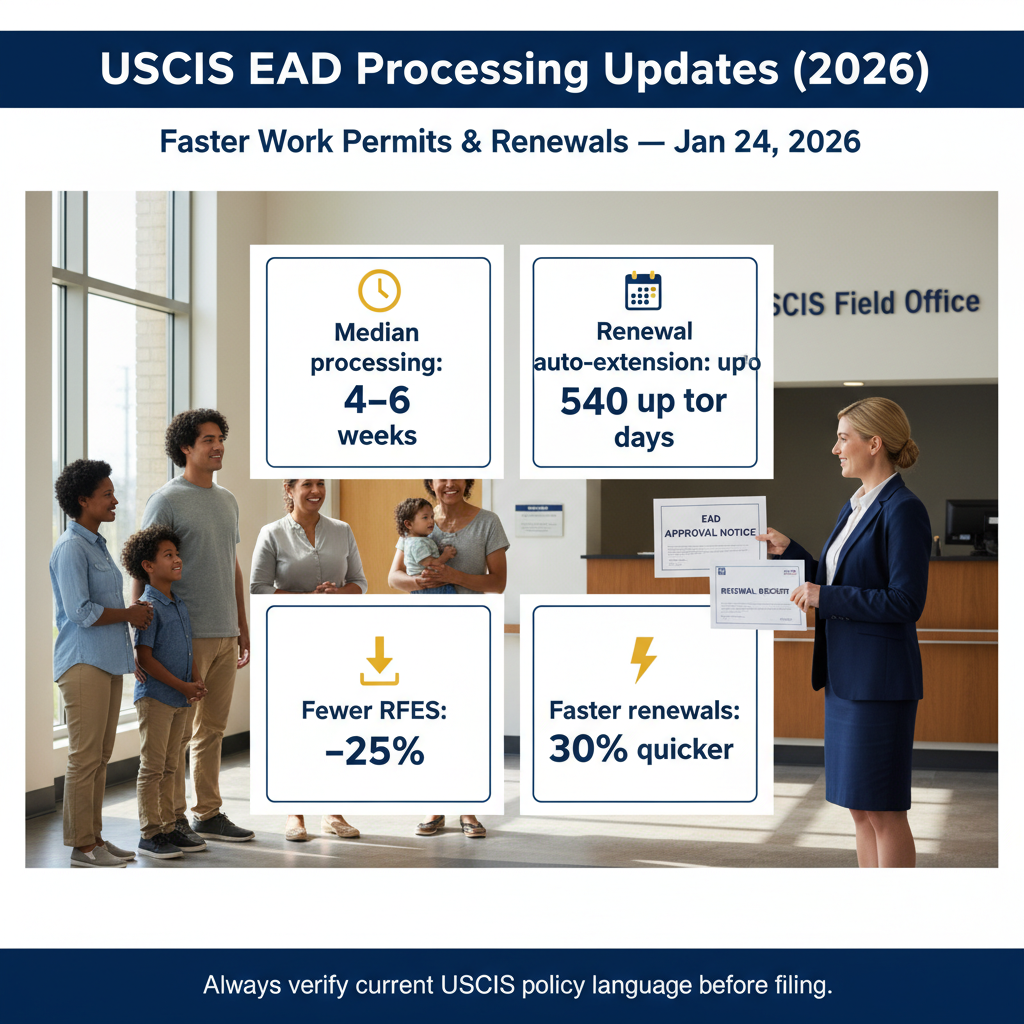
This article is based on ongoing USCIS-related reporting and updates circulating in immigration news feeds and official announcements, including:
Employment Authorization Document Processing (USCIS)
Reminder: Immigration “news” moves fast. Always verify the most current policy language and filing instructions directly through the USCIS official website and your specific receipt notices.
Need Help? Our Orlando immigration team is ready to assist. Call +1 786-791-3106 for a free consultation, or message us online. Se Habla Español.
What This News Means for Immigrants in Orlando and Across Florida
Why this news is showing up now
Employment Authorization Documents (EADs)—often called “work permits”—are one of the most time-sensitive benefits in the U.S. immigration system. When EAD processing slows down, people can lose jobs, health insurance, driver’s license renewals, or the ability to start work after an approval. When processing speeds up (or renewal protections improve), families gain stability.
This topic is trending now because USCIS has been under strong pressure to reduce backlogs, modernize filing systems, and publish clearer guidance on:
- How EAD processing times are measured and reported
- Which categories qualify for automatic extension rules at renewal
- How online filing and biometrics reuse affect timelines
- How quickly USCIS issues cards after approval
Important: “Faster” headlines do not mean every EAD category is fast. Processing depends heavily on your eligibility category, your filing method, evidence quality, and USCIS workload at the time your case is received.
How it can affect Florida residents
For immigrants living and working in Florida—especially in Central Florida along the I-4 corridor (Orlando, Kissimmee, Sanford, Winter Park, and surrounding Orange County communities)—EAD timing can determine whether you can:
- Accept a new job offer or promotion
- Keep working lawfully while a renewal is pending
- Update your I-9 employment authorization with your employer
- Maintain income while pursuing Adjustment of Status through Form I-485
If your case is in Orlando, you may interact with the Orlando-area USCIS footprint in multiple ways: your EAD is typically adjudicated by a USCIS service center (not the local office), but your underlying benefit (like Form I-485) may eventually require an interview at The Orlando USCIS Field Office. That means EAD delays can happen even when your “main” case appears to be moving normally—or vice versa.
What Employment Authorization Document Processing Is (and Why It Matters)
A plain-English definition
An Employment Authorization Document (EAD) is a photo ID card issued by USCIS that proves you are authorized to work in the United States for a specific period of time. Most people apply using Form I-765 (Application for Employment Authorization).
“EAD processing” refers to the full timeline USCIS takes to:
- Receive your Form I-765
- Issue a receipt notice
- Request more evidence (if needed)
- Approve or deny the application
- Produce and mail the physical EAD card
Key terms you need to know
- EAD: The work permit card (often labeled “Form I-766” on the card itself).
- Form I-765: The application used to request an EAD.
- Category: The eligibility code on the EAD (for example, (c)(9) for many Adjustment of Status applicants with a pending Form I-485).
- Receipt Notice (Form I-797): Proof USCIS accepted your filing; often critical for renewal extensions.
- RFE (Request for Evidence): USCIS asks for additional documents; this can add weeks or months.
- Automatic Extension: Some renewal applicants may keep work authorization for a set period if they file on time and qualify.
- Processing Times: USCIS’s published estimates; check USCIS Processing Times.
- Priority Date: Relevant for many green card paths; while EADs don’t always depend on it, your underlying case might.
Warning: Working without authorization can create serious immigration problems. Even if you have a pending application (like Form I-485), you typically need valid work authorization unless an exception applies.
Current Immigration Law: The Foundation
EAD eligibility is rooted in federal immigration law and regulations. While news cycles focus on “processing,” the legal authority for employment authorization generally comes from the Immigration and Nationality Act (INA) and Department of Homeland Security regulations.
Federal requirements
USCIS issues EADs under regulatory authority found primarily at 8 C.F.R. § 274a (employment authorization rules). Your eligibility depends on your immigration category—such as a pending Adjustment of Status application, certain humanitarian statuses, or other authorized classifications.
Common USCIS forms that interact with EAD eligibility include:
- Form I-765 (EAD application/renewal)
- Form I-485 (Application to Register Permanent Residence or Adjust Status)
- Form I-130 (Petition for Alien Relative) — often the family petition underlying Form I-485
- Form I-589 (Asylum application) — may support EAD eligibility after waiting periods
- Form I-821D (DACA request) — where available and eligible, historically linked to EAD requests
USCIS publishes filing instructions, fees, and edition dates at the USCIS Forms page and policy guidance on the USCIS official website.
Important: Always use the correct form edition and filing address (or online account process). Using the wrong edition or sending to the wrong location can lead to rejection and lost time.
Florida-specific considerations
Immigration is federal, but Florida residents often face state-level “real life” impacts when an EAD is delayed, including:
- Employer onboarding deadlines and I-9 reverification schedules
- Driver’s license/ID renewal timing (state processes may require proof of lawful presence and unexpired documents)
- Professional licensing and background checks
For Central Florida residents, commuting patterns along the I-4 corridor mean job changes can happen quickly—hospitality, healthcare, construction, and logistics employers may require immediate proof of work authorization. If your EAD is pending, planning ahead matters.
If your case is in Orlando, note that local USCIS field operations (interviews, certain in-person services) are separate from where many EADs are adjudicated. Still, your overall strategy should be coordinated—especially when your EAD is tied to a pending Form I-485.
Need Help? Our Orlando immigration team is ready to assist. Call +1 786-791-3106 for a free consultation, or message us online. Se Habla Español.
How to Apply for or Renew an EAD: A Complete Step-by-Step Guide
Below is a practical, document-driven roadmap for most applicants filing Form I-765. Because eligibility categories differ, treat this as a framework and confirm category-specific requirements on the USCIS Forms page and the USCIS official website.
1) Identify your eligibility category (and your timing window)
Start by identifying the correct eligibility category for your EAD request (for example, based on a pending Form I-485, asylum, TPS, certain parole categories, etc.). The category you choose determines:
- Whether you can file online or must file by mail
- What evidence is required
- Whether a renewal may qualify for an automatic extension
- How USCIS calculates processing time for your case type
Reminder: Many renewals should be filed early enough to avoid gaps. Some categories also have an automatic extension if you file a timely renewal and meet specific conditions—this can be essential if your employer needs proof you can keep working.
Documents to gather (category identification):
- Your current/previous EAD (front and back), if renewing
- Your I-94 record, if applicable
- Receipt notices for underlying cases (e.g., Form I-485 receipt)
- Any approval notices tied to your status
- Passport biographic page and visa page (if applicable)
2) Choose the right filing method: online vs. paper filing
USCIS increasingly encourages online filing for certain Form I-765 categories, but not every category is eligible for online submission. Filing method can affect:
- How quickly you get a receipt number
- How you receive RFEs and upload responses
- How clean your record is for future filings (everything is in one portal)
If you file by mail, you must follow USCIS lockbox instructions precisely—wrong fees, missing signatures, or incorrect addresses can cause rejection.
Documents to gather (filing method readiness):
- A USCIS online account login (if filing online)
- Payment method (card/ACH for online; check/money order or approved method for paper)
- Printer/scanner access to produce legible copies
- Mailing tracking method (USPS/UPS/FedEx) for paper filing
3) Prepare Form I-765 and supporting evidence correctly
The biggest driver of delays is not “USCIS being slow”—it’s preventable errors: wrong category, inconsistent addresses, missing pages, missing signature, or incomplete evidence.
USCIS generally requires identity documentation and category-specific eligibility proof. If your EAD is based on Adjustment of Status, your pending Form I-485 receipt is often central.
Documents to gather (typical evidence list):
- Completed and signed Form I-765 (correct edition)
- Government-issued photo ID (passport page, visa, etc.)
- Two passport-style photos (if required for your filing method/category)
- Copy of I-94 (if applicable)
- Copy of prior EAD (front/back) for renewals or replacements
- Underlying case receipt/approval: e.g., Form I-485 receipt notice, TPS approval, etc.
- Any name-change documents (marriage certificate, court order), if applicable
Important: Your mailing address matters. If you move in Orange County or elsewhere along the I-4 corridor, update USCIS promptly (typically via online change of address) so your card is not mailed to the wrong place.
4) File, track, and respond quickly to USCIS notices
After filing, you should receive a receipt notice. Use the receipt number to track the case and check posted processing times at: USCIS Processing Times.
If USCIS issues an RFE, respond fully and by the deadline. An incomplete RFE response is one of the most common reasons for denial.
Documents to gather (after filing):
- Receipt notice (Form I-797)
- USCIS online account screenshots/updates (if relevant)
- RFE notice (if issued) and a copy of your response packet
- Delivery confirmation/tracking (for mailed responses)
Warning: Do not ignore mail from USCIS. Missed RFEs or biometrics appointments can lead to denial.
5) Plan for work continuity: I-9 compliance and renewal protection
If you are renewing, your goal is to avoid a gap. Some categories may receive an automatic extension of work authorization when a timely filed renewal is pending, but the rules are category-specific and require proper documentation.
Employers typically must follow federal I-9 rules. If your EAD expires, they may need updated proof of continued authorization—even if you have a pending renewal. In eligible cases, your receipt notice plus expired EAD may serve as temporary proof during an automatic extension period.
Documents to gather (employment continuity):
- Expired/expiring EAD (front/back)
- Form I-765 receipt notice (Form I-797)
- Any USCIS guidance printout relevant to your category (for HR reference)
- Valid state ID/driver’s license (if applicable for I-9 List B)
Reminder: The common “automatic extension” concept is not universal. Do not assume you are covered without confirming your exact category and timely filing.
6) If delayed: escalate appropriately (service requests, expedite, ombuds, congressional inquiry)
If your case is outside normal processing times, you may be able to submit a service request or take other escalation steps. In truly urgent situations, you may request expedited processing, but expedite criteria are strict and evidence-based.
Documents to gather (delay/expedite package):
- Receipt notice and current case status printout
- Job offer letter with start date (if relevant)
- Letter from employer describing financial loss or operational need
- Evidence of severe financial loss (rent arrears, eviction notice, medical bills)
- Any dependent hardship evidence
If your case is in Orlando and you are also awaiting an interview at The Orlando USCIS Field Office for Form I-485, coordinate strategy—sometimes the best approach is to ensure the underlying case is clean and interview-ready while you pursue EAD escalation options.
7) After approval: monitor card production, delivery, and correction needs
Approval is not the end. Card production and delivery can take additional time. Also, USCIS sometimes prints errors (wrong category, dates, or name). If there is a mistake, you may need to request a correction quickly.
Documents to gather (post-approval):
- Approval notice (if issued)
- Tracking information (if available)
- Photos/scans of the EAD upon arrival (front/back)
- Evidence of the correct information (passport, notices) if requesting a correction
Practical Steps You Can Take Today
If you are worried about EAD processing delays—or you need to renew soon—these actions can reduce risk immediately.
- Checklist item #1: Confirm your EAD category code and your eligibility basis (for example, pending Form I-485 under Adjustment of Status vs. another category).
- Checklist item #2: Create or log into your USCIS online account and confirm your mailing address is correct.
- Checklist item #3: Download the newest edition of Form I-765 and read the category-specific instructions at USCIS Forms.
- Checklist item #4: Prepare a clean evidence packet (IDs, prior EAD, receipts like Form I-485 receipt notice, photos if needed) and keep a complete copy for your records.
- Checklist item #5: Track your case and compare it to posted estimates on USCIS Processing Times.
- Checklist item #6: If you are renewing, plan for employer I-9 reverification and ask HR what they will need (expired EAD + receipt notice if an automatic extension applies).
- Checklist item #7: If you must travel, confirm whether you also need Advance Parole (often Form I-131 for many Adjustment of Status applicants) and do not assume an EAD allows re-entry.
Timeline expectations: Processing times vary widely by category and USCIS workload. Many applicants should plan around multi-month timelines and file renewals early when permitted. If you are relying on an automatic extension, remember the commonly discussed extension period is often referenced as 180 days in many contexts—however, the actual eligibility and duration depend on your category and current USCIS rules.
Document preparation guidance: Use clear scans, consistent names and addresses, and avoid submitting unreadable copies. If your name changed, include the legal proof. If you previously filed Form I-130 and are now filing Form I-485, ensure your biographical information matches across filings to avoid delays.
Need Help? Our Orlando immigration team is ready to assist. Call +1 786-791-3106 for a free consultation, or message us online. Se Habla Español.
How Imigrar Helps Immigrants in Orlando
At Imigrar, we help clients in Orlando, Orange County, and across the U.S. build reliable immigration strategies that support real life—work, family stability, and long-term status. Our firm’s mission is simple: Keep Families Together.
EADs seem straightforward, but the “small” details often decide whether you get approved quickly or face months of delay. We help by:
- Confirming the correct Form I-765 eligibility category and evidence
- Coordinating EAD strategy with underlying cases like Form I-130 and Form I-485 (Adjustment of Status)
- Preparing clean filings designed to avoid RFEs
- Advising on renewal timing, including when an automatic extension may apply
- Guiding escalation options when cases exceed normal timeframes
We offer a free consultation to discuss your EAD, renewal timing, and how processing trends may affect your job and family. Se Habla Español.
Frequently Asked Questions
Q: Am I eligible to apply for an EAD if I have a pending green card case?
A: Many applicants with a pending Form I-485 (Adjustment of Status) are eligible to file Form I-765. Eligibility depends on your specific basis for Form I-485 (family-based, employment-based, etc.) and whether USCIS accepted the filing. Keep your Form I-485 receipt notice because it is often key evidence for the EAD.
Q: Does filing Form I-765 change my immigration status?
A: Filing Form I-765 generally does not grant or change immigration status by itself. It requests work authorization based on a status or pending application you already have. Your underlying status (or pending benefit) is what matters most. If you are unsure whether your underlying basis is valid, speak with an attorney before filing.
Q: How long does USCIS take to process an EAD in 2026?
A: Timelines vary by category and workload. The most reliable way to estimate your case is to check your category on USCIS Processing Times and compare it to your receipt date. Reminder: “Card produced” and “card delivered” can take additional time after approval.
Q: What documents do I need for an EAD renewal?
A: Most renewals require: a completed Form I-765, a copy of your prior EAD (front/back), proof of your eligibility category (often a receipt or approval notice), identity documents, and photos if required. If your renewal is tied to Adjustment of Status, include your Form I-485 receipt notice. Keep a full copy of everything you submit.
Q: How much does an EAD application cost?
A: USCIS fees depend on the category and whether you are filing concurrently with another benefit. Always confirm the current fee and any fee exemptions directly on the USCIS Forms page. Important: Submitting the wrong fee is a common reason applications are rejected, which can cost you critical time.
Q: What happens if my EAD is denied?
A: A denial can stop your ability to work and may signal a problem with your underlying eligibility. First, read the denial notice carefully to understand whether it was due to missing evidence, category error, or ineligibility. In many situations you may be able to refile with corrected evidence; in other cases, you may need to address the underlying immigration issue (for example, problems in your Form I-485 or other basis). If you are in removal proceedings, coordination with the Executive Office for Immigration Review process may be necessary.
Q: Can I travel while my EAD is pending?
A: An EAD is not a travel document. If you have a pending Form I-485, leaving the U.S. without Advance Parole may be risky and could be considered abandoning your application in many cases. Review travel guidance and your specific category carefully and consult counsel. For consular processes and visa guidance, see the U.S. Department of State resources.
Q: What if my employer says my receipt notice is not enough to keep working?
A: Employers must follow I-9 rules, and not every EAD category qualifies for an automatic extension. If you qualify, the combination of an expired EAD and a timely-filed renewal receipt may be acceptable temporary proof for a limited period (often discussed as 180 days in many eligible contexts). If your employer is unsure, provide USCIS guidance relevant to your category and consider speaking with an attorney to avoid job loss due to misunderstanding.
Q: If my case is in Orlando, can I walk into the local office to fix an EAD delay?
A: Usually, EADs are handled by USCIS service centers/lockboxes rather than local field offices. The Orlando field office typically handles interviews and certain in-person services by appointment. If your case involves Adjustment of Status and you are also awaiting an interview at The Orlando USCIS Field Office, an attorney can help coordinate the best strategy—service request, expedite request, and ensuring the underlying file is interview-ready.
Common Mistakes (and How to Avoid Them)
Mistake #1: Filing the wrong eligibility category on Form I-765
Choosing the wrong category can lead to denial or long delays. Avoid this by confirming your category from official USCIS instructions and matching it to your underlying status or pending case (for example, a pending Form I-485 under Adjustment of Status).
Mistake #2: Waiting too long to renew and missing the safe planning window
Many people wait until the last minute, then discover processing is slower than expected. Even when an automatic extension might apply, employer timelines can be strict. Plan early and track deadlines. If a special timing rule applies (for example, a 90-day window in certain benefit contexts), follow it exactly.
Mistake #3: Submitting weak or inconsistent evidence (or ignoring an RFE)
Missing pages, unsigned forms, unreadable copies, or inconsistent addresses can trigger RFEs or denials. Build a clean packet, keep copies, and respond to any RFE fully and on time.
Need Help? Our Orlando immigration team is ready to assist. Call +1 786-791-3106 for a free consultation, or message us online. Se Habla Español.
Official Resources to Bookmark (EAD Processing & Related)
Conclusion: Protect Your Job, Your Timeline, and Your Family’s Stability
EAD processing updates matter because they affect real families: the ability to work, pay rent, keep health coverage, and move forward with long-term immigration goals. Whether you are renewing a work permit tied to Adjustment of Status through Form I-485, or applying under another eligible category, the best results usually come from a proactive approach: correct category, strong evidence, early renewal planning, and smart escalation when appropriate.
For Central Florida residents—especially in Orange County and communities along the I-4 corridor—job timelines can be unforgiving. If your case is in Orlando and you’re juggling both an EAD and a pending green card process, coordination is critical.
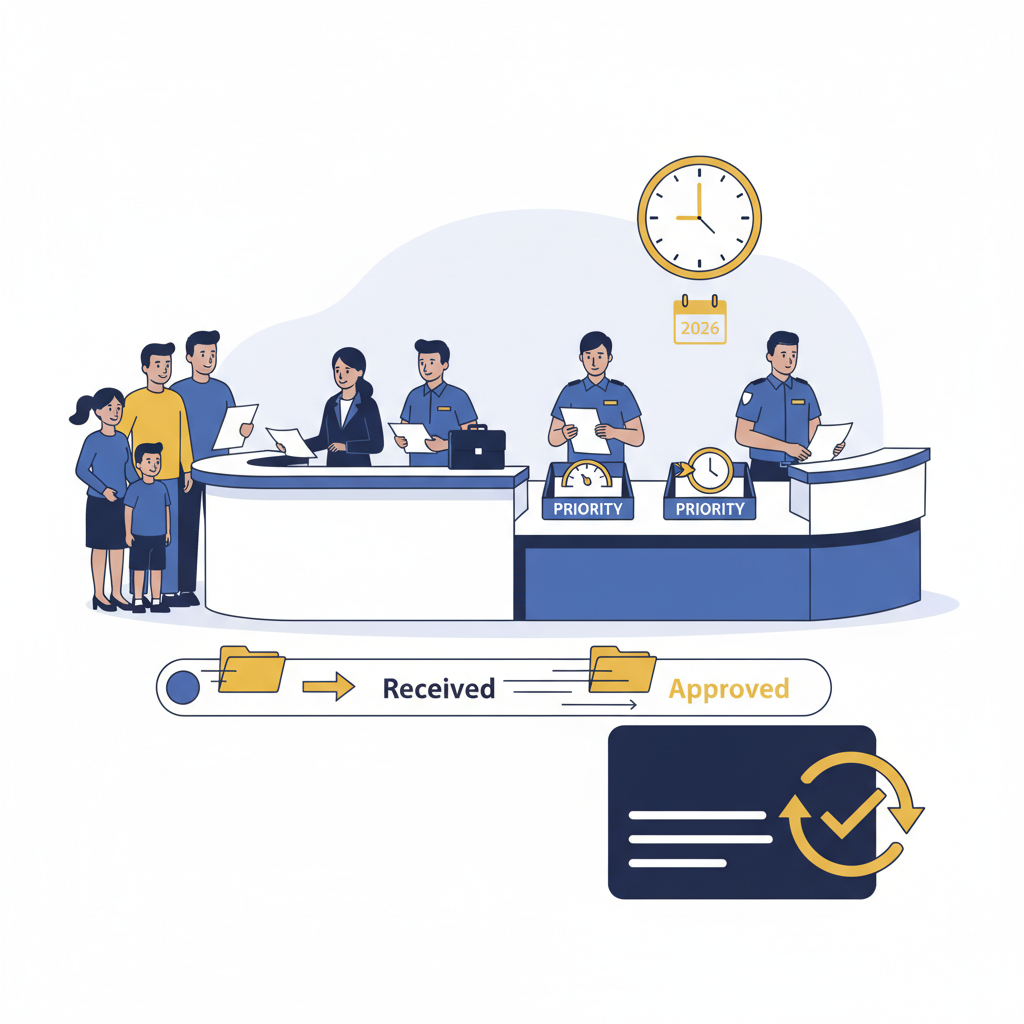
Get Help From Imigrar (Orlando Immigration Team)
If you have questions about EAD processing, renewals, RFEs, delays, or how your EAD connects to Form I-130 and Form I-485, Imigrar is here to help you build a plan that protects your work authorization and your future.
Need Help? Call +1 786-791-3106 for a free consultation, or message us online. Se Habla Español.


