


The reporting that sparked this guide
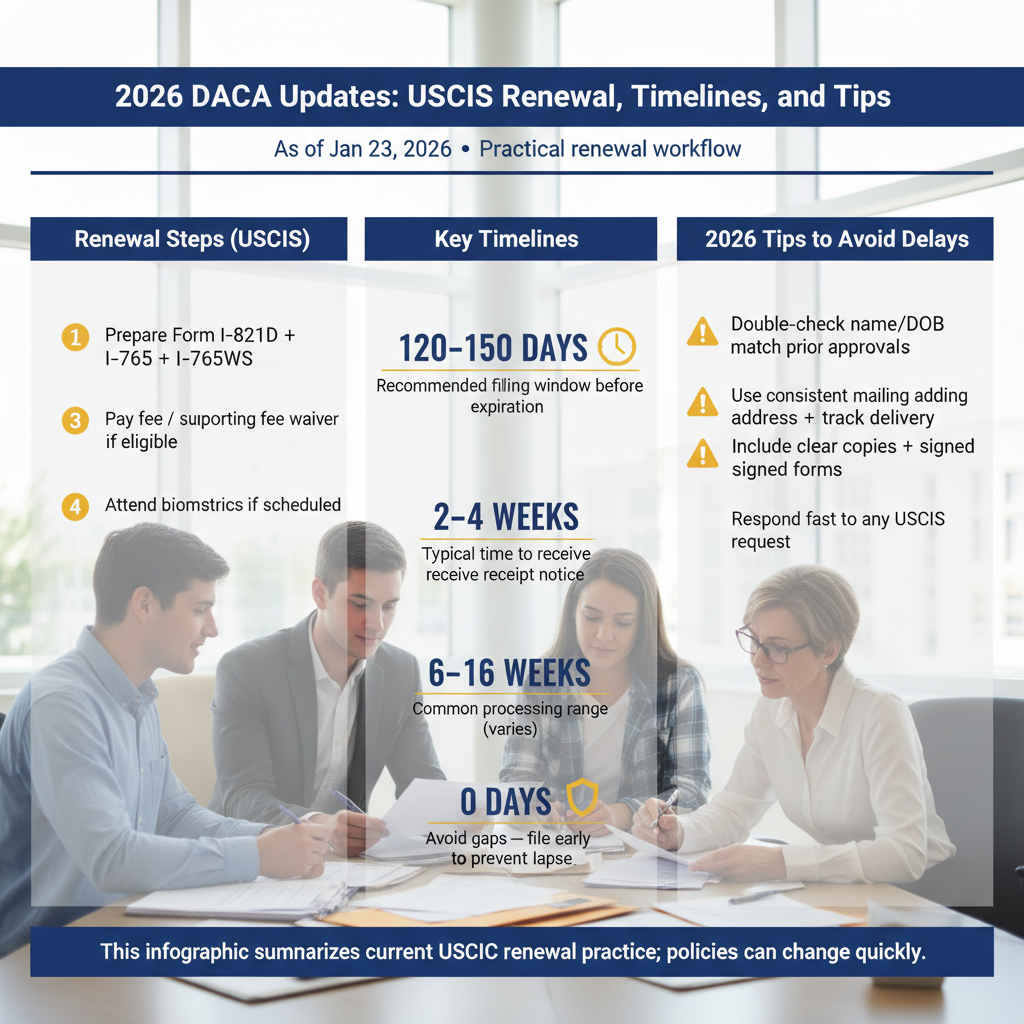
This article is based on the recent news cycle and official agency guidance referenced through: DACA Program Updates and Renewal Information (USCIS).
Important: DACA is a fast-moving area of immigration policy and litigation. This guide focuses on what USCIS is doing now in practice—especially for renewals—and how to protect yourself while staying compliant.
Need Help? Our Orlando immigration team is ready to assist. Call +1 786-791-3106 for a free consultation, or message us online. Se Habla Español.
What This News Means for Immigrants in Orlando and Across Florida
Why this news is showing up now
DACA (Deferred Action for Childhood Arrivals) continues to generate headlines because it sits at the intersection of executive policy, federal court decisions, and day-to-day USCIS processing realities. Even when there is no single “new law,” changes can still happen through:
- USCIS operational updates (how filings are handled, what evidence is requested, and processing priorities)
- Federal litigation that can limit or expand what USCIS can accept (for example, initial filings vs. renewals)
- Work authorization timing (EAD expiration dates, renewal backlogs, and the impact on employment)
For many Dreamers, the most urgent issue is not the politics—it’s the calendar. If your EAD is expiring soon, you need a realistic plan for filing, tracking, and responding to USCIS quickly.
Reminder: USCIS guidance and court orders can affect whether new DACA requests are accepted. In most recent practice, the biggest actionable pathway for most people has been DACA renewal and work permit renewal, not first-time applications.
How it can affect Florida residents
Florida Dreamers often face added pressure because many industries along the I-4 corridor—hospitality, healthcare support roles, construction, logistics, and tourism—are highly time-sensitive about work authorization. If your DACA-based EAD lapses:
- You may lose your job or be placed on unpaid leave (depending on employer policy and I-9 compliance)
- Your driver’s license renewal may become more complicated if your proof of lawful presence/work authorization is expiring
- You may face disruptions in school, internships, or professional licensing timelines
If your case is in Orlando or you live in Orange County, Seminole County, Osceola County, or anywhere in Central Florida, the practical strategy is the same: file early, file accurately, and build a paper trail that protects you if USCIS issues a request or if processing slows.
Warning: Notarios and unlicensed “immigration consultants” can cause life-changing harm. DACA filings require accuracy, consistency with prior submissions, and careful screening for any arrests, citations, or immigration history issues.
What DACA Program Updates and Renewal Information Is (and Why It Matters)
A plain-English definition
DACA is a DHS policy that can grant certain individuals who came to the U.S. as children a period of “deferred action” (a decision to temporarily not pursue removal) and eligibility for a work permit (Employment Authorization Document, or EAD).
DACA does not give you lawful permanent resident status (a green card), U.S. citizenship, or a permanent immigration status. It is a temporary protection that must be renewed.
The “updates” people see in the news usually relate to: (1) whether USCIS is accepting initial DACA requests, (2) how renewals are being processed, and (3) how quickly EADs are issued.
Key terms you need to know
- DACA: Deferred Action for Childhood Arrivals; a discretionary DHS policy
- Deferred Action: A decision to defer (pause) removal action for a period of time
- EAD: Employment Authorization Document (work permit), typically issued under category (c)(33) for DACA
- USCIS: U.S. Citizenship and Immigration Services, the agency that processes DACA requests
- Biometrics: Fingerprints/photo/signature appointment (sometimes reused; sometimes required)
- RFE: Request for Evidence—USCIS asking for more documents before deciding
- NOID: Notice of Intent to Deny—more serious than an RFE; requires a strong legal response
- Processing times: Estimated timeframes posted by USCIS (not guaranteed)
- 90-day window: A commonly referenced planning benchmark for filing early; USCIS has often encouraged filing well before expiration
- 180 days: A critical planning marker many applicants use as a “file early” guardrail to reduce lapse risk (even though DACA does not have the same automatic extension rules as some other EAD categories)
- Adjustment of Status: A green card process inside the U.S. (not a DACA benefit, but relevant if you later qualify through family/employment). Mentioned here because many Dreamers explore family-based options like Form I-130 + Form I-485.
- Priority Date: A waiting-list date used in many green card categories (not DACA itself, but relevant if you pursue a long-term plan)
Why it matters: DACA renewal is often the difference between uninterrupted work authorization and a lapse that can disrupt employment, education, and stability for entire families—especially in Central Florida households where one DACA recipient may be a primary wage earner.
Need Help? Our Orlando immigration team is ready to assist. Call +1 786-791-3106 for a free consultation, or message us online. Se Habla Español.
Current Immigration Law: The Foundation
DACA is not a statute passed by Congress. It is an executive branch policy implemented by the Department of Homeland Security (DHS) and administered through USCIS. Even though it is policy-based, DACA cases still interact with federal immigration law, regulations, and enforcement priorities.
Federal requirements
The legal “foundation” for DACA processing includes DHS authority to exercise prosecutorial discretion and to grant employment authorization under existing regulatory frameworks. Key legal references include:
- Immigration and Nationality Act (INA)—the core federal immigration statute (various sections govern admissibility, removal, and benefits)
- 8 C.F.R. § 274a—regulations governing employment authorization; DACA EADs are generally issued under category (c)(33)
- Administrative Procedure Act (APA)—often central in DACA litigation about how policies are created and implemented
For renewals, USCIS generally requires the standard DACA renewal package, which commonly includes:
- Form I-821D (Consideration of Deferred Action for Childhood Arrivals)
- Form I-765 (Application for Employment Authorization)
- Form I-765WS (Worksheet showing economic need)
You can confirm current forms, instructions, and fees on the USCIS official website and the dedicated forms page: USCIS Forms.
Important: This article also references other common family-based paths because many DACA recipients pursue long-term solutions. For example, a U.S. citizen spouse may file Form I-130, and the immigrant may later file Form I-485 for Adjustment of Status if eligible. These are separate from DACA and require individualized legal screening.
Florida-specific considerations
Florida does not control DACA approval (it is federal), but Florida residents face state-level “real life” impacts tied to DACA validity—especially:
- Employment verification and employer compliance practices
- Driver license and ID renewal timing tied to document expiration
- Local enforcement and court issues that can trigger immigration consequences (even for minor offenses)
For Central Florida residents, a key operational point is that USCIS case processing is largely handled through USCIS service centers and online systems, but interviews or certain in-person services may connect back to the region. The Orlando USCIS Field Office is relevant for many immigration benefits (especially family-based cases), even though DACA renewals typically do not require an in-person interview.
If you have removal proceedings or prior immigration court history, your case may also involve the Executive Office for Immigration Review (EOIR). That can change the risk analysis for DACA and any future filings.
How to Renew DACA: A Complete Step-by-Step Guide
Below is a practical renewal roadmap that aligns with common USCIS expectations. Because processing times vary, the best approach is to plan early, file cleanly, and track every notice.
Reminder: Check current estimates before you file and while your case is pending: USCIS Processing Times.
1) Confirm you’re filing a renewal (and choose your timing)
Start by confirming you are eligible to file a DACA renewal and that your prior DACA was approved. Timing matters because you want to reduce the risk of an EAD gap.
- Many applicants plan to file within a 90-day window to 180 days before expiration to reduce the chance of a lapse.
- Filing too late can lead to job loss if your employer requires an unexpired EAD for I-9 compliance.
Documents to gather for Step 1:
- Copy (front/back) of your current EAD card
- Copy of your last DACA approval notice(s) (I-821D and I-765 approvals, if available)
- Any USCIS receipt notices from prior filings
- A list of all addresses and employment history since your last filing
2) Screen for risk factors before you submit anything
Before filing, do a careful “risk check.” Some issues can trigger an RFE, NOID, or denial—and in certain situations, can increase enforcement risk.
Warning: If you have any arrests, charges, convictions, or even unresolved citations, speak with an immigration attorney before filing.
Documents to gather for Step 2:
- Certified court dispositions for any criminal or traffic cases (even if “dismissed”)
- Arrest reports and final outcomes (if any)
- Proof of compliance with probation/community service (if applicable)
- Any immigration documents: prior orders, NTA, FOIA results (if you have them)
3) Prepare the correct USCIS forms (I-821D, I-765, I-765WS)
A standard DACA renewal package typically includes Form I-821D, Form I-765, and Form I-765WS. Small inconsistencies—like mismatched addresses, missing A-Number, or incorrect entry details—can cause delays.
Use the most current editions from USCIS Forms and follow the official instructions on USCIS official website.
Documents to gather for Step 3:
- Government-issued photo ID (if available)
- Your A-Number (from prior notices/EAD)
- All prior names used (if any)
- Dates of travel outside the U.S. since last approval (if any) and supporting proof
- Employment and residence history since last filing
4) Assemble supporting evidence (only what’s needed, but enough)
Many renewals do not require extensive evidence like an initial request, but you still must submit what USCIS requests and what your facts require—especially if anything changed since your last approval.
Documents to gather for Step 4:
- Copy of your current/most recent EAD
- Copies of prior approval notices (if available)
- Two passport-style photos (if filing by mail and required by instructions)
- Evidence explaining any changes (name change order, corrected date of birth evidence, etc.)
- If you traveled: proof of authorized travel and re-entry documentation (consult counsel if applicable)
5) Pay fees or request a fee exemption (if available) and file correctly
USCIS fees can change, and DACA fee rules are specific. Always verify the current fee amount and payment method directly with USCIS. Incorrect fees or payment methods can lead to rejection and lost time.
Important: If you cannot afford the fee, talk with an attorney about whether any limited fee exemption criteria apply and what documentation is needed. Do not assume you qualify.
Documents to gather for Step 5:
- Proof of payment method (money order/cashier’s check/credit card authorization if permitted)
- If seeking a fee exemption: supporting documents (benefit letters, financial hardship evidence, etc.)
- A complete copy of the entire filing packet for your records
6) Track your case, biometrics, and respond fast to USCIS notices
After filing, you should receive a receipt notice. You may also receive a biometrics appointment notice or a biometrics reuse notice. Keep every USCIS letter.
Track your case through your USCIS online account and save screenshots/PDFs of updates. If USCIS issues an RFE or NOID, respond by the deadline with a complete, well-organized packet.
Documents to gather for Step 6:
- USCIS receipt notice(s)
- Biometrics notice (if scheduled) and government ID for the appointment
- Any RFE/NOID letter and a copy of what you send back
- Delivery confirmations if you mail any responses
7) Plan for your EAD card delivery and employer updates
When approved, USCIS will issue a decision and then the EAD card is produced and mailed. Make sure your address is correct and secure.
If you move along the I-4 corridor (for example, between Orlando, Kissimmee, Sanford, and Daytona), update your address with USCIS immediately to avoid lost cards.
Documents to gather for Step 7:
- Approval notice
- Tracking information (if available)
- Your new EAD card (copy front/back for your records)
- Employer I-9 re-verification instructions (ask HR what they need and when)
Need Help? Our Orlando immigration team is ready to assist. Call +1 786-791-3106 for a free consultation, or message us online. Se Habla Español.
Practical Steps You Can Take Today
Whether your DACA expires soon or months from now, you can reduce stress and risk by preparing early and building a clean renewal file.
Actionable checklist
- Check your expiration date today (both DACA and EAD) and set reminders for 180 days, 120 days, and the 90-day window.
- Create a “DACA renewal folder” (digital + paper) with prior approvals, EAD copies, receipts, and every USCIS notice.
- Request certified court records early if you had any police contact—courts can take weeks to produce documents.
- Review your last filing and keep your answers consistent unless something truly changed (addresses, travel, arrests, school, marital status).
- Confirm your mailing address is stable for the next 3–6 months so you don’t miss biometrics or an RFE.
- Monitor processing times here: USCIS Processing Times.
- Build a long-term plan: If you may qualify through a U.S. citizen spouse or adult child, ask about Form I-130, Form I-485, Adjustment of Status, and your Priority Date strategy.
Document preparation guidance
- Make clear PDF scans of both sides of your EAD and all USCIS notices.
- Keep a single “master timeline” of addresses and jobs since your last DACA approval.
- If you had any legal issues, obtain certified final dispositions—not just online docket printouts.
- Use official instructions from USCIS Forms to avoid outdated editions.
Timeline expectations
Processing can fluctuate. Some renewals move quickly; others take longer due to biometrics scheduling, background checks, RFEs, or workload shifts. For Central Florida residents, the key is to avoid last-minute filings and to keep your evidence ready.
If your case is in Orlando and you are also pursuing a family case (like Form I-130 / Form I-485), timelines may involve the Orlando USCIS Field Office for interviews—separate from the DACA renewal track.
How Imigrar Helps Immigrants in Orlando
Imigrar is an immigration law firm based in Orlando, Florida, serving clients nationwide. Our mission is to Keep Families Together. We help DACA recipients and their families approach renewals strategically—especially when a “simple renewal” becomes complicated due to arrests, prior immigration history, or urgent work deadlines.
Here’s how we support you:
- Renewal readiness review: We compare your prior filings to prevent inconsistencies that can trigger delays.
- Risk screening: We analyze any criminal/court history and immigration history before you file.
- End-to-end filing: We prepare and file the renewal package with organized exhibits and tracking.
- RFE/NOID response: We build a strong, deadline-driven response strategy.
- Long-term planning: We evaluate whether you may qualify beyond DACA (family-based options, Adjustment of Status, consular processing through the U.S. Department of State, or other pathways).
Se Habla Español. We offer a free consultation so you can understand your options and risks before you file.
Frequently Asked Questions
Q: Am I still eligible to renew DACA if I had a traffic ticket in Florida?
A: Sometimes yes, but it depends on what happened and the final outcome. Many traffic matters are not disqualifying, but some can be treated as misdemeanors or involve allegations that raise red flags (for example, DUI or driving without a valid license). Important: Get a certified disposition from the clerk of court (Orange County or your county) and speak with an attorney before filing so your renewal does not trigger unexpected issues.
Q: Does renewing DACA give me lawful status or a green card?
A: No. DACA is not lawful permanent status. It is a discretionary decision to defer removal and it can provide work authorization. If you want a long-term solution, you may need a separate process such as family-based sponsorship (Form I-130) and possibly Form I-485 for Adjustment of Status, depending on your immigration history. Your Priority Date matters in many categories, but DACA itself does not create a priority date.
Q: How long does a DACA renewal take right now?
A: It varies widely. Some cases are approved in a few months; others take longer due to biometrics, background checks, or an RFE. Monitor estimates at USCIS Processing Times. Reminder: Because timing is unpredictable, many applicants aim to file within 180 days of expiration when possible to reduce lapse risk.
Q: What documents do I need for a DACA renewal?
A: Most renewals include Form I-821D, Form I-765, and Form I-765WS, plus copies of your current/most recent EAD and prior approval notices. If anything changed (name, address history, travel, arrests), you should include documents that explain those changes. Use current form editions from USCIS Forms and follow instructions on the USCIS official website.
Q: How much does it cost to renew DACA?
A: Costs include USCIS filing fees (which can change). Always confirm the current amount and payment rules directly on USCIS official website. You should also consider indirect costs like passport photos, mailing, and obtaining certified court records. Important: If you cannot afford the fee, speak with an attorney about whether any limited fee exemption criteria apply and what evidence is required.
Q: What happens if my DACA renewal is denied?
A: A denial can mean loss of deferred action and work authorization, and it may increase risk depending on your history. If you receive a denial, do not ignore it—get legal help immediately to evaluate next steps, including whether there was an error, whether a motion is possible, or whether another immigration option exists. If you are in removal proceedings or have an immigration court history, your strategy may also involve EOIR: Executive Office for Immigration Review.
Q: If I move within Central Florida while my renewal is pending, what should I do?
A: Update your address with USCIS immediately and keep proof you did. If you move along the I-4 corridor (Orlando to Kissimmee, Sanford, or beyond), missed mail can cause missed biometrics or RFE deadlines. Warning: Missing a deadline can lead to denial.
Q: Can I travel internationally with DACA?
A: International travel rules are highly sensitive and can change based on policy and individual history. Do not travel without legal advice and proper authorization. For travel-related immigration processes and visa information, consult the U.S. Department of State and speak with counsel about your specific risks and documentation.
Common Mistakes (and How to Avoid Them)
Mistake #1: Filing too late and assuming USCIS will “process fast”
Processing times can change without warning. If you wait until the last minute, you risk an EAD gap and job loss. Avoid this by planning to file in the 90-day window to 180 days before expiration whenever possible and monitoring: USCIS Processing Times.
Mistake #2: Not disclosing or misunderstanding criminal history
Some people assume a sealed record, withheld adjudication, or “dismissed” case does not matter. USCIS can still see arrests and charges. Avoid this by obtaining certified dispositions and getting legal screening before filing—especially in Orange County and surrounding Central Florida courts where record retrieval can take time.
Mistake #3: Using outdated forms or making inconsistent statements
Using the wrong edition of a form or changing answers from your prior filing without explanation can cause delays or an RFE. Avoid this by downloading fresh forms from USCIS Forms, keeping a copy of your prior filing, and preparing a consistent address/employment timeline.
Additional official resources to rely on (not rumors)
Because DACA is frequently discussed on social media, it helps to anchor your decisions in primary sources:
- USCIS official website (forms, fees, alerts, and official guidance)
- USCIS Forms (current editions and instructions)
- USCIS Processing Times (time estimates by form type)
- U.S. Department of State (consular processing and travel/visa information)
- Executive Office for Immigration Review (immigration court information)
Important: If you are exploring a family-based path in parallel (for example, a spouse petition with Form I-130 and a possible Form I-485 Adjustment of Status filing), get individualized advice—DACA does not automatically fix unlawful entry, prior orders, or other bars.
Need Help? Our Orlando immigration team is ready to assist. Call +1 786-791-3106 for a free consultation, or message us online. Se Habla Español.

Closing: Protect your renewal—and your future
DACA renewals are often straightforward—until they aren’t. The safest approach is to file early, document everything, and get legal guidance if there is any arrest history, prior immigration contact, travel, or a looming EAD expiration that could affect your job.
For Central Florida residents, especially those living and working along the I-4 corridor, a well-timed renewal can prevent avoidable gaps that impact employment, driver’s license renewals, and family stability. If your case is in Orlando or you’re dealing with multiple immigration steps at once (for example, DACA plus a family petition), planning matters.
Need help now? Call Imigrar at +1 786-791-3106 for a free consultation or message us online. Se Habla Español. We’re here to Keep Families Together.


