


The reporting that sparked this guide
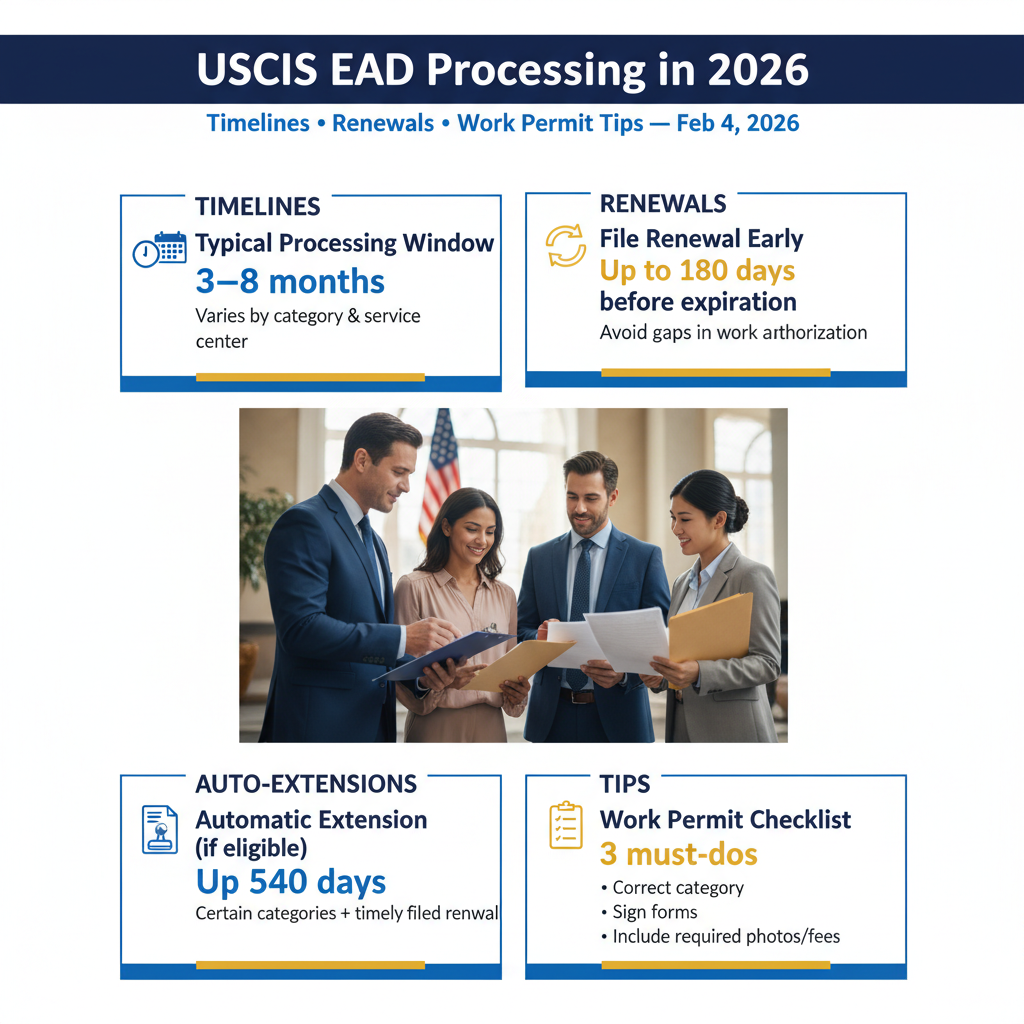
The reporting that sparked this guide: Employment Authorization Document Processing (USCIS).
Important: News headlines about Employment Authorization Document (EAD) processing often summarize multiple USCIS updates at once—processing times, automatic extensions, online filing changes, and category-specific policy shifts. This article explains what those updates typically mean in practice and how to protect your ability to work lawfully while your Form I-765 is pending.
Need Help? Our Orlando immigration team is ready to assist. Call +1 786-791-3106 for a free consultation, or message us online. Se Habla Español.
What This News Means for Immigrants in Orlando and Across Florida
Why this news is showing up now
EAD processing becomes “trending” whenever USCIS announces operational changes (like expanding online filing), adjusts policies on automatic extensions, or experiences shifts in workloads that affect the time it takes to issue new cards and renewals. In 2025–2026, families and employers are paying extra attention because:
- Many applicants are filing renewals earlier to avoid job interruptions.
- USCIS has been modernizing systems (online accounts, electronic notices) which can reduce some delays but create new “gotchas” if you miss an online request.
- Category-specific rules (for example, certain asylum-based, TPS-based, or adjustment-based EADs) can change quickly through policy guidance.
Reminder: USCIS processing is not “one-size-fits-all.” Your category code on Form I-765 (like (c)(9), (a)(5), (c)(8), etc.) is often the biggest driver of timing, evidence requirements, and whether an 180 days (or longer) automatic extension may apply.
How it can affect Florida residents
For Florida residents—especially in Central Florida along the I-4 corridor—EAD timing affects everyday life: keeping a job, renewing a driver’s license, maintaining health insurance, and supporting family stability. If you live in Orange County or nearby (Kissimmee, Winter Park, Sanford, Lake Nona, Celebration, Davenport), delays can create urgent problems such as:
- Employers pausing work schedules due to I-9 reverification deadlines.
- DMV/FLHSMV documentation challenges when an EAD is expired and the renewal receipt is not understood.
- Gaps in income while waiting for a new card—even when you remain eligible to work.
If your case is in Orlando... you may interact with multiple USCIS components (a lockbox, a service center, and sometimes The Orlando USCIS Field Office for related applications like Form I-485). Understanding who is handling what can prevent wasted time and misdirected requests.
What Employment Authorization Document Processing Is (and Why It Matters)
A plain-English definition
An Employment Authorization Document (EAD) is a USCIS-issued card that proves you are authorized to work in the United States for a specific period of time. “EAD processing” refers to everything USCIS does between receiving your Form I-765 and producing/mailling your card (or issuing a denial/RFE).
In plain terms: EAD processing is the timeline and decision-making path that determines whether you can start working, keep working, or renew your work authorization without interruption.
Key terms you need to know
- Form I-765: The application for an EAD (work permit).
- Receipt Notice (Form I-797): Proof USCIS accepted your filing; may support an automatic extension in eligible categories.
- RFE (Request for Evidence): USCIS asks for missing/extra documents; can significantly delay approval.
- Service Center: The USCIS facility processing many EADs (not always your local field office).
- Expedite Request: A request to speed up processing for urgent reasons; approval is discretionary.
- Automatic Extension: In certain categories, timely-filed renewals can extend work authorization beyond the card’s expiration (often tied to 180 days, and sometimes longer depending on category and current USCIS policy).
- Adjustment of Status: A process to apply for a green card from inside the U.S., typically using Form I-485. Many adjustment applicants file EADs under category (c)(9).
- Priority Date: The place in line for certain immigrant visa categories; it can impact when you can file Adjustment of Status and related benefits.
- 90-day window: A common planning benchmark people use for renewals (and sometimes employer reverification planning), even though USCIS rules may allow earlier filing in many categories. Always confirm your category’s timing rules.
Need Help? Our Orlando immigration team is ready to assist. Call +1 786-791-3106 for a free consultation, or message us online. Se Habla Español.
Current Immigration Law: The Foundation
EAD authority comes primarily from the Immigration and Nationality Act (INA) and DHS/USCIS regulations. While most people experience EADs as “just a card,” the legal foundation matters because it determines eligibility, timing, and what evidence USCIS can require.
Federal requirements
Key federal authorities include:
- INA § 274A (8 U.S.C. § 1324a): Governs unlawful employment and employment verification; connects to employer Form I-9 obligations and the need for valid proof of work authorization.
- 8 C.F.R. § 274a.12: Lists categories of noncitizens authorized to accept employment and those who must apply for employment authorization (EAD).
- 8 C.F.R. § 274a.13: Governs EAD application procedures, adjudication, and related requirements.
- 8 C.F.R. § 103.2: General USCIS filing and evidence rules (including signatures, RFEs, and denials for abandonment).
The primary form is Form I-765. Depending on your situation, your EAD may be connected to other filings, including:
- Form I-485 (green card / Adjustment of Status)
- Form I-130 (family petition)
- Form I-589 (asylum)
- Form I-821 (TPS)
- Form I-129 (certain work visas, depending on category and employer)
For official instructions and the latest updates, use: USCIS official website and the USCIS Forms library.
Florida-specific considerations
Immigration law is federal, but Florida residents experience local “friction points” where documentation timing matters:
- Driver’s license/ID timing: Florida agencies may require current proof of lawful status/work authorization. If your EAD is expired, you may need to present the renewal receipt and evidence of an automatic extension (if eligible). Policies can vary by office and staff training.
- Employment compliance: Many Florida employers (hospitality, tourism, healthcare, construction) have strict onboarding timelines. In Orlando and across the I-4 corridor, seasonal hiring cycles can make EAD delays especially disruptive.
- Address stability: Frequent moves can cause returned cards. USCIS expects you to keep addresses updated (often via online account and/or Form AR-11 where applicable).
Warning: A returned EAD card can add weeks or months if you do not respond quickly or if the mailing address is inconsistent across filings (for example, your Form I-485 address differs from your Form I-765 address).
How to Get or Renew an EAD: A Complete Step-by-Step Guide
1) Confirm your eligibility category (and code) before you file
EAD eligibility depends on the category you select on Form I-765 (for example, (c)(9) for many Adjustment of Status applicants, (c)(8) for asylum applicants, categories tied to TPS, certain parole programs, and more). Choosing the wrong category is one of the fastest ways to trigger an RFE or denial.
Documents to gather for this step:
- Current immigration status documents (I-94 record, approval notices, parole documents)
- Copies of any pending receipt notices (I-797) for related cases (e.g., Form I-485, Form I-589, TPS filings)
- Any prior EAD cards (front and back)
- Your passport biographic page and visa page (if applicable)
Important: Your eligibility can change if you travel, if your underlying status expires, or if USCIS denies the underlying case. Make sure your EAD plan matches your broader strategy (family-based via Form I-130/Form I-485, humanitarian, employment-based, etc.).
2) Decide whether you are filing a first-time EAD or a renewal (and when)
Timing is everything. Some categories allow filing renewals well in advance; others have restrictions. USCIS processing times can fluctuate, so many applicants plan ahead to reduce the risk of a work gap.
Documents to gather for this step:
- Current EAD card (to confirm category and expiration date)
- USCIS receipt notices for your underlying case
- Employment verification needs (I-9 reverification date, employer letter if needed)
Reminder: Even if you file early, USCIS may not approve until closer to expiration depending on category and internal workflows. But filing early can still protect you—especially if you qualify for an automatic extension and need the receipt notice.
3) Prepare Form I-765 and your evidence packet (or online upload)
Whether you file online or by mail, your goal is the same: a clean, consistent application with correct category, accurate biographic info, and evidence that matches USCIS instructions.
Documents to gather for this step:
- Completed Form I-765 (correct edition; signed if filing by mail)
- Two passport-style photos (if required by your filing method/category)
- Government-issued photo ID (passport, prior EAD, driver’s license where appropriate)
- I-94 record (printout) if applicable
- Proof of eligibility for the category (receipts/approvals for Form I-485, Form I-589, TPS documentation, etc.)
- Any required filing fee or fee waiver request (if eligible)
Warning: Small inconsistencies—name spelling, date of birth formatting, A-Number, or address—can cause delays. If you previously filed Form I-130 or Form I-485, keep your identifiers consistent unless you are correcting an error (and then explain clearly).
4) File correctly (online or mail) and track your receipt immediately
After filing, USCIS will issue a receipt notice. This notice is critical for tracking and, in some categories, for proving an automatic extension past expiration (often tied to 180 days).
Documents to gather for this step:
- Filing confirmation (online submission confirmation or mailing courier proof)
- USCIS online account access credentials (if used)
- Copy of the full submission (PDF or scanned packet)
Track your case through your USCIS account and check: USCIS Processing Times. If you need to reference official form instructions, use: USCIS Forms.
If your case is in Orlando... your EAD may still be processed at a service center, but your related green card interview (for example, family-based Adjustment of Status) may be scheduled at The Orlando USCIS Field Office. Keep your address updated everywhere to avoid missing notices.
5) Respond quickly to biometrics notices or RFEs (and avoid “silent delays”)
USCIS may require biometrics (fingerprints/photo) or may reuse them. If USCIS issues an RFE, your case pauses until you respond, and then resumes once USCIS receives and accepts your response.
Documents to gather for this step:
- Biometrics appointment notice (if scheduled)
- Government photo ID for biometrics appointment
- RFE notice (read carefully; respond to every item)
- Supporting documents requested (e.g., clearer copy of I-94, proof of pending Form I-485, updated photos)
- Cover letter and organized exhibit list for an RFE response
Important: Missing an RFE deadline can lead to denial. Missing a biometrics appointment can also derail the case. If you must reschedule, do so immediately and document your attempt.
6) Use the receipt notice and automatic extension rules to protect your job (if eligible)
Many renewal applicants worry about what happens when the EAD expires but the renewal is still pending. USCIS has rules allowing automatic extensions for certain categories when a renewal is filed on time and the category qualifies.
Documents to gather for this step:
- Expired/expiring EAD card (front and back)
- Form I-797 receipt notice for the renewal filing
- Employer I-9 reverification request (if your employer provides one)
- Any USCIS policy printouts relevant to your category (for HR reference)
Reminder: Employers must follow Form I-9 rules. Some HR departments may not understand automatic extensions. Providing the receipt notice and pointing them to official guidance can help. If your employer is unsure, it may help to consult counsel.
7) If delayed, consider an expedite request or other escalation—strategically
If your EAD is severely delayed and you face serious harm (financial loss, medical emergency, humanitarian reasons), you may request expedited processing. USCIS decides expedite requests case-by-case.
Documents to gather for this step:
- Evidence of urgent need (job offer letter, termination notice, eviction notice, medical letters)
- Proof of category eligibility and pending application (receipt notice)
- Proof of identity
- A clear written explanation of the harm and why normal processing is insufficient
Warning: Expedite requests are not “guaranteed fast approvals.” A weak expedite request can waste time. A strong, well-documented request can make a real difference—especially when your employer or family depends on your income.
Need Help? Our Orlando immigration team is ready to assist. Call +1 786-791-3106 for a free consultation, or message us online. Se Habla Español.
Practical Steps You Can Take Today
The best way to handle EAD processing uncertainty is to prepare like a project manager: dates, documents, backups, and a plan if timelines slip.
- Checklist item #1: Identify your EAD category code and confirm it matches your underlying case (for example, (c)(9) tied to Form I-485).
- Checklist item #2: Create a renewal calendar with milestones at 180 days before expiration and again at the 90-day window before expiration (even if your category allows earlier filing, these reminders help prevent last-minute emergencies).
- Checklist item #3: Make a “USCIS packet” folder: passport, I-94, prior EADs, all I-797 receipts/approvals, marriage certificate (if family-based), and copies of Form I-130/Form I-485 filings.
- Checklist item #4: Confirm your mailing address is consistent across all pending cases and your USCIS online account. If you move along the I-4 corridor (Orlando to Tampa/Daytona), update immediately.
- Checklist item #5: If your employer is likely to reverify, prepare an HR packet: EAD copy, receipt notice, and a short note citing that USCIS permits automatic extensions for certain categories (where applicable).
- Checklist item #6: Monitor your case status weekly and check USCIS Processing Times monthly for your form/category.
Timeline expectations: EAD timelines can vary widely by category and service center workload. Some applicants receive cards in weeks; others wait months. The most reliable planning method is to (1) file early when allowed, (2) avoid RFEs, and (3) understand whether you qualify for an automatic extension so you can keep working while pending.
Document preparation guidance: Use clear scans, keep translations for any non-English civil documents, and label evidence logically (Exhibit A, B, C). If you previously filed Adjustment of Status, keep a copy of the full Form I-485 submission—USCIS sometimes requests items you already provided elsewhere.
How Imigrar Helps Immigrants in Orlando
At Imigrar, we focus on strategies that protect your ability to work legally while building a strong long-term immigration case. Because EADs are often tied to bigger filings—like family-based green cards through Form I-130 and Form I-485—we look at the full picture, not just the card.
- We confirm the correct eligibility category and evidence before filing Form I-765.
- We help clients plan around real-world deadlines (employer reverification, driver’s license renewal, travel plans).
- We prepare RFE responses and, when appropriate, expedite requests with strong documentation.
- We support families throughout Central Florida, Orange County, and nationwide—especially when timelines affect employment and stability.
We offer a free consultation. Se Habla Español.
Frequently Asked Questions
Q: Who is eligible to apply for an EAD through USCIS?
A: Eligibility depends on your immigration category under federal regulations (see 8 C.F.R. § 274a.12). Common eligible groups include many applicants with pending Adjustment of Status (often tied to Form I-485), certain asylum applicants, TPS applicants/beneficiaries, certain parole categories, and others. The correct category code on Form I-765 is essential. If you’re not sure, consult counsel before filing to avoid a denial.
Q: Will applying for or renewing an EAD affect my immigration status?
A: Filing Form I-765 generally does not “create” immigration status by itself; it requests work authorization based on an underlying status or pending benefit (like Form I-485). However, what can affect your status is the underlying case (for example, denial of Form I-485 or a change in asylum eligibility). Warning: If your underlying basis ends, your EAD eligibility may end too.
Q: How long does EAD processing take right now?
A: It varies by category and the USCIS office handling your case. The best public tool is USCIS Processing Times. For Central Florida residents, even if your interview is at The Orlando USCIS Field Office, your EAD is often processed elsewhere. Plan conservatively and file early when permitted.
Q: What documents do I need for an EAD renewal?
A: Typically you need: (1) completed Form I-765, (2) copy of your current/expired EAD (front/back), (3) proof of eligibility category (such as Form I-485 receipt for (c)(9)), (4) passport ID page and I-94 (if applicable), (5) photos if required, and (6) the correct fee or a fee waiver request if eligible. Always follow the latest USCIS Forms instructions.
Q: How much does it cost to file Form I-765?
A: Fees depend on your eligibility category and whether your Form I-765 is filed with another application (for example, some applicants filing Form I-485 may have different fee structures than stand-alone filings). USCIS fee rules change periodically, so confirm the current fee on the USCIS official website before submitting. Reminder: Submitting the wrong fee can result in rejection and lost time.
Q: What happens if my EAD is denied?
A: A denial means USCIS found you ineligible or your filing was deficient (wrong category, missing signature, insufficient evidence, or underlying case issues). Next steps depend on the reason: you may be able to refile with corrected evidence, address the underlying case, or explore other options. Important: If you are relying on the EAD to work, talk to an attorney immediately to avoid unauthorized employment and to protect your broader immigration strategy.
Q: Can I travel while my EAD renewal is pending?
A: The EAD itself is not a travel document. If you have a pending Adjustment of Status case (Form I-485), traveling without advance parole can be risky and may be considered abandonment in many situations. Always confirm travel rules for your specific status and filings. For travel guidance, see U.S. Department of State and consult counsel for your facts.
Common Mistakes (and How to Avoid Them)
Mistake #1: Filing under the wrong eligibility category or code
This can trigger an RFE, denial, or long delays. Avoid it by confirming your category using the current Form I-765 instructions and your underlying receipt/approval notices. If your EAD is based on Adjustment of Status, make sure your Form I-485 is properly filed and pending.
Mistake #2: Waiting too long and assuming USCIS will “process it in time”
Processing times fluctuate. Avoid last-minute renewals. Build a calendar around your expiration date with reminders at 180 days and the 90-day window. If your category allows an automatic extension, filing on time is the key to protecting your work authorization while pending.
Mistake #3: Missing an RFE or biometrics notice due to address problems
Moves are common in Orlando and across the I-4 corridor. Avoid this by updating your address immediately and keeping copies of all notices. Warning: Missing an RFE deadline can lead to denial, and fixing it later may cost months.
For removal proceedings or immigration court-related concerns that may intersect with work authorization for some individuals, consult the Executive Office for Immigration Review resources and speak with counsel about your specific posture.
Need Help? Our Orlando immigration team is ready to assist. Call +1 786-791-3106 for a free consultation, or message us online. Se Habla Español.

Closing: Protect Your Work Authorization and Your Family’s Stability
EAD processing updates can feel overwhelming, but the best outcomes usually come from disciplined preparation: correct category selection, strong documentation, timely filing, and a plan for employer reverification. For many families, the EAD is the bridge that keeps income stable while a long-term case—like a family petition through Form I-130 and green card filing through Form I-485 (Adjustment of Status)—moves forward.
For Central Florida residents, we understand how local realities—jobs tied to tourism and healthcare, commuting along the I-4 corridor, and time-sensitive DMV needs—turn processing delays into real emergencies. If you want a tailored strategy, we’re here to help.
Need Help? Our Orlando immigration team is ready to assist. Call +1 786-791-3106 for a free consultation, or message us online. Se Habla Español.
Reminder: This article is educational and not legal advice. Because USCIS policies and processing can change, always verify current guidance at the USCIS official website and consult an attorney for advice about your specific facts.


