
U.S. Naturalization Test Changes in 2026: Your Essential Guide
Navigate the updated U.S. Naturalization Test for 2026. Imigrar provides crucial insights, preparation tips, and Orlando-specific guidance to help you achieve U.S. citizenship.

The journey to U.S. citizenship is a profound step for many immigrants and their families, representing a new chapter of belonging and opportunity. At Imigrar, we understand the immense significance of this process, and our mission, "Keep Families Together," drives us to provide the most accurate, timely, and supportive guidance possible. As we move through 2026, it's crucial for aspiring citizens to be aware of significant updates to the naturalization test that are now taking effect or are imminent.
Navigating the New Naturalization Test? Don't face it alone. Our experienced Orlando immigration team at Imigrar is here to guide you through every change and requirement. Call +1 786-791-3106 for a free, confidential consultation, or message us online. Se Habla Español.
These changes are designed to ensure that new citizens have a comprehensive understanding of U.S. history, government, and civics, while also integrating a more dynamic assessment of English language proficiency. For immigrants in Orlando, across Florida, and nationwide, understanding these modifications is key to a successful naturalization application.
The reporting that sparked this guide
Our commitment to keeping you informed means we constantly monitor official sources and immigration news. The information in this comprehensive guide is based on official announcements and discussions surrounding the Naturalization Test Changes Coming in 2026 (Citizenship), as reported by various reputable news outlets following U.S. Citizenship and Immigration Services (USCIS) pilot programs and policy directives.
What This News Means for Immigrants in Orlando and Across Florida
As we are now well into 2026, the anticipated changes to the U.S. naturalization test are no longer distant possibilities but current realities or imminent implementations. For thousands of permanent residents in Florida, especially those along the I-4 corridor in Central Florida, these updates directly impact your path to becoming a U.S. citizen. Understanding the nuances of these changes is paramount to preparing effectively.
Why this news is showing up now
The discussion and development of changes to the naturalization test have been ongoing for several years. USCIS, the federal agency responsible for processing naturalization applications, periodically reviews and updates its examination procedures to ensure they remain relevant, fair, and effective. The year 2026 was earmarked as a target for implementing these significant updates following extensive pilot programs, public feedback, and internal evaluations. As of November 2026, these modifications are either being phased in, have recently taken effect, or are expected to be fully implemented very soon within the calendar year. This timing allows USCIS to refine the test content and administration methods before a full rollout, aiming for a more robust assessment of civic knowledge and English proficiency.
The impetus for these changes often stems from a desire to modernize the test, improve its consistency, and potentially make it more interactive. Past administrations have explored various formats, including scenario-based questions and more integrated English and civics components. The aim is to move beyond rote memorization towards a deeper understanding of American democratic principles. This ongoing evolution ensures that the naturalization process reflects current best practices in assessment and civic education.
How it can affect Florida residents
Florida is home to a vast and diverse immigrant population, with major USCIS Field Offices located in cities like Orlando, Miami, and Tampa. For Central Florida residents, particularly those in Orange County and surrounding areas, the effects of these changes are direct:
- New Study Materials: USCIS will provide updated study materials reflecting the new civics questions and potentially new English language components. It is critical for applicants to use the most current official materials.
- Adjusted Interview Format: The structure of the naturalization interview itself may change. Instead of purely factual recall, you might encounter more analytical or scenario-based questions during the civics portion. The English test could also become more integrated with the civics discussion.
- Preparation Strategy Shift: Simply memorizing 100 civics questions may no longer be sufficient. Applicants will need to develop a deeper understanding of the concepts behind the questions, practice critical thinking, and strengthen their conversational English skills.
- Increased Complexity: For some, the new format might feel more challenging if it moves away from a predictable question-and-answer structure. This underscores the importance of comprehensive preparation and potentially seeking legal guidance.
- Orlando USCIS Field Office Impact: The staff at the Orlando USCIS Field Office and other Florida locations will be administering the new test. Their training will reflect these changes, and applicants attending interviews in Orlando will be subject to the updated format.
Important: Whether you are just beginning your naturalization journey or have an interview scheduled for late 2026 or beyond, you must be aware of these modifications. Ignoring them could jeopardize your application. Imigrar is closely monitoring all USCIS announcements to provide our Orlando clients with the most current advice and preparation strategies.
What Naturalization Test Changes Are (and Why They Matter)
The naturalization test is a pivotal hurdle for permanent residents seeking to become U.S. citizens. It assesses an applicant's knowledge of U.S. history and government (the civics test) and their ability to read, write, and speak English. The changes being implemented in 2026 are not just minor tweaks; they represent a significant evolution in how USCIS evaluates an applicant's readiness for citizenship.
A plain-English definition
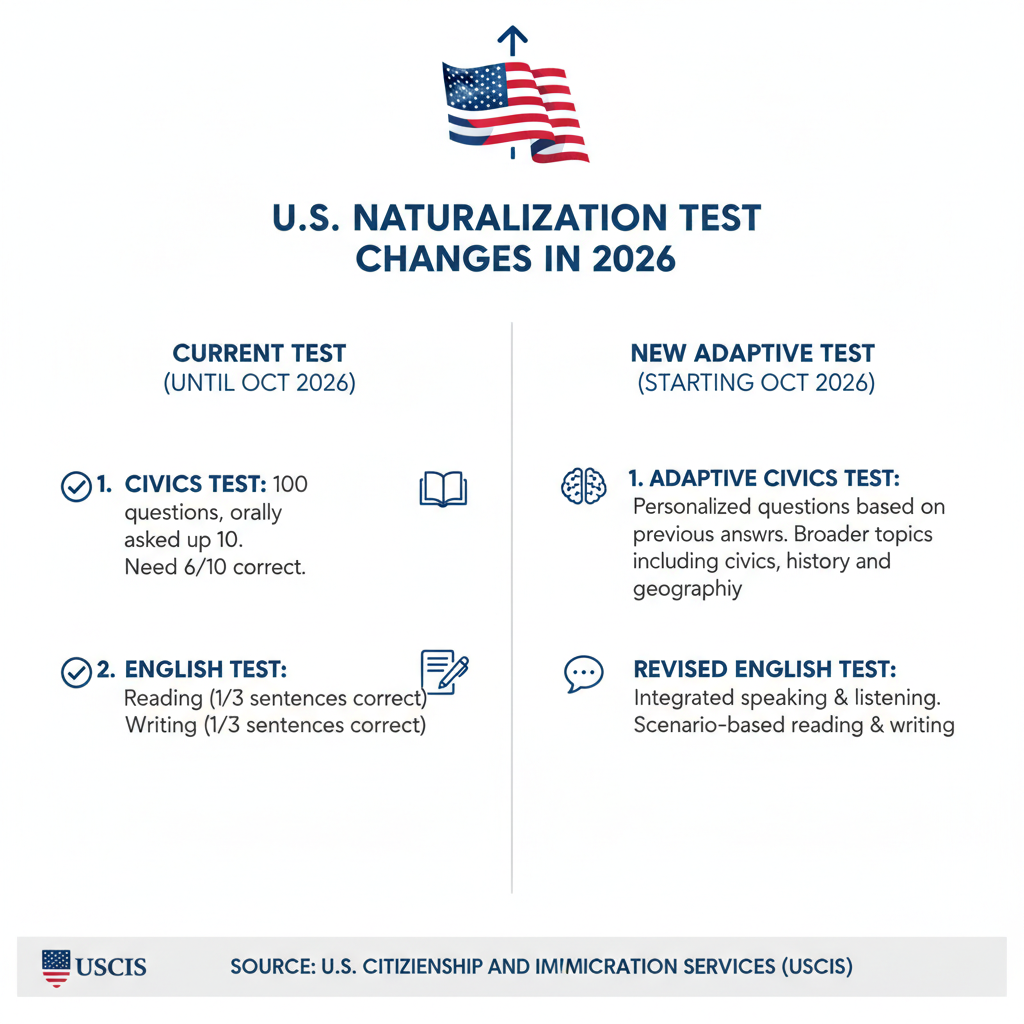
Naturalization Test Changes: These are updates to the examination administered by USCIS to immigrants applying for U.S. citizenship. Specifically, in 2026, these changes primarily affect the civics test, introducing new questions and potentially a different format, and may also involve a more integrated approach to assessing English proficiency. Instead of just asking factual questions, the new test may involve more interpretive or scenario-based questions, requiring a deeper understanding rather than mere memorization. The goal is to ensure that new citizens possess a functional comprehension of American democratic principles and a practical ability to communicate in English.
Key terms you need to know
To fully grasp the implications of these changes, it’s helpful to understand the core terminology:
- Naturalization: The process by which a foreign citizen or national becomes a U.S. citizen. It is the final step for most lawful permanent residents to gain full citizenship.
- U.S. Citizenship and Immigration Services (USCIS): The federal agency within the Department of Homeland Security (DHS) that oversees lawful immigration to the United States. USCIS processes naturalization applications and administers the test.
- Form N-400: The official application form for naturalization. This is the primary document filed by individuals seeking U.S. citizenship.
- Civics Test: One part of the naturalization test that assesses an applicant's knowledge of U.S. history, government, and civics. Historically, applicants were asked 10 out of 100 possible questions and had to answer 6 correctly. The 2026 changes specifically target this component.
- English Test: The other part of the naturalization test, which evaluates an applicant's ability to read, write, and speak basic English. This includes reading a sentence, writing a sentence, and understanding/responding to questions during the interview. The 2026 changes may integrate this more closely with the civics portion.
- Lawful Permanent Resident (LPR): An individual who has been granted the privilege of residing permanently in the United States as an immigrant. Also commonly known as a "green card holder."
- Good Moral Character: A legal standard that applicants for naturalization must meet. It generally means adherence to the moral standards of the average citizen in the community in which the applicant resides. Certain criminal offenses or other negative factors can prevent an applicant from meeting this requirement.
- Oath of Allegiance: The final step in the naturalization process, where an applicant formally pledges loyalty to the United States and renounces allegiance to any foreign state.
These changes matter because they directly influence how you prepare for and experience the naturalization interview. A deeper understanding of civics, coupled with strong English communication skills, will be crucial. For Imigrar, "Keep Families Together" means preparing you thoroughly for every aspect of this updated process.
Current Immigration Law: The Foundation for U.S. Citizenship
The ability to become a naturalized U.S. citizen is enshrined in federal law, primarily within the Immigration and Nationality Act (INA). While the naturalization test questions may evolve, the fundamental legal requirements for eligibility remain the bedrock of the process. Understanding these foundational laws is crucial before you even consider the test itself.
Federal requirements
The primary legal framework for naturalization is found in Title III of the Immigration and Nationality Act (INA), specifically INA sections 310-337. To be eligible for naturalization, most applicants must meet the following criteria:
- Age: Be at least 18 years old at the time of filing Form N-400, Application for Naturalization.
- Lawful Permanent Resident Status: Be a Lawful Permanent Resident (LPR) (Green Card holder) for a specific period.
- Continuous Residency: Have resided continuously in the U.S. as an LPR for at least 5 years immediately preceding the date of filing Form N-400 (or 3 years if married to and living with a U.S. citizen for that entire period, and the U.S. citizen spouse has been a citizen for at least 3 years).
- Physical Presence: Have been physically present in the U.S. for at least half of the required continuous residency period (e.g., 30 months out of 5 years, or 18 months out of 3 years).
- Residency in State/USCIS District: Have resided for at least 3 months immediately preceding the filing of Form N-400 (or immediately preceding the examination if the application was filed early based on the 3-month rule) in the state or USCIS district where the application is filed. For Orlando residents, this means living in the jurisdiction of the Orlando USCIS Field Office.
- Good Moral Character (GMC): Demonstrate Good Moral Character for the statutory period (usually 5 or 3 years) leading up to the naturalization interview and up to the Oath of Allegiance. This is a crucial and often complex requirement, encompassing a review of your criminal record, tax history, marital fidelity (in some cases), and compliance with child support obligations.
- Attachment to the U.S. Constitution: Be able to demonstrate attachment to the principles of the U.S. Constitution and a willingness to support and defend the U.S.
- English Language Proficiency: Be able to read, write, and speak basic English. There are exceptions for age and length of residency (e.g., the "50/20" and "55/15" rules, and medical waivers using Form N-648).
- Knowledge of U.S. Civics: Pass the U.S. civics test, demonstrating knowledge and understanding of U.S. history and government. This is the component undergoing changes in 2026.
Applicants must file Form N-400, Application for Naturalization, to initiate this process. This form collects extensive information about your background, residency, employment, family, and any interactions with law enforcement. Accuracy and completeness are paramount.
For the most current information on eligibility and forms, always refer to the USCIS official website.
Florida-specific considerations
While the naturalization laws are federal, the application process is administered locally. For residents of Orlando and throughout Central Florida, the primary point of contact for your naturalization interview will be the Orlando USCIS Field Office. Key considerations for Florida residents include:
- Jurisdiction: Ensure you meet the 3-month residency requirement within the jurisdiction of the Orlando Field Office or other relevant Florida USCIS office (e.g., Miami, Tampa) before filing your Form N-400.
- Processing Times: Processing times for Form N-400 can vary significantly by field office. You can check estimated processing times for the Orlando USCIS Field Office on the USCIS Processing Times page.
- Local Resources: Florida offers various community organizations and adult education programs that provide assistance with English language learning and civics test preparation. Imigrar can help connect you with reputable local resources in Orlando and surrounding areas.
- Legal Support: Given the complexity of the Good Moral Character requirement and the new test changes, having an experienced immigration attorney, especially one familiar with the Orlando USCIS Field Office's practices, can be invaluable.
Understanding these federal and local considerations forms the robust foundation upon which your naturalization application rests. Imigrar ensures that our clients in Orlando are fully prepared for both the legal requirements and the evolving test format.
Worried About Naturalization Eligibility? Our Orlando immigration team provides clear, personalized guidance. Don't leave your future to chance. Call +1 786-791-3106 for a free consultation today, or contact us online. Se Habla Español.
How to Navigate the Naturalization Process: A Complete Step-by-Step Guide
The path to U.S. citizenship involves several distinct stages, each requiring careful attention to detail and adherence to USCIS regulations. With the naturalization test changes now in effect or imminent in 2026, preparing effectively is more important than ever. Here’s a comprehensive step-by-step guide to help you through the journey.
1) Determine Eligibility and Gather Documents
Before you even touch Form N-400, you must confirm you meet all the basic eligibility requirements discussed in the "Current Law Section." This includes age, continuous residency, physical presence, and good moral character. This initial assessment is crucial to avoid filing an application that will ultimately be denied.
Required Documents for Eligibility Assessment:
- Your Green Card (Form I-551, Permanent Resident Card).
- Proof of your continuous residency and physical presence (e.g., entry/exit stamps, travel records, utility bills, tax returns for the last 5 years or 3 years if married to a U.S. citizen).
- Proof of marital status (marriage certificate, divorce decrees) if applying under the 3-year rule.
- Proof of U.S. citizen spouse's citizenship (birth certificate, naturalization certificate, U.S. passport).
- Any arrest records, court dispositions, or police reports, even for minor incidents, to assess Good Moral Character.
- Tax transcripts for the past 5 (or 3) years from the IRS.
Tip: If you have any doubts about your eligibility, especially regarding continuous residency, physical presence, or good moral character, consult with an immigration attorney at Imigrar before proceeding. It's better to address potential issues proactively.
2) Prepare and File Form N-400
This is the official application for naturalization. It’s a lengthy and detailed form that asks for extensive personal, residential, employment, and family history, along with questions about your eligibility and good moral character. Completing it accurately is paramount.
Required Documents for Filing Form N-400:
- Completed and signed Form N-400.
- Two passport-style photos (if filing by mail; online filing may not require physical photos upfront).
- A copy of both sides of your Green Card.
- A copy of your current and any previous marriage certificates and divorce decrees (if applicable).
- Copies of any official name change documents (if applicable).
- Fee payment (check, money order, or credit card authorization via Form G-1450). Be sure to check the current filing fee on the Form N-400 Information page, as fees can change.
- If applying for a fee waiver, Form I-912, Request for Fee Waiver, and supporting documentation.
Warning: Any misstatements or omissions on Form N-400, even unintentional ones, can lead to delays or denial. Review every answer meticulously. Our team at Imigrar can help you prepare and review your application to ensure accuracy and completeness.
3) Attend Biometrics Appointment
After USCIS receives your Form N-400, they will send you an appointment notice for a biometrics services appointment at an Application Support Center (ASC). This appointment is typically scheduled a few weeks after filing.
What Happens at Biometrics:
- Your fingerprints, photograph, and signature will be taken.
- These biometrics are used for background checks by the FBI and other government agencies to verify your identity and check for any criminal history.
Reminder: Do not miss your biometrics appointment. If you have an unavoidable conflict, follow the instructions on the notice to reschedule immediately. Bring your appointment notice and a valid photo ID (e.g., your Green Card, state ID, or passport) with you.
4) Prepare for the Interview (English & Civics Test)
This is where the 2026 Naturalization Test Changes become most relevant. After your biometrics, USCIS will schedule your naturalization interview. This is a critical stage where an officer reviews your application, verifies your eligibility, and administers the English and Civics tests.
Preparing for the English Test (Updated Approach):
- Speaking: Your ability to speak English will be assessed throughout the interview. The officer will ask questions about your Form N-400. Practice answering questions about your personal history, family, work, and the N-400 application in English. The 2026 changes may integrate this more with civics discussions, requiring you to explain your answers.
- Reading: You will need to read one out of three sentences correctly to demonstrate your ability to read English. Practice reading from the official USCIS Study Materials.
- Writing: You will need to write one out of three sentences correctly to demonstrate your ability to write English. Practice writing sentences dictated by the officer, focusing on proper spelling and grammar.
Preparing for the Civics Test (New 2026 Format):
- The 2026 Civics Test is moving towards a more comprehensive understanding of U.S. history and government. While a list of official questions will still be provided, the format may involve more scenario-based questions or require deeper explanations.
- Study Materials: Use only the most current official USCIS study materials, which will be updated to reflect the new questions and format. Do not rely on outdated resources.
- Beyond Memorization: Focus on understanding the *concepts* behind the civics questions. For example, instead of just naming a right, understand its importance and how it functions in American society.
- Practice: Engage in mock interviews, either with a trusted friend, an English tutor, or an immigration professional. Practice explaining answers in English.
Important: For those in Orlando, the USCIS Field Office will be implementing these new test formats. Our team at Imigrar is fully up-to-date on the changes and offers specialized preparation assistance.
5) Attend the Interview
Your interview will be with a USCIS Officer at a local field office, such as the Orlando USCIS Field Office. During the interview:
- The officer will review your Form N-400 and ask questions about your application.
- You will take the English reading and writing tests.
- You will take the civics test, based on the new 2026 format.
- The officer will confirm your eligibility, including your Good Moral Character and attachment to the Constitution.
Required Documents for Interview:
- Your interview appointment notice.
- Your Green Card.
- Your passport and any other travel documents.
- Your state-issued ID (driver's license).
- Originals of all documents you submitted as copies with your Form N-400 (birth certificates, marriage certificates, divorce
Related Topics
Need Legal Assistance?
Our experienced immigration attorneys are here to help with your case. Contact Imigrar today for a free consultation and let us guide you through the legal process with confidence.
📍 Orlando, Florida • Serving clients nationwide
📧 info@imigrar.com