
Navigating the 2026 Naturalization Test Changes: What Immigrants
Understand the upcoming 2026 Naturalization Test changes. Imigrar provides a comprehensive guide for immigrants in Orlando and nationwide, covering new civics test requirements, eligibility, and how to prepare.
What This News Means for Immigrants in Orlando and Across Florida
The journey to U.S. citizenship is a significant milestone for many immigrants, symbolizing a deep commitment to a new home and a future filled with opportunities. A critical component of this journey is the naturalization test, which assesses an applicant’s knowledge of U.S. history, government, and English proficiency. As of November 15, 2026, the landscape of this test is undergoing significant changes, as widely reported by various news outlets, including those focusing on citizenship. For individuals and families across Florida, particularly in vibrant hubs like Orlando, understanding these updates is not just helpful—it’s essential.Why this news is showing up now
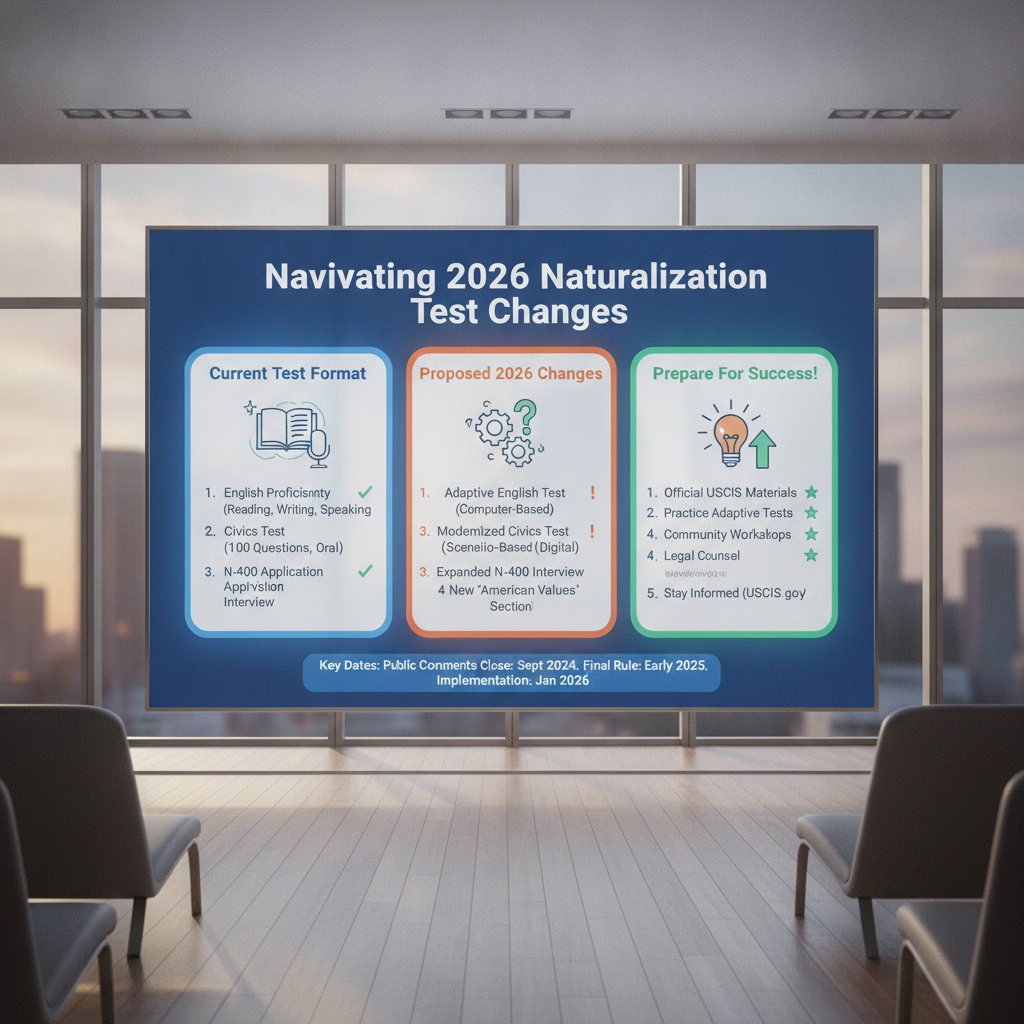
The United States Citizenship and Immigration Services (USCIS) regularly reviews its policies and procedures to ensure they align with current educational best practices and reflect the evolving needs of the nation. Discussions and proposals for changes to the naturalization test often begin years in advance, allowing for public comment, pilot programs, and thorough revisions. The current buzz around "Naturalization Test Changes Coming in 2026" stems from these ongoing efforts. USCIS has been working to introduce a revised civics test that aims to be more standardized, transparent, and reflective of civic knowledge necessary for active participation in American society. While the exact details of every new question or format are still being finalized and rolled out, the general direction points towards updates that will necessitate a fresh approach to preparation for many applicants. These changes are designed to ensure that new citizens possess a foundational understanding of American democracy, its principles, and its history.How it can affect Florida residents
For the diverse immigrant communities throughout Florida, from the bustling streets of Miami to the family-friendly neighborhoods of Orlando and the vibrant communities along the I-4 corridor, these upcoming changes have direct implications. Florida is home to a significant immigrant population, many of whom are on their path to naturalization. * **Preparation Strategies:** Current study materials, primarily focused on the 2008 civics test, may not fully cover the breadth or depth of the new 2026 questions. Applicants will need to adapt their study methods, possibly focusing on new topics or different ways of understanding existing ones. * **Timing of Application:** Depending on when an applicant submits their Form N-400, Application for Naturalization, they might fall under the current test rules or the new 2026 rules. This creates a strategic consideration for those close to meeting their eligibility requirements. * **Local Resources:** Community organizations, adult education centers, and legal aid services in Orlando, Orange County, and across Central Florida that offer naturalization test preparation will need to update their curricula. * **Imigrar’s Role:** As an Orlando-based immigration law firm, Imigrar is uniquely positioned to guide clients through these transitions. We stay abreast of all USCIS updates and tailor our advice to ensure our clients are fully prepared for whatever format the test takes. Our goal is always to "Keep Families Together" by making the naturalization process as smooth and successful as possible.Navigating the New Naturalization Test? Don't face the 2026 changes alone. Our Orlando immigration team is ready to assist. Call +1 786-791-3106 for a free consultation, or message us online. Se Habla Español.
What Naturalization Test Changes Are (and Why They Matter)
The naturalization test is a pivotal step towards becoming a U.S. citizen. It demonstrates an applicant's commitment to understanding the country's foundational principles and language. The upcoming 2026 changes are not merely administrative tweaks; they represent a significant update to how future citizens will be assessed on their knowledge of American civic life.A plain-English definition
At its core, **Naturalization** is the process by which a foreign citizen or national can become a U.S. citizen. The **Naturalization Test** is a required component of this process for most applicants. It consists of two main parts: an English test and a civics test. * **English Test:** This evaluates an applicant's ability to read, write, and speak basic English. The interviewing officer will assess your ability to understand and respond to questions in English, and you'll be asked to read and write simple sentences. * **Civics Test:** This assesses your knowledge of U.S. history and government. Currently, applicants are asked up to 10 questions from a list of 100 civics questions, and they must answer 6 correctly to pass. The "changes coming in 2026" specifically refer to updates to the **Civics Test** and potentially the method of evaluating English proficiency. These updates are expected to introduce new questions, possibly alter the format of questions, and aim for a more comprehensive assessment of civic knowledge. The goal is to ensure that new citizens have a deeper, more practical understanding of how the U.S. government functions and the rights and responsibilities of citizenship.Key terms you need to know
Understanding the terminology associated with naturalization is crucial for navigating the process effectively. * **Naturalization (N-400):** The process of becoming a U.S. citizen for those born outside the U.S. It involves filing Form N-400, Application for Naturalization, and meeting specific eligibility requirements. * **USCIS:** The **U.S. Citizenship and Immigration Services** is the government agency responsible for overseeing lawful immigration to the United States. They administer the naturalization process and the test. You'll interact with USCIS extensively throughout your journey. * **Green Card Holder (Lawful Permanent Resident):** An individual who has been granted authorization to live and work permanently in the United States. Holding a Green Card is a prerequisite for most naturalization applicants. * **Continuous Residence:** A requirement for naturalization, meaning you must have maintained your residence in the U.S. for a specific period (usually 3 or 5 years) prior to applying. * **Physical Presence:** The actual time you have spent physically within the United States during your continuous residence period. * **Good Moral Character:** A crucial eligibility factor, meaning you must demonstrate a history of honesty, integrity, and adherence to the law. Certain criminal offenses or other issues can disqualify an applicant. * **Oath of Allegiance:** The final step in the naturalization process, where new citizens formally pledge loyalty to the United States. * **Civics Test:** The portion of the naturalization test that assesses knowledge of U.S. history and government. This is the primary focus of the 2026 changes. * **English Test:** The portion of the naturalization test that assesses reading, writing, and speaking ability in English. These terms are not just bureaucratic jargon; they represent the fundamental requirements and stages you will encounter. Familiarizing yourself with them will empower you to understand the process and prepare more effectively, especially as the 2026 changes take effect.Current Immigration Law: The Foundation of Naturalization
While the naturalization test is undergoing changes, the underlying federal immigration laws that govern eligibility for U.S. citizenship remain largely consistent. These laws are primarily found in the **Immigration and Nationality Act (INA)**, specifically Section 316 and subsequent sections, which outline the general requirements for naturalization. Understanding this legal framework is the first step in any naturalization journey.Federal requirements
To be eligible for naturalization under current federal law, most applicants must meet several key criteria. These requirements are consistently applied by **USCIS** nationwide. * **Age:** Be at least 18 years old at the time of filing Form N-400. * **Lawful Permanent Resident Status:** Have been a lawful permanent resident (Green Card holder) for at least 5 years. This period can be reduced to 3 years if you are married to a U.S. citizen and meet other specific criteria. * **Continuous Residence and Physical Presence:** * You must have resided continuously in the U.S. as a Green Card holder for at least 5 years (or 3 years if married to a U.S. citizen) immediately preceding the date you file Form N-400. * You must have been physically present in the U.S. for at least half of that 5-year (or 3-year) period. * You must have resided for at least 3 months in the state or USCIS district where you file your application (e.g., Orlando, Florida). * **Good Moral Character:** Demonstrate a history of good moral character for the statutory period (5 or 3 years) leading up to your application and until you take the Oath of Allegiance. This includes abiding by U.S. laws, paying taxes, and not engaging in certain criminal activities. * **Attachment to the Principles of the U.S. Constitution:** Be willing to support and defend the U.S. Constitution. * **English Language Proficiency:** Be able to read, write, and speak basic English. There are certain exemptions for age and length of U.S. residency. * **Knowledge of U.S. History and Government (Civics):** Pass the civics test, demonstrating knowledge and understanding of U.S. history and government. This is the area directly impacted by the 2026 changes. For comprehensive details on these requirements and potential exemptions, always refer to the USCIS official website.Florida-specific considerations
While naturalization is a federal process and the eligibility requirements are uniform across the United States, there are practical considerations for applicants residing in Florida, particularly in the Orlando area. * **USCIS Field Office:** If you reside in Orlando or Central Florida, your naturalization interview will typically be conducted at the **Orlando USCIS Field Office**. Familiarity with this office's procedures and local appointment scheduling can be beneficial. * **Local Resources:** Florida offers numerous community organizations, adult education programs, and non-profit groups that provide free or low-cost naturalization test preparation classes and assistance with the application process. In Orlando and Orange County, these resources can be invaluable, especially as new study materials become available for the 2026 test changes. * **Legal Expertise:** Given Florida's large immigrant population, there is a robust network of immigration legal services. Firms like Imigrar, based in Orlando, specialize in guiding clients through the complexities of federal immigration law, including naturalization, and are prepared to address the specific needs of Florida residents. * **Demographic Nuances:** The diverse demographics of Florida mean that applicants come from various linguistic and cultural backgrounds. Our firm, Imigrar, offers services in both English and Spanish (Se Habla Español) to ensure clear communication and support for all our clients. **Important:** While Florida does not have its own specific naturalization laws, understanding the local context and available resources can significantly ease the application process. The changes to the civics test in 2026 will apply uniformly across all USCIS field offices, including the one serving Orlando and the wider I-4 corridor.Considering Naturalization in Florida? Get expert guidance on eligibility and the upcoming test changes. Call Imigrar at +1 786-791-3106 for a free consultation, or message us online. Se Habla Español.
How to Prepare for Naturalization: A Complete Step-by-Step Guide
The path to U.S. citizenship through naturalization involves several distinct stages, each requiring careful attention to detail and adherence to USCIS guidelines. With the 2026 naturalization test changes on the horizon, proactive preparation is more important than ever. This guide outlines the essential steps for applicants, keeping the upcoming changes in mind.1) Determine Eligibility & Gather Documents
Before you even touch Form N-400, confirm you meet all the basic naturalization requirements. This initial assessment is critical to avoid wasted time and fees. * **Review Eligibility:** Check your age, Green Card holder status, continuous residence, and physical presence. For example, have you been a lawful permanent resident for the required 3 or 5 years? Have you been physically present in the U.S. for at least half of that time? Have you resided in Florida for at least 3 months? * **Assess Good Moral Character:** Reflect on your past. Any arrests, convictions, or other legal issues must be fully disclosed. It’s better to consult with an attorney like Imigrar early if you have any concerns about your good moral character. * **Start Gathering Documents:** Begin compiling everything you’ll need. * **Required Documents:** * Your Green Card (front and back) * Marriage certificate (if applying under the 3-year rule) * Divorce decrees or death certificates for prior spouses (if applicable) * Birth certificates of children (if applicable) * Selective Service registration number (for males aged 18-26) * Travel records (dates of all trips outside the U.S. since becoming a Green Card holder) * Certified court dispositions for any arrests or citations, even if charges were dismissed * Tax returns for the past 5 years (or 3 years if applicable) * Proof of payment of child support/alimony (if applicable) * Any USCIS correspondence or notices * Two passport-style photos2) Complete and File Form N-400, Application for Naturalization
The Form N-400 is the core of your application. It’s a lengthy and detailed form that requires accurate and complete information. * **Fill Out Form N-400:** Complete the form meticulously. Answer every question truthfully and to the best of your knowledge. Double-check for any typos or omissions. * **Attach Required Documents:** Include copies of all supporting documents gathered in Step 1. Do not send original documents unless specifically requested by USCIS. * **Pay the Filing Fee:** As of late 2026, the filing fee for Form N-400 is subject to change, so always check the USCIS Forms page for the most current fee schedule. Fee waivers are available for eligible low-income applicants. * **Mail Your Application:** Send your completed Form N-400 and supporting documents to the correct USCIS lockbox facility. The address depends on your state of residence. For Florida residents, check the USCIS website for the specific mailing address. * **Reminder:** Keep a complete copy of your entire application package for your records.3) Attend Biometrics Appointment
After USCIS accepts your application, they will send you an appointment notice for biometrics collection. * **Receive Appointment Notice:** USCIS will mail you Form I-797C, Notice of Action, with the date, time, and location of your biometrics appointment. This typically occurs a few weeks after filing. * **Attend Appointment:** Go to the designated Application Support Center (ASC) on the scheduled date. For Central Florida residents, this will likely be an ASC near Orlando. Your fingerprints, photograph, and signature will be collected. This data is used for background checks. * **Important:** Bring the appointment notice and a valid photo ID (like your Green Card or driver's license).4) Prepare for the Naturalization Interview (Focus on Test Changes)
This is where the 2026 test changes become highly relevant. Your preparation strategy must adapt to the new civics test content. * **English Test Preparation:** Practice speaking, reading, and writing English. The USCIS officer will assess your ability to communicate during the interview, and you’ll be asked to read and write simple sentences. * **Civics Test Preparation (2026 Changes):** This is the most crucial aspect of preparation given the upcoming changes. * **Stay Updated:** Regularly check the USCIS official website for the latest study materials for the 2026 civics test. USCIS will release the official list of questions and study guides. * **Focus on Concepts:** The new test may move beyond rote memorization, emphasizing understanding of key concepts, historical events, and governmental functions. * **Practice:** Utilize practice tests and study groups. Many community centers in Orlando and online resources will update their materials as the new test is implemented. * **Understand Your Application:** Be ready to answer questions about your Form N-400 and the information you provided. The officer will verify all details.5) Attend the Interview
This is the heart of the naturalization process, where you demonstrate your eligibility and knowledge. * **Receive Interview Notice:** USCIS will send Form I-797C, Notice of Action, with your interview date, time, and location (e.g., the Orlando USCIS Field Office). * **Gather All Original Documents:** Bring all original documents you submitted copies of with your Form N-400, plus any updated information (e.g., new passport, updated travel history, new marriage certificate). * **Attend the Interview:** Arrive early. The USCIS officer will: * Review your application (Form N-400). * Ask questions about your personal history, travel, good moral character, and other details. * Administer the English test (reading, writing, speaking). * Administer the civics test (using the 2026 questions if your interview date falls under the new rules). * **Warning:** Answer truthfully and clearly. If you don’t understand a question, ask the officer to repeat or rephrase it.6) Receive a Decision & Attend Oath Ceremony
The final steps confirm your new status as a U.S. citizen. * **Receive Decision:** After the interview, the officer will typically give you a decision: * **Approved:** You pass, and your application is recommended for approval. You'll receive a notice for your Oath of Allegiance ceremony. * **Continued:** You may need to provide additional documents or re-take a portion of the test (e.g., if you failed the civics test). * **Denied:** Your application is not approved. If this happens, consult with an immigration attorney immediately. * **Attend Oath Ceremony:** This is the final and celebratory step. You will receive Form N-445, Notice of Naturalization Oath Ceremony. * **Important:** Bring your Green Card and the Form N-445 to the ceremony. You will surrender your Green Card at this time. * You will take the **Oath of Allegiance** and receive your **Certificate of Naturalization**. This certificate is proof of your U.S. citizenship. **Congratulations!** Once you have your Certificate of Naturalization, you are officially a U.S. citizen. You can then apply for a U.S. passport and register to vote.Practical Steps You Can Take Today
Even with the 2026 changes looming, there are immediate, actionable steps you can take to strengthen your naturalization application and prepare for the updated test. Proactive planning is key to a smooth process. * **Actionable Checklist:** 1. **Review Your Green Card Status:** Confirm you meet the 3 or 5-year residency requirement. Mark your eligibility date on a calendar. 2. **Assess Your Good Moral Character:** Be honest about your legal history. If you have any past arrests or convictions, no matter how minor, consult an attorney to understand their impact. 3. **Start English Practice:** Regardless of the civics test changes, basic English proficiency remains crucial. Read English newspapers, watch English news, and practice speaking with native speakers. 4. **Begin Civics Study (Current & Future):** Start studying the current 100 civics questions. This builds a foundational understanding that will likely be relevant to the 2026 changes. As USCIS releases new materials for 2026, transition your focus to those. Check the USCIS official website regularly for updates. 5. **Organize Your Documents:** Create a dedicated folder for all your immigration documents. Ensure your Green Card, passports, and any court documents are easily accessible. 6. **Track Your Travel:** Maintain an accurate log of all trips outside the U.S. since becoming a Green Card holder, including departure and return dates. This is critical for meeting physical presence requirements. 7. **Consult with Imigrar:** Schedule a free consultation with our Orlando team to discuss your specific situation and get personalized advice on navigating the naturalization process, especially with the 2026 changes. * **Document Preparation Guidance:** * **Make Copies:** Always make multiple copies of every document you submit. Keep one set for your records and one to bring to your interview. * **Certified Translations:** If any document is not in English, you must provide a certified English translation. * **Originals for Interview:** While you submit copies with your application, you **must** bring all original documents to your interview for the officer to review. * **Financial Records:** Have proof of tax filings for the last 5 years (or 3 years if applicable). USCIS may ask for this to confirm good moral character. * **Timeline Expectations:** * **Application Processing:** USCIS processing times for Form N-400 can vary significantly, ranging from several months to over a year. You can check current processing times on the USCIS Processing Times page. * **2026 Test Implementation:** The changes are expected to be fully implemented throughout 2026. If you file your application now, your interview might fall under the new rules depending on processing speed. It's prudent to prepare for the new test if you anticipate your interview happening in late 2026 or beyond. * **Biometrics and Interview:** After filing, expect a biometrics appointment within 1-2 months, followed by an interview notice several months later. * **Oath Ceremony:** If approved, the Oath of Allegiance ceremony usually takes place a few weeks to a few months after your interview. * **Warning:** Don't delay your application if you are eligible. The sooner you apply, the sooner you can become a citizen. However, be prepared for the 2026 test changes if your interview falls within that timeframe.How Imigrar Helps Immigrants in Orlando Navigate Naturalization
At Imigrar, we understand that the journey to U.S. citizenship is one of the most significant steps an immigrant can take. It’s a process filled with legal complexities, extensive paperwork, and, with the upcoming 2026 test changes, new learning challenges. Our mission, "Keep Families Together," drives us to provide exceptional legal support and compassionate guidance to immigrants in Orlando, Central Florida, and across the nation.Our experience and expertise
Our team of dedicated immigration attorneys possesses extensive experience in naturalization cases. We have successfully guided countless individuals and families through every stage of the process, from initial eligibility assessments to preparing for interviews and attending oath ceremonies. * **Up-to-Date Knowledge:** We are relentlessly committed to staying current with all USCIS policies, regulations, and procedural updates, including the latest information on the 2026 Naturalization Test changes. This ensures that our advice is always accurate and our clients are never caught off guard. * **Personalized Strategy:** We don't believe in a one-size-fits-all approach. Each client's situation is unique, and we tailor our legal strategies to address your specific circumstances, challenges, and goals. Whether you have complex travel history, prior legal issues, or questions about the new civics test, we provide clear, actionable advice. * **Comprehensive Support:** From meticulously preparing your Form N-400 and compiling all necessary supporting documents to preparing you for your interview at the Orlando USCIS Field Office, we handle every detail. We provide mock interviews, review potential civics questions, and ensure you feel confident and ready. * **Local Insight:** As an Orlando-based firm, we are familiar with the specific nuances of the local USCIS field office and the resources available to immigrants in Orange County and the wider Central Florida region.Free consultation offer
We believe that everyone deserves access to expert legal advice, especially when facing life-changing immigration decisions. That's why Imigrar offers a **free consultation** to all prospective clients. During this consultation, you can: * Discuss your eligibility for naturalization. * Understand the potential impact of the 2026 Naturalization Test changes on your case. * Ask questions about the application process, required documents, and timelines. * Learn how Imigrar can specifically assist you in achieving your citizenship goals. We are here to demystify the legal process and provide the clarity and confidence you need. Don't let the upcoming changes deter you from pursuing your dream of U.S. citizenship.Ready to become a U.S. Citizen? Imigrar is here to guide you through every step, including the 2026 test changes. Call +1 786-791-3106 for your free consultation today! Se Habla Español.

Frequently Asked Questions About Naturalization and the 2026 Test Changes
Q: Who is exempt from the English or civics test?
A: Certain applicants may be exempt from the English language requirement or receive special accommodations for the civics test. Generally, these exemptions are based on age and length of time as a lawful permanent resident. For example, applicants who are 50 years old or older and have lived in the U.S. as a Green Card holder for at least 20 years (the "50/20" rule), or those 55 years old or older with 15 years of residency (the "55/15" rule), are exempt from the English test. Those 65 years old or older with 20 years of residency (the "65/20" rule) can take a simpler version of the civics test. Additionally, individuals with certain medical disabilities may be exempt from both tests, provided they submit Form N-
Related Topics
Need Legal Assistance?
Our experienced immigration attorneys are here to help with your case. Contact Imigrar today for a free consultation and let us guide you through the legal process with confidence.
📍 Orlando, Florida • Serving clients nationwide
📧 info@imigrar.com