
Mastering Your Green Card Interview: A Comprehensive Guide for
Unlock the secrets to a successful Green Card interview with Imigrar's expert guide. Learn how to prepare, what to expect, and avoid common pitfalls for immigrants in Orlando and nationwide. We provide practical advice, timelines, and crucial document checklists to help you keep your family together. Se Habla Español.

For many aspiring immigrants, the Green Card interview represents a pivotal moment – the final hurdle before achieving lawful permanent residency in the United States. It's a process that can feel daunting, filled with anticipation and the need for meticulous preparation. At Imigrar, an immigration law firm based in Orlando, Florida, we understand the stakes involved and are dedicated to guiding individuals and families through every step, ensuring they are well-prepared for this crucial meeting.
The reporting that sparked this guide
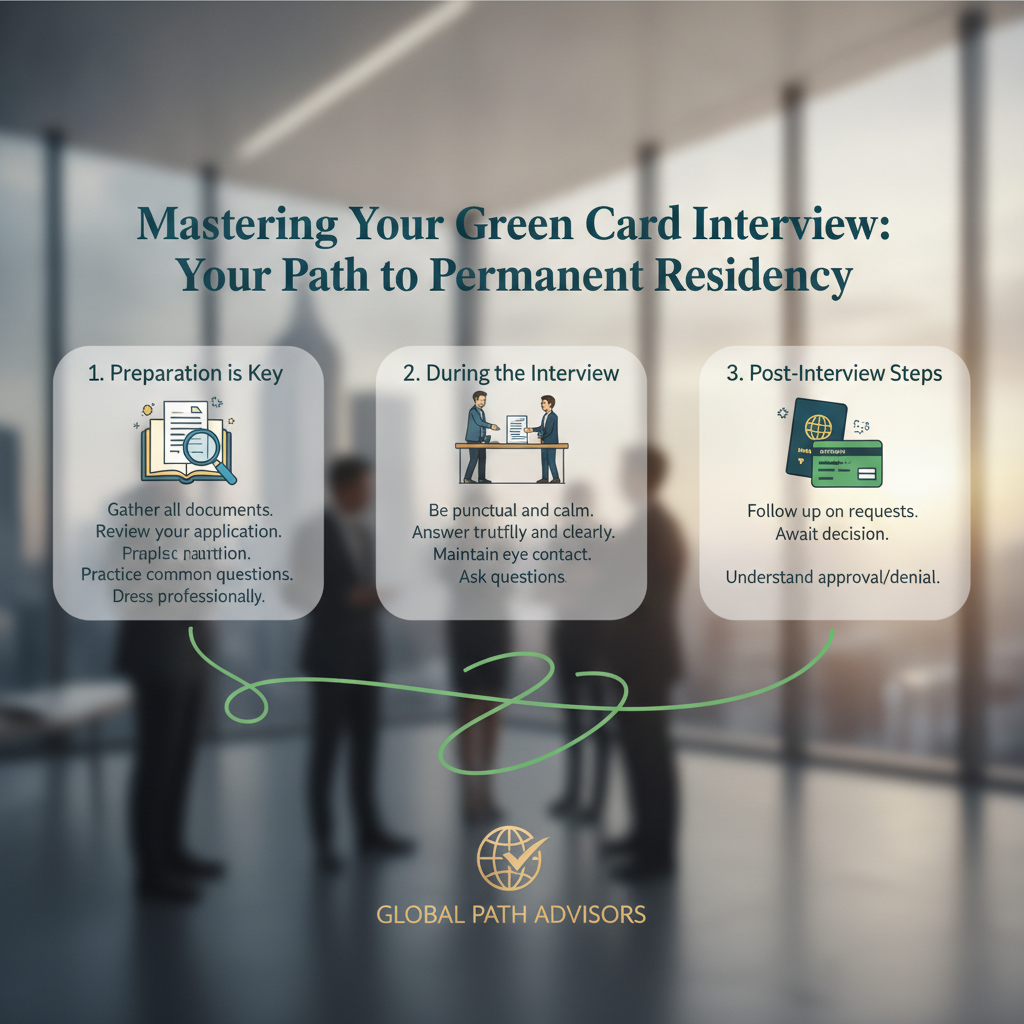
The journey to obtaining a Green Card is complex, and the interview is often the culmination of months, if not years, of diligent application and waiting. News and discussions around Green Card Interview Preparation Tips (Immigration Law) consistently highlight the need for thorough understanding and readiness. This ongoing conversation underscores the fact that while the interview might seem straightforward, it requires careful attention to detail, comprehensive document organization, and a clear understanding of your immigration journey. Our guide aims to demystify this critical stage, providing actionable insights for success.
What This News Means for Immigrants in Orlando and Across Florida
The continuous focus on Green Card interview preparation is not just a passing trend; it reflects the enduring importance of this final step in the immigration process. For immigrants in Orlando, across Florida, and indeed nationwide, understanding how to approach this interview can significantly impact the outcome of their Green Card application.
Why this news is showing up now
The emphasis on Green Card interview preparation is a constant in immigration law for several key reasons:
- Increased Scrutiny: Immigration authorities, particularly USCIS (U.S. Citizenship and Immigration Services), continue to exercise thorough scrutiny in all Green Card applications. This includes ensuring the applicant meets all eligibility criteria, that the relationship (if family-based) is genuine, and that there are no grounds of inadmissibility.
- Evolving Procedures: While core requirements remain, USCIS may periodically update interview procedures, question formats, or document requests. Staying informed about best practices for preparation is always relevant.
- Complexity of Cases: Many Green Card applications involve unique circumstances, requiring applicants to present their case clearly and comprehensively. The interview is the primary opportunity to do so directly.
- High Stakes: For applicants, the Green Card represents stability, family unity, and a path to a new life. The outcome of the interview directly affects these profound personal goals, making preparation paramount.
- Addressing Backlogs: As USCIS works through application backlogs, interviews remain a critical component of their adjudicative process, ensuring each case is individually assessed.
How it can affect Florida residents
For individuals and families residing in Florida, particularly in the Orlando metropolitan area, the importance of interview preparation is acutely relevant. The Orlando USCIS Field Office, located in Orange County, serves a vast number of applicants from Central Florida and beyond. Here’s how this ongoing emphasis can affect you:
- Local Office Procedures: While federal law governs, each USCIS Field Office, including Orlando's, may have slight variations in how interviews are conducted, though the core questions and requirements remain standard. Being prepared for general USCIS standards is key, but local insights can be beneficial.
- Diverse Applicant Pool: Florida is home to a highly diverse immigrant population. This means the Orlando office handles a wide array of Green Card cases, from family-based petitions to employment-based adjustments, each requiring specific preparation strategies.
- Attorney Familiarity: An experienced Orlando immigration attorney is familiar with the local USCIS field office, its processes, and the types of issues that commonly arise for local residents. This local knowledge can be invaluable during preparation.
- Accessibility of Legal Help: With firms like Imigrar located in Orlando, Florida residents have direct access to expert legal counsel who can provide personalized guidance for their Green Card interview.
Ultimately, the news around Green Card interview preparation is a constant reminder: preparation is not optional; it is essential. It’s about more than just showing up; it’s about presenting your case clearly, truthfully, and with all necessary supporting evidence to secure your future in the U.S.
Need Help Preparing for Your Green Card Interview? Don't leave your future to chance. Our Orlando immigration team at Imigrar is ready to assist you with comprehensive preparation. Call +1 786-791-3106 for a free consultation, or message us online. Se Habla Español.
What Green Card Interview Preparation Is (and Why It Matters)
The Green Card interview is a critical step in the process of becoming a Lawful Permanent Resident (LPR) of the United States. It is a formal meeting with a USCIS officer (or a Consular Officer if applying from outside the U.S.) designed to verify the information in your application, confirm your eligibility, and ensure that you are not inadmissible to the United States.
A plain-English definition
Think of the Green Card interview as your opportunity to personally present your case to the U.S. government. It’s where you, sometimes with your sponsoring relative or employer, sit down with an immigration officer to discuss your application, answer questions about your background, your relationship (if applicable), and your intentions for living in the U.S. The officer’s goal is to ensure you meet all legal requirements for a Green Card and that there are no issues that would prevent you from receiving one. It's a conversation to confirm everything submitted in writing is true and accurate.
Key terms you need to know
Navigating the immigration process requires understanding specific terminology. Here are some key terms related to the Green Card interview:
- Green Card: The common name for the Permanent Resident Card, which proves that you are a Lawful Permanent Resident (LPR) of the United States.
- USCIS (U.S. Citizenship and Immigration Services): The government agency responsible for adjudicating immigration petitions and applications, including Green Cards, within the United States.
- Adjustment of Status (AOS): The process of applying for a Green Card while physically present in the United States. The interview for AOS typically takes place at a USCIS Field Office, such as the one in Orlando.
- Consular Processing: The process of applying for a Green Card through a U.S. embassy or consulate in your home country. If you are applying from outside the U.S., your interview will be part of consular processing.
- Interview Notice (Form I-797C): The official document from USCIS or the National Visa Center (NVC) that schedules your interview, specifies the date, time, and location, and lists required documents to bring.
- Sponsor: The U.S. citizen or lawful permanent resident who filed a petition on your behalf (e.g., a relative on Form I-130 or an employer on Form I-140). They may need to attend the interview with you, especially in family-based cases.
- Affidavit of Support (Form I-864): A legally binding document signed by a sponsor to accept financial responsibility for the applicant. This is often a key document reviewed at the interview.
- Medical Examination (Form I-693): A required medical examination conducted by a USCIS-approved civil surgeon to ensure the applicant is not inadmissible on health-related grounds. The sealed results must be brought to the interview if not already submitted.
- Prima Facie Case: This means that on its face, your application appears to meet the basic eligibility requirements. The interview is to confirm this beyond a doubt.
- Inadmissibility: Grounds under U.S. immigration law that can prevent an individual from entering the U.S. or obtaining a Green Card (e.g., certain criminal convictions, health issues, prior immigration violations).
Understanding these terms will empower you to better comprehend the process and what is expected of you during your Green Card journey.
Current Immigration Law: The Foundation
The Green Card interview, and the entire Green Card application process, is governed by the Immigration and Nationality Act (INA), the body of law that dictates immigration policy in the United States. Understanding the legal framework is crucial for a successful application.
Federal requirements
The INA outlines the eligibility categories and requirements for obtaining a Green Card. Key sections of the INA dictate:
- Eligibility Categories: Most Green Cards are issued based on family relationships (INA §201, §203(a)), employment (INA §203(b)), refugee/asylee status (INA §207, §208), or special categories. Each category has specific requirements. For instance, family-based petitions require a qualifying relationship (e.g., U.S. citizen sponsoring a spouse, child, or parent).
- Admissibility Standards: INA §212 lists various grounds of inadmissibility, which are factors that can make an applicant ineligible for a Green Card. These include health-related grounds, criminal grounds, security grounds, public charge grounds, and prior immigration violations. The interview is a key stage where USCIS assesses whether any of these apply to you.
- Good Moral Character: While not explicitly required for all Green Card categories, demonstrating good moral character is often an underlying expectation, especially in cases where discretionary relief might be needed.
- Financial Support: For most family-based Green Cards and some employment-based categories, the sponsor must demonstrate the ability to financially support the applicant, preventing them from becoming a "public charge." This is primarily assessed through Form I-864, Affidavit of Support, which is thoroughly reviewed during the interview.
The primary forms you will interact with under federal law include:
- Form I-130, Petition for Alien Relative: Filed by a U.S. citizen or LPR to establish a qualifying relationship with a foreign national.
- Form I-485, Application to Register Permanent Residence or Adjust Status: The main application filed by an individual seeking a Green Card while present in the U.S. (Adjustment of Status).
- Form I-765, Application for Employment Authorization: Often filed concurrently with Form I-485 to obtain work authorization while the Green Card application is pending.
- Form I-131, Application for Travel Document: Filed concurrently with Form I-485 for advance parole, allowing travel outside the U.S. while the Green Card application is pending.
- Form I-693, Report of Medical Examination and Vaccination Record: The sealed results of your medical exam.
For the most up-to-date forms and instructions, always refer to the USCIS official website, specifically the USCIS Forms page.
Florida-specific considerations
It's important to clarify that immigration law is federal law. There are no "Florida-specific immigration laws" that dictate Green Card eligibility or interview requirements. The rules for obtaining a Green Card are the same whether you apply from Orlando, Florida, or San Francisco, California.
However, what is "Florida-specific" relates to the practicalities of the process:
- Orlando USCIS Field Office: If your case is in Orlando, your interview will be scheduled at the local USCIS Field Office. Familiarity with the office location, parking, and general procedures can ease stress on interview day. The Orlando Field Office serves Central Florida residents, including Orange County, Seminole County, Osceola County, and others along the I-4 corridor.
- Local Legal Expertise: While federal law applies everywhere, an immigration attorney based in Orlando, like those at Imigrar, is intimately familiar with the local USCIS office, its staff, and common practices. They can offer insights into what to expect based on local experience, helping tailor your preparation.
- Community Resources: Florida has a robust network of immigrant communities and support services. Being aware of these local resources can be beneficial during your immigration journey.
Reminder: While the legal framework is federal, the local context of your interview (e.g., the specific USCIS office) is a practical consideration that a local attorney can help you navigate.
Confused by Immigration Law? Our expert attorneys at Imigrar can clarify the legal requirements for your Green Card application and guide you through the interview process. Contact us today for a free consultation at +1 786-791-3106. Se Habla Español.
How to Prepare for Your Green Card Interview: A Complete Step-by-Step Guide
Preparing for your Green Card interview is crucial for a successful outcome. This comprehensive guide breaks down the process into actionable steps, ensuring you are fully ready for your meeting with USCIS.
1) Understand Your Interview Notice
Your journey to interview preparation begins the moment you receive your Form I-797C, Notice of Action, which is your official interview notice. This document is packed with vital information.
- Date, Time, and Location: Carefully note the exact date, time, and the address of the USCIS Field Office where your interview will take place. For Central Florida residents, this will typically be the Orlando USCIS Field Office. Plan your travel well in advance to ensure you arrive punctually.
- Required Documents List: The notice will include a list of documents you MUST bring to the interview. This list is not exhaustive; you should always bring all original documents related to your application, even if not explicitly listed.
- Who Must Attend: For family-based petitions, both the applicant and the petitioner (sponsor) are generally required to attend. For employment-based cases, typically only the applicant attends. Your notice will specify.
Actionable Advice: Read your interview notice multiple times. Highlight key details. If anything is unclear, consult with your attorney immediately.
2) Gather and Organize All Required Documents
This is arguably the most critical step. The USCIS officer will review your original documents and compare them against the copies submitted with your application. A well-organized set of documents demonstrates preparedness and can streamline the interview process.
- Originals and Copies: Bring ALL original documents that you submitted as copies with your application (e.g., birth certificates, marriage certificates, divorce decrees, passports, I-94 records). Also, bring a complete set of photocopies of everything. The officer may keep the copies and return your originals.
- Application Forms: Bring a complete copy of your entire application packet, including Form I-130, Form I-485, Form I-864, Form I-693, and any other forms you submitted. This allows you to refer to them if questioned about specific entries.
- Identity and Travel Documents:
- Valid passport and any expired passports.
- Birth certificate (original and translation if not in English).
- Government-issued photo identification (e.g., driver's license, for both applicant and petitioner).
- Arrival/Departure Record (Form I-94).
- Marriage and Relationship Evidence (Family-Based):
- Original marriage certificate.
- Joint bank statements, utility bills, leases/mortgages, insurance policies (life, health, auto) showing both names.
- Photos together (dating, engagement, wedding, family events, travel).
- Children's birth certificates (if applicable).
- Affidavits from friends/family attesting to the bona fide nature of your relationship.
- Any other evidence proving your relationship is legitimate and ongoing.
- Financial Documents:
- Original Form I-864, Affidavit of Support, signed by the petitioner/sponsor.
- Sponsor's federal income tax returns (most recent 3 years) and W-2s/1099s.
- Proof of sponsor's current employment and income (e.g., recent pay stubs, employment verification letter).
- Bank statements, property deeds, or other asset documentation if relying on assets to meet income requirements.
- Medical Examination: The sealed envelope containing your Form I-693, Report of Medical Examination and Vaccination Record, if you haven't already submitted it. DO NOT open this envelope.
- Police Records/Court Documents: If you have any arrests, citations, or criminal convictions, bring all certified court dispositions, even if the charges were dismissed or expunged.
- Translations: Any document not in English must be accompanied by a certified English translation and a copy of the original document.
Organization Tip: Use a binder with dividers or clearly labeled folders. Arrange documents in the order they appear on your interview notice, or in a logical sequence (e.g., identity, marriage, financial, medical).
3) Review Your Application Forms Thoroughly
The immigration officer will use your submitted application forms (e.g., Form I-130, Form I-485) as the basis for their questions. It is imperative that you know every detail of what you submitted.
- Read Everything: Go through every single page of your application packet. Understand each question and the answer you provided.
- Consistency is Key: Ensure your verbal answers during the interview are consistent with the information on your forms. Any discrepancies, even minor ones, can raise red flags and lead to further questioning or delays.
- Update Information: If any information has changed since you filed your application (e.g., new address, new job, new child, new travel), prepare to inform the officer and bring supporting documentation.
Warning: Never misrepresent facts or provide false information. Doing so can lead to a denial and potentially severe immigration consequences.
4) Prepare for Potential Questions
While no one can predict every question, common themes emerge during Green Card interviews. Preparing for these can significantly boost your confidence.
- General Background: Questions about your name, date of birth, place of birth, parents' names, previous addresses, and employment history.
- Immigration History: When and how you entered the U.S., your visa history, any previous immigration applications, and any travel outside the U.S.
- Relationship (Family-Based):
- How and when you met your spouse/petitioner.
- Details about your wedding (date, location, attendees).
- Daily life together (who cooks, cleans, manages finances, shared activities).
- Petitioner's background (job, family, previous marriages).
- Any previous relationships or marriages for both applicant and petitioner.
- Financial Support: Questions about the petitioner's income, assets, and ability to support you, often directly from Form I-864.
- Inadmissibility: Questions related to criminal history (if any), health issues, prior immigration violations, or public charge concerns.
Actionable Advice: Practice answering questions out loud. Have a trusted friend, family member, or your attorney conduct a mock interview with you.
5) Practice Your Interview
Rehearsal can significantly reduce anxiety and improve your performance during the actual interview.
- Mock Interview: Ask your attorney to conduct a mock interview. They can simulate the experience, ask probing questions, and provide constructive feedback on your answers and demeanor.
- Pace and Clarity: Practice speaking slowly and clearly. Take a moment to understand the question before answering.
- Be Truthful and Direct: Always tell the truth. Answer directly and concisely. Do not volunteer information that wasn't asked, but also don't withhold relevant information.
- Role-Playing with Petitioner: If your petitioner is attending, practice together, especially for family-based questions, to ensure consistency in your stories.
Important: If you do not understand a question, politely ask the officer to repeat or rephrase it. Do not guess or answer a question you don't understand.
6) Attend the Interview Punctually and Professionally
First impressions matter, and your conduct on interview day can set the tone.
- Dress Appropriately: Dress in business casual or professional attire. This shows respect for the process and the officer.
- Arrive Early: Plan to arrive at the Orlando USCIS Field Office at least 30-45 minutes before your scheduled appointment. This allows time for security checks, parking, and finding the correct waiting area.
- Be Polite and Respectful: Maintain a respectful and polite demeanor throughout the interview. Answer all questions honestly and directly.
- Bring an Interpreter (If Needed): If you are not fluent in English, bring a certified interpreter. Your attorney can often serve this role or arrange for one. Do not rely on family members unless specifically allowed by USCIS and noted on your application.
- Your Attorney's Role: Your immigration attorney can attend the interview with you. While they cannot answer questions for you, they can clarify questions, ensure the process is fair, and provide legal counsel if issues arise.
7) What to Expect After the Interview
The interview is not always the final step. Be prepared for several possible outcomes:
- Approval: The officer may approve your application on the spot. You might receive a stamp in your passport as temporary proof of LPR status, and your Green Card will be mailed within a few weeks.
- Request for Evidence (RFE): The officer may issue an RFE if they need additional documents or information to make a decision. You will be given a deadline to submit the requested evidence.
- Continued Case: The officer may continue your case for various reasons, such as needing to consult with a supervisor, conduct further background checks, or waiting for a visa number to become available.
- Denial: Although rare for well-prepared cases, an application can be denied. If this happens, you will receive a written decision explaining the reasons, and you may have options to appeal or refile.
Timeline Expectation: While some cases are approved immediately, others can take weeks or months for a final decision, especially if an RFE is issued or further review is required. You can check your case status online at USCIS Case Status Online and processing times at USCIS Processing Times.

Practical Steps You Can Take Today
Don't wait until the last minute to prepare for your Green Card interview. Here are practical steps you can start taking right now to ensure a smooth process:
Actionable Checklist:
- Consult an Attorney: Schedule a free consultation with an experienced immigration attorney at Imigrar. We can assess your case, identify potential issues, and provide personalized guidance.
- Organize Your Existing Documents: Start gathering all original documents you have. Create a master checklist of everything you submitted with your application and verify you have the originals readily available.
- Request Missing Documents: If you realize you're missing any original documents (e.g., birth certificate, marriage certificate, divorce decrees, criminal records), begin the process of requesting certified copies from the issuing authorities today.
- Review Your Application Packet: Pull out your copy of Form I-130, Form I-485, and all supporting documents. Read through every answer you provided. Make notes of any changes or updates.
- Start Gathering Relationship Evidence (Family-Based): If your Green Card is family-based, begin compiling strong evidence of your bona fide relationship. This includes recent photos, joint financial accounts, shared bills, and letters from friends/family.
- Financial Document Check: Ensure your sponsor has all their latest tax returns, W-2s/1099s, and recent pay stubs ready for Form I-864.
- Medical Exam Status: If you haven't had your medical exam, research USCIS-approved civil surgeons in the Orlando area and schedule your appointment. Ensure the sealed envelope is ready for the interview.
- Plan Your Travel: If your interview notice has arrived, plan your route to the Orlando USCIS Field Office. Consider traffic, parking, and security screening times.
Document Preparation Guidance:
- Binders and Dividers: Invest in a good binder with clear dividers. Label each section (e.g., "Identity," "Marriage Evidence," "Financial," "Medical").
- Originals vs. Copies: Keep originals separate from copies. You'll hand over copies to the officer, but they will want to see (and return) your originals.
- Certified Translations: For any document not in English, you need a full, accurate English translation, certified by the translator as complete and accurate, and that they are competent to translate.
- Organize Chronologically: For documents like bank statements or utility bills, organize them chronologically within their respective sections.
Timeline Expectations:
The Green Card process can be lengthy, and the interview is a significant milestone. Here's a general timeline:
- Application Filing to Interview Notice: This can vary widely depending on the Green Card category, your country of origin, and USCIS processing times
Related Topics
Need Legal Assistance?
Our experienced immigration attorneys are here to help with your case. Contact Imigrar today for a free consultation and let us guide you through the legal process with confidence.
📍 Orlando, Florida • Serving clients nationwide
📧 info@imigrar.com