


Navigating the complex landscape of U.S. immigration law can be challenging, especially when significant changes are introduced. For thousands of skilled professionals and their prospective employers, the annual H-1B visa lottery is a crucial gateway to working in the United States. As we approach the registration period for Fiscal Year 2027 (FY2027), the U.S. Citizenship and Immigration Services (USCIS) has implemented pivotal changes that demand careful attention.
At Imigrar, an immigration law firm based in Orlando, Florida, we are committed to keeping families together and helping skilled individuals achieve their professional dreams in the U.S. These new H-1B lottery rules represent a fundamental shift in how petitions are selected, directly impacting the strategies beneficiaries and employers must adopt. This comprehensive guide will break down these changes, explain their implications, and provide actionable steps to prepare for the upcoming lottery.
The reporting that sparked this guide
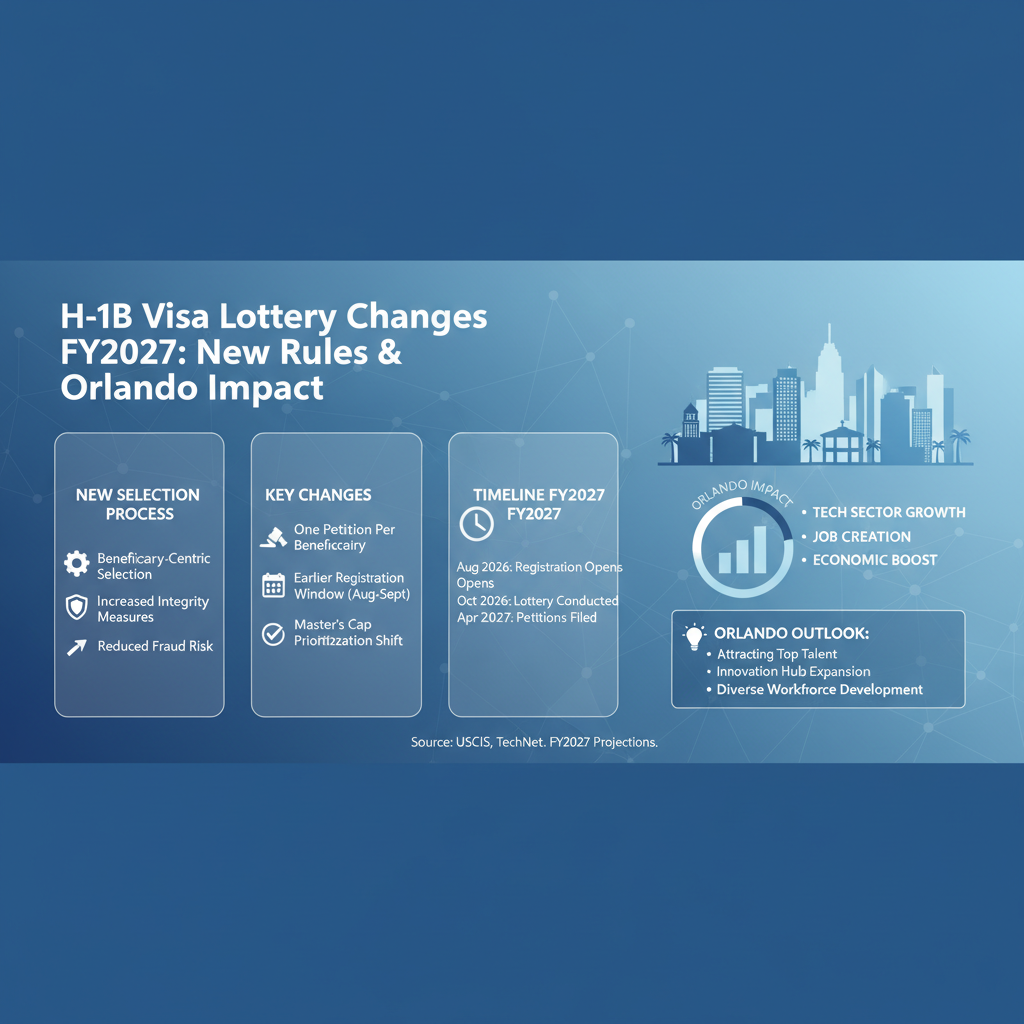
The information and guidance provided in this article are based on recent announcements and policy updates from official sources regarding the H-1B visa program. For the latest developments, we refer to:
H-1B Visa Lottery Changes for FY2027 (Legal News)
What This News Means for Immigrants in Orlando and Across Florida
The **H-1B visa** program is vital for many industries in Florida, from technology and healthcare to tourism and engineering. Orlando, with its burgeoning tech scene, world-class universities, and diverse economy, attracts a significant number of skilled foreign professionals. The new rules for the **FY2027 H-1B lottery** will profoundly impact how these individuals and their prospective employers in Central Florida and beyond approach the application process.
Why this news is showing up now
The **USCIS** typically announces changes to the **H-1B visa lottery** process well in advance of the registration period. With the **FY2027** lottery registration expected to open in March 2026, announcements regarding new rules and procedures are made in late 2025 or early 2026. This lead time allows individuals and employers to understand and adapt to the new requirements, ensuring compliance and maximizing their chances of selection. The current discussions around the **FY2027 H-1B lottery changes** are a continuation and reinforcement of USCIS's efforts to enhance the integrity of the lottery system, particularly by combating fraud related to multiple registrations for the same beneficiary.
How it can affect Florida residents
For individuals residing in Florida on other non-immigrant visas (like F-1 OPT, J-1, or L-1) who hope to transition to **H-1B status**, these changes are critical. The Orlando, Tampa, Miami, and Jacksonville metropolitan areas are hubs for companies that frequently sponsor H-1B visas. The previous system, which allowed multiple employers to register the same beneficiary, inadvertently created a loophole that some exploited to inflate selection chances. The new **beneficiary-centric selection process** aims to level the playing field, giving every eligible individual a fair, single chance at selection, regardless of the number of employers who register them.
For Florida-based employers, particularly those along the **I-4 corridor** or in Orange County's growing tech parks, these changes simplify the registration process by removing the incentive for multiple registrations. However, it places a greater emphasis on ensuring the legitimacy of job offers and the qualifications of the beneficiary. Companies must now focus on the quality of their single registration for each candidate rather than the quantity of registrations.
Need Help? The new H-1B lottery changes can be confusing. Our Orlando immigration team is ready to assist you in understanding these rules and preparing your application. Call +1 786-791-3106 for a free consultation, or message us online. Se Habla Español.
What H-1B Visa Lottery Changes for FY2027 Is (and Why It Matters)
The **H-1B visa** is a non-immigrant visa that allows U.S. employers to temporarily employ foreign workers in **specialty occupations**. These occupations generally require a bachelor's degree or higher in a specific field. Due to high demand, the number of H-1B petitions often exceeds the annual cap set by Congress, necessitating a lottery system to select eligible registrations.
The **FY2027 H-1B visa lottery changes** fundamentally alter the selection mechanism. Historically, the lottery selected registrations based on the employer's submission. If multiple employers registered the same beneficiary, each registration counted as a separate entry, increasing that individual's statistical chance of selection. This system was prone to abuse, with some entities submitting multiple registrations for the same person without genuine job offers, simply to game the system.
The new rule, first introduced for FY2025 and reaffirmed for subsequent fiscal years including **FY2027**, shifts to a **beneficiary-centric selection process**. This means that selection is now based on the unique beneficiary, identified by their valid passport or travel document number. Regardless of how many employers register a particular individual, that individual is entered into the lottery only once. If selected, any of the employers who registered that individual can then file a petition on their behalf.
This change matters immensely because it aims to ensure fairness and reduce fraudulent registrations, giving every eligible beneficiary an equal chance. For genuine employers and qualified foreign professionals, it provides a more equitable and transparent lottery process.
A plain-English definition
Think of the **H-1B visa lottery** like a drawing for a very popular concert ticket. Before, if five different friends (employers) tried to buy a ticket for you (the beneficiary), you'd have five entries, increasing your chances. Now, under the new rules, no matter how many friends try to buy you a ticket, your name (and unique ID) only goes into the drawing ONCE. If your name is drawn, any of those friends can then buy the ticket for you. It's about giving each person one fair shot, not boosting chances through multiple registrations.
Key terms you need to know
- H-1B Visa: A non-immigrant visa for temporary workers in specialty occupations.
- Specialty Occupation: An occupation that requires theoretical and practical application of a body of highly specialized knowledge and a bachelor's or higher degree in the specific specialty (or its equivalent) as a minimum for entry into the occupation in the United States.
- USCIS (U.S. Citizenship and Immigration Services): The government agency that oversees lawful immigration to the United States. USCIS official website
- H-1B Cap: The annual numerical limit on the number of H-1B visas issued. Congress currently sets the annual regular cap at 65,000 and an additional 20,000 for those with a U.S. master's degree or higher (the **Master's Cap**).
- Fiscal Year (FY): The U.S. government's fiscal year runs from October 1 to September 30. The **FY2027** H-1B cap will apply to petitions approved for employment starting October 1, 2026.
- Beneficiary: The foreign national seeking the H-1B visa.
- Registrant/Petitioner: The U.S. employer filing the H-1B registration or petition on behalf of the beneficiary.
- H-1B Registration: The electronic process where employers submit basic information about the company and the prospective H-1B worker during a designated period. Only selected registrations can proceed to file a full H-1B petition.
- Beneficiary-Centric Selection: The new lottery method where selection is based on the unique individual (beneficiary) rather than on the number of registrations submitted on their behalf.
- Form I-129, Petition for a Nonimmigrant Worker: The primary form used by employers to petition for nonimmigrant workers, including H-1B.
- Form I-797, Notice of Action: USCIS uses this form to communicate various actions, including receipt notices, approvals, and denials.
Current Immigration Law: The Foundation
The **H-1B visa** program operates under the authority of the **Immigration and Nationality Act (INA)**, specifically Section 101(a)(15)(H)(i)(b), codified at 8 U.S.C. § 1101(a)(15)(H)(i)(b). Regulations governing the program are found at 8 CFR Part 214.2(h). These laws define the eligibility criteria for both employers and beneficiaries, the annual cap, and the operational framework for the H-1B program.
The recent **H-1B visa lottery changes for FY2027** are implemented through changes to these regulations, specifically addressing the electronic registration process and the selection methodology. The Department of Homeland Security (**DHS**) and **USCIS** have the authority to amend these regulations to ensure program integrity and efficiency.
Federal requirements
To qualify for an H-1B visa, both the employer and the prospective employee must meet specific federal requirements:
- For the Employer (Petitioner):
- Must offer a job in a **specialty occupation**.
- Must pay the H-1B worker at least the prevailing wage for the occupation in the area of intended employment or the actual wage paid to other employees with similar experience and qualifications, whichever is higher.
- Must have an Employer Identification Number (EIN).
- Must attest to certain labor conditions (e.g., wages, working conditions) through a Labor Condition Application (**LCA**, certified by the U.S. Department of Labor).
- For the Employee (Beneficiary):
- Must possess a bachelor's degree or its equivalent, or a license in a specialty occupation field, or work experience equivalent to a bachelor's degree.
- The job offered must be in a **specialty occupation** directly related to the beneficiary's field of study or experience.
- Must hold a valid passport or travel document for the registration process.
The **H-1B cap** is a critical federal requirement. For **FY2027**, the statutory cap remains at 65,000 for the regular category and an additional 20,000 for the **Master's Cap**. The lottery is necessary because demand almost always exceeds these numbers. The new beneficiary-centric selection process directly addresses how these limited cap numbers are allocated fairly.
Florida-specific considerations
While the H-1B visa is a federal program, its impact is felt locally. Florida's economy, particularly in sectors like information technology, aerospace, healthcare, and finance, relies on skilled foreign talent. Many companies in Orlando, Tampa, and Miami regularly sponsor H-1B visas. For individuals in Florida, understanding the local prevailing wage for their occupation is essential, as this directly impacts the employer's wage attestation. Educational institutions like the University of Central Florida (UCF) in Orlando or the University of Florida (UF) are often sources of highly qualified graduates who might seek H-1B sponsorship, especially those with U.S. master's degrees who qualify for the **Master's Cap**.
The **Orlando USCIS Field Office** handles interviews and other in-person services for various immigration matters, though H-1B petitions are generally processed at service centers. Nevertheless, local counsel is invaluable for understanding how national policies apply to your specific situation in Florida.
Important: All H-1B petitions require the use of **Form I-129, Petition for a Nonimmigrant Worker**. If selected in the lottery, this is the primary form that will be filed by the employer. Supporting documentation, including the certified LCA, will accompany it. For status updates and general information, always refer to the USCIS official website.
How to Navigate the H-1B Visa Lottery Changes for FY2027: A Complete Step-by-Step Guide
Preparing for the **FY2027 H-1B lottery** under the new beneficiary-centric rules requires a strategic and meticulous approach. Here's a step-by-step guide for employers and beneficiaries.
1) Understand the New Beneficiary-Centric Selection Process
The most significant change for **FY2027** is that each unique beneficiary, identified by their valid passport or travel document number, will have only one entry in the lottery, regardless of how many employers submit registrations on their behalf. If a beneficiary is selected, any employer that submitted a registration for them can then file the H-1B petition.
- Action for Beneficiaries: Ensure all potential employers have your exact, current passport/travel document information. Do not use an expired or invalid document number.
- Action for Employers: Focus on submitting one accurate registration for each desired beneficiary. The benefit of multiple employers registering the same person is now nullified in terms of increasing selection chances.
- Required Documents/Information for Understanding:
- Beneficiary's valid passport or travel document number.
- Understanding of the latest USCIS guidance on the **H-1B lottery** process.
2) Employer Registration Process (Early March 2026)
The **H-1B registration period** typically opens in early March for approximately two to three weeks. During this time, prospective H-1B employers (registrants) must electronically register each beneficiary for whom they intend to file an H-1B cap-subject petition using the **USCIS online H-1B registrant account**.
- Employer Actions:
- Create or log in to your **USCIS online account**.
- For each beneficiary, provide their full legal name, date of birth, country of birth, country of citizenship, gender, and their valid passport or travel document number.
- Indicate if the beneficiary is eligible for the **Master's Cap** (U.S. master's degree or higher).
- Pay the required H-1B registration fee (historically $10 per beneficiary, but subject to change).
- Submit the registration within the designated window.
- Beneficiary Actions:
- Provide accurate and up-to-date personal information, especially your passport or travel document number, to all employers who plan to register for you.
- Verify with your employer(s) that they have successfully submitted your registration.
- Required Documents/Information for Registration:
- Beneficiary's full legal name, date of birth, country of birth, country of citizenship, gender.
- Beneficiary's valid passport or travel document number.
- Employer's legal name, mailing address, EIN, and authorized signatory's name and title.
- Payment method for the registration fee.
3) Await Lottery Results and If Selected: Prepare the H-1B Petition
After the registration period closes, **USCIS** conducts the random selection process. Results are typically announced by the end of March. If your registration is selected, the employer will receive a selection notice in their **USCIS online account**.
- Employer Actions Upon Selection:
- Upon receiving a selection notice, the employer must then prepare and file a full **Form I-129, Petition for a Nonimmigrant Worker**, along with all supporting documentation, within the filing window specified on the selection notice (typically 90 days).
- Conduct a thorough review of the job offer to ensure it meets **specialty occupation** requirements and prevailing wage standards.
- Obtain a certified Labor Condition Application (**LCA**) from the U.S. Department of Labor. This must be certified before filing **Form I-129**.
- Beneficiary Actions Upon Selection:
- Work closely with your employer and their legal counsel to gather all necessary personal and educational documents.
- Ensure all required evaluations (e.g., foreign degree equivalency) are completed.
- Required Documents/Information for Petition Preparation (Post-Selection):
- Certified LCA (Form ETA 9035).
- Employer's financial statements, tax returns, business license.
- Detailed job description, employer support letter.
- Beneficiary's educational degrees, transcripts, diplomas.
- Foreign degree equivalency evaluation (if applicable).
- Beneficiary's resume/CV.
- Copies of beneficiary's passport, visa, I-94, EAD (if applicable).
- Photographs (passport-style).
4) Filing the H-1B Petition and Fees
The selected employer must mail the complete **Form I-129** package to the correct **USCIS service center** within the designated filing window. The package must include all forms, supporting documents, and required fees.
- Employer Actions:
- Complete **Form I-129** accurately and sign it.
- Assemble all supporting documents, including the LCA, educational credentials, and employer information.
- Include all required filing fees:
- Base filing fee for **Form I-129**.
- ACWIA (American Competitiveness and Workforce Improvement Act) fee (varies based on employer size).
- Fraud Prevention and Detection Fee.
- Public Law 114-113 Fee (for employers with 50+ employees, where 50% are H-1B or L-1).
- Optional: Premium Processing Fee (for expedited processing, if available and desired).
- Mail the complete package via certified mail with tracking.
- Beneficiary Actions:
- Ensure you have provided all requested information and documents to your employer and attorney.
- Keep copies of everything submitted.
- Required Documents/Information for Filing:
- Completed and signed **Form I-129**.
- Certified LCA.
- All supporting documentation from Step 3.
- Checks or money orders for all applicable USCIS fees.
- Copy of the H-1B selection notice.
5) USCIS Processing and Adjudication
Once **USCIS** receives the petition, they will send a receipt notice (**Form I-797C, Notice of Action**). The petition will then be processed. Processing times can vary significantly. You can check estimated processing times on the USCIS Processing Times page.
- Common Outcomes:
- Approval: If approved, **USCIS** will issue an approval notice (**Form I-797A or I-797B**). If the beneficiary is already in the U.S., their status may be changed to H-1B. If outside the U.S., they will need to apply for an H-1B visa stamp at a U.S. consulate abroad.
- Request for Evidence (RFE): **USCIS** may issue an RFE if they need more information or clarification. A timely and comprehensive response is crucial.
- Denial: If denied, **USCIS** will provide reasons. There may be options to appeal or refile, depending on the reason for denial.
- Actions for Both:
- Monitor the case status online using the receipt number.
- Respond promptly and thoroughly to any RFEs with the help of legal counsel.
Warning: The H-1B process is highly competitive and complex. Mistakes can lead to denial. Our experienced immigration attorneys at Imigrar in Orlando can guide you through every step. Call us at +1 786-791-3106 for expert assistance. Se Habla Español.

Practical Steps You Can Take Today
Even though the **FY2027 H-1B lottery** registration is still some months away, proactive preparation is key to success. Here are actionable steps you can take today:
Actionable Checklist:
- Consult with an Immigration Attorney: This is paramount. An experienced attorney can assess your eligibility, advise on the new rules, and help develop a strategy. Imigrar offers free consultations for this purpose.
- Verify Beneficiary Information: Ensure the beneficiary's passport or travel document is valid and will remain valid through the registration period. Any discrepancies can invalidate a registration.
- Employer Readiness Check: Employers should verify their EIN and **USCIS online account** access. Ensure the company meets all H-1B petitioner requirements.
- Document Gathering: Start compiling all necessary personal and educational documents (degrees, transcripts, professional licenses, resume, previous work authorization documents) for the beneficiary. For employers, gather corporate documents, financial statements, and detailed job descriptions.
- Educational Credential Evaluation: If the beneficiary obtained their degree outside the U.S., initiate a foreign degree equivalency evaluation by an accredited service. This takes time.
- Job Offer Review: Ensure the job offered clearly falls under a **specialty occupation** and that the employer is prepared to pay the prevailing wage.
- Stay Informed: Continuously monitor official **USCIS** announcements for any further updates or clarifications regarding the **FY2027 H-1B lottery**.
Document Preparation Guidance:
- Organize Digitally: Scan all documents clearly and organize them into logical folders. This speeds up the process when working with your attorney.
- Translations: Any document not in English must be accompanied by a certified English translation.
- Multiple Copies: Keep original documents safe and provide copies for petitions.
- Accuracy is Paramount: Double-check all dates, names, and numbers. Even a minor error can lead to an RFE or denial.
Timeline Expectations:
- Late 2025/Early 2026: **USCIS** announces specific dates and finalizes rules for the **FY2027 H-1B lottery** registration.
- Early March 2026 (Approx. 2-3 weeks): **H-1B electronic registration period** opens. Employers submit registrations.


