
H-1B Visa Lottery Changes FY2027: Navigating New Rules
Understand the critical H-1B visa lottery changes for FY2027, including the new beneficiary-centric selection process. Imigrar offers expert guidance for immigrants and employers in Orlando and nationwide.

The landscape of U.S. immigration law is constantly evolving, and for those pursuing professional opportunities in the United States, few changes are as impactful as those affecting the H-1B visa program. As we look ahead to the Fiscal Year 2027 (FY2027) H-1B cap season, new rules are set to reshape the lottery process, aiming to enhance fairness and integrity. For many aspiring professionals and the employers who seek their talent, particularly here in vibrant economic hubs like Orlando and across Florida, understanding these updates is paramount.
Need Help? Our Orlando immigration team is ready to assist. Call +1 786-791-3106 for a free consultation, or message us online. Se Habla Español.
NEWS SOURCE REFERENCE SECTION
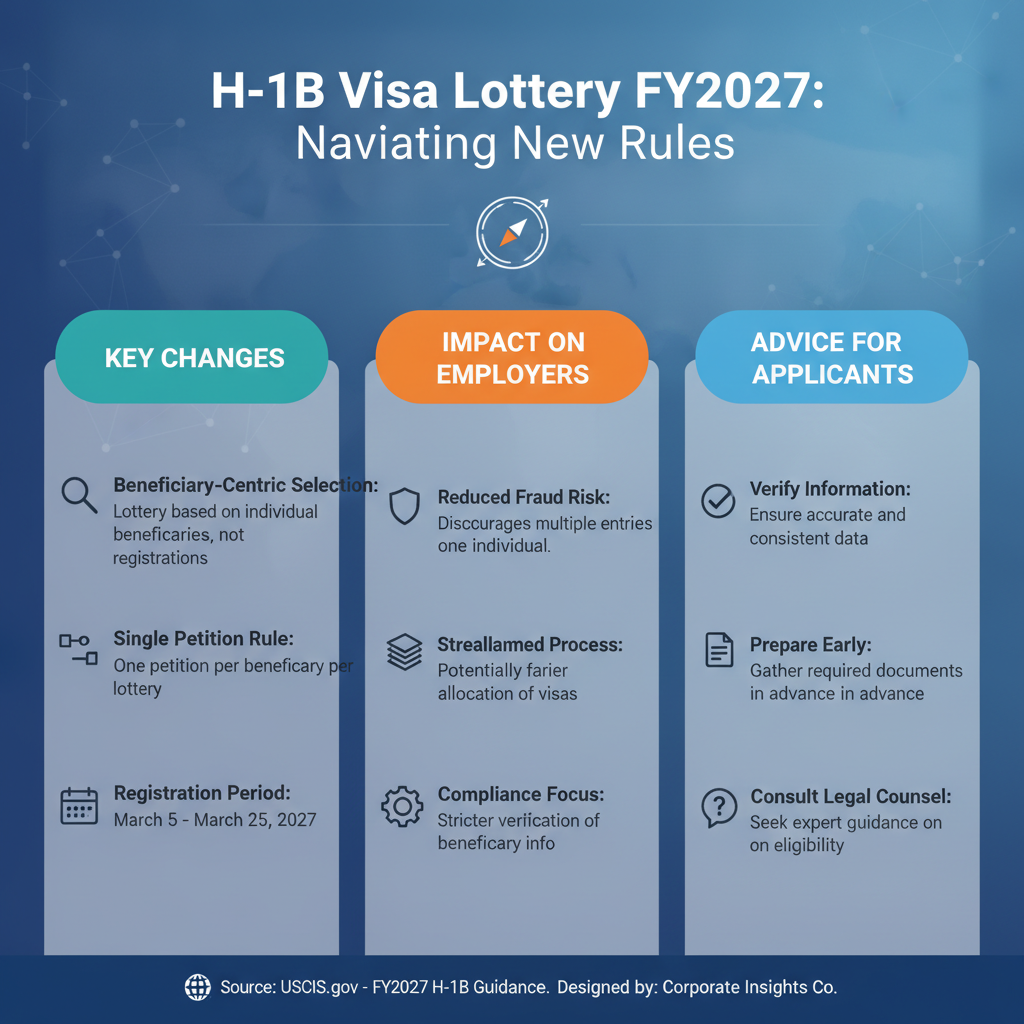
The reporting that sparked this guide: H-1B Visa Lottery Changes for FY2027 (Legal News)
What This News Means for Immigrants in Orlando and Across Florida
The H-1B visa program is a cornerstone of U.S. economic growth, enabling American employers to temporarily employ foreign workers in specialty occupations. These are professions that generally require a bachelor's degree or higher in a specific field, such as IT, engineering, medicine, and education. Florida, with its booming tech sector, robust tourism industry, and growing healthcare and aerospace fields, is a significant destination for H-1B professionals. From the innovative companies along Orlando's I-4 corridor to the research institutions in Gainesville and the financial hubs in Miami, the demand for skilled talent is high.
Why this news is showing up now
The H-1B visa program operates under an annual cap, meaning only a limited number of visas are issued each fiscal year. Currently, this cap is 65,000 for regular H-1B visas and an additional 20,000 for those with a U.S. master's degree or higher. For many years, the demand for H-1B visas has far exceeded the available supply, necessitating a lottery system to select eligible registrations. This high demand, coupled with persistent reports of fraudulent registrations where multiple employers would register the same individual to increase their chances, led to a critical need for reform.
The U.S. Citizenship and Immigration Services (USCIS) and the Department of Homeland Security (DHS) have been working to address these integrity concerns. The new rules for FY2027 are the culmination of these efforts, designed to ensure that each eligible beneficiary has an equal chance in the lottery, regardless of how many potential employers register them. This significant shift aims to create a more equitable and transparent process, benefiting legitimate employers and truly aspiring workers.
How it can affect Florida residents
For individuals currently living in Florida on other nonimmigrant visas (like F-1 OPT, L-1, or TN) who aspire to secure an H-1B visa, these changes are incredibly important. It means a level playing field. If you've been worried that other applicants might have an unfair advantage due to multiple registrations, the new beneficiary-centric selection process directly addresses that concern. Employers in Florida, from startups in Lake Nona's Medical City to established firms in downtown Orlando, will also find a more streamlined and fair process, allowing them to focus on recruiting the best talent without navigating a system susceptible to widespread abuse.
The changes will impact how employers strategize their H-1B filings, emphasizing early identification of talent and meticulous preparation of a single, accurate registration for each desired beneficiary. For students graduating from Florida universities like UCF, UF, or FIU, the new rules mean that their pursuit of an H-1B sponsorship will be based on their qualifications and a fair lottery, rather than the number of registrations submitted on their behalf. This promotes integrity and ensures that the H-1B program continues to serve its intended purpose: bringing highly skilled workers to meet U.S. economic needs.
What H-1B Visa Lottery Changes for FY2027 Is (and Why It Matters)
The H-1B visa is a nonimmigrant visa that allows U.S. employers to temporarily employ foreign workers in specialty occupations. These occupations generally require a bachelor's degree or higher in a specific field, or its equivalent. The visa program is crucial for American businesses that need to fill positions requiring specialized knowledge or skills that cannot be readily found in the U.S. labor market. However, due to the annual cap on H-1B visas, a lottery system has been necessary for many years to allocate the available visas among the overwhelming number of petitions.
A plain-English definition
The "H-1B Visa Lottery Changes for FY2027" refers to new regulations implemented by USCIS that fundamentally alter how the H-1B lottery is conducted. The most significant change is the shift from a "registration-centric" selection to a "beneficiary-centric" selection. In simple terms, this means that instead of allowing multiple employers to register the same individual (beneficiary) for the lottery, potentially giving that individual several "tickets" in the drawing, the new rule ensures that each unique individual beneficiary is entered into the lottery only once, regardless of how many employers wish to sponsor them. If a beneficiary is selected, all employers who registered that individual will be notified and can then proceed with filing a petition on their behalf.
This change is designed to combat fraud and abuse, where some registrants or employers would collude to submit multiple registrations for the same individual, artificially inflating their chances of selection. By focusing on the unique beneficiary, USCIS aims to restore fairness, increase the integrity of the lottery process, and ensure that all eligible individuals have an equal opportunity at selection.
Key terms you need to know
- H-1B Cap: The annual limit on the number of H-1B visas issued. It's currently 65,000 for the regular cap and an additional 20,000 for the U.S. master's cap.
- Cap-Subject: An H-1B petition that is subject to the annual numerical limits. Most H-1B petitions fall into this category.
- Cap-Exempt: Certain H-1B petitions are exempt from the annual cap, such as those filed by institutions of higher education, non-profit organizations affiliated with higher education, or non-profit research organizations.
- Beneficiary: The foreign national worker who is seeking the H-1B visa.
- Petitioner: The U.S. employer who is sponsoring the foreign national for the H-1B visa.
- Registration Period: The specific window of time (typically in March) during which employers must electronically register their prospective H-1B beneficiaries with USCIS.
- Selection Notice: The notification from USCIS to a petitioner indicating that their beneficiary's registration has been selected in the H-1B lottery.
- DHS (Department of Homeland Security): The federal department responsible for immigration enforcement and services, including USCIS.
- USCIS (U.S. Citizenship and Immigration Services): The agency within DHS responsible for administering the country's lawful immigration system. USCIS official website
- FY2027 (Fiscal Year 2027): The U.S. government's fiscal year runs from October 1st to September 30th. H-1B visas for FY2027 will become available starting October 1, 2027. The lottery for FY2027 typically occurs in March 2027.
- Beneficiary-Centric Selection: The new rule for the H-1B lottery where selections are based on unique beneficiaries, identified by their passport or travel document number, rather than by individual registrations. This prevents multiple registrations for the same person from increasing their lottery odds.
Need Help? Our Orlando immigration team is ready to assist. Call +1 786-791-3106 for a free consultation, or message us online. Se Habla Español.
Current Immigration Law: The Foundation
The H-1B visa program is governed primarily by the Immigration and Nationality Act (INA), specifically sections related to nonimmigrant workers. Key statutory provisions include INA § 101(a)(15)(H)(i)(b), which defines the H-1B nonimmigrant classification, and INA § 214(g), which establishes the annual numerical cap. Regulations further detailing the H-1B program are found in 8 CFR Part 214.2(h). These laws and regulations outline the eligibility criteria for both employers and beneficiaries, the application process, and the terms of stay.
Federal requirements
To qualify for an H-1B visa, both the employer (petitioner) and the foreign worker (beneficiary) must meet specific federal requirements:
- Specialty Occupation: The job must qualify as a specialty occupation, meaning it requires theoretical and practical application of a body of highly specialized knowledge, and a bachelor's or higher degree in the specific specialty (or its equivalent) as a minimum for entry into the occupation.
- Beneficiary Qualifications: The beneficiary must meet the educational and/or licensure requirements of the specialty occupation. This typically means holding a U.S. bachelor's or higher degree, a foreign equivalent degree, or a state license in a specialty occupation field, or having work experience equivalent to a bachelor's degree.
- Employer-Employee Relationship: A valid employer-employee relationship must exist between the petitioner and the beneficiary, as defined by USCIS. The employer must have the right to control the beneficiary's work.
- Prevailing Wage: The employer must agree to pay the beneficiary at least the actual wage paid to other employees with similar experience and qualifications, or the prevailing wage for the occupation in the area of intended employment, whichever is higher. This is certified through a Labor Condition Application (LCA) with the Department of Labor.
- Annual Cap: As mentioned, most H-1B petitions are subject to the annual cap of 65,000 visas, plus 20,000 for those with a U.S. master's degree or higher. Petitions for cap-exempt employers (e.g., universities) are not subject to the lottery.
The primary USCIS form for the H-1B petition is Form I-129, Petition for a Nonimmigrant Worker. This form is filed by the employer after a successful selection in the H-1B lottery.
For more detailed information on H-1B requirements, always refer to the USCIS official website.
Florida-specific considerations
While H-1B is a federal program, its impact and application are deeply felt at the local level. Florida's economy is diverse and growing, with key sectors relying heavily on skilled foreign talent:
- Technology: Cities like Orlando, Tampa, and Miami are burgeoning tech hubs, attracting software developers, data scientists, and IT professionals.
- Healthcare: Florida's large and aging population drives demand for doctors, nurses, and medical researchers in specialty fields.
- Aerospace and Defense: The Space Coast and defense contractors throughout the state seek engineers and scientists.
- Hospitality Management: Orlando, as a global tourism destination, has a unique demand for highly specialized management roles in large hotel chains and theme parks that may qualify as specialty occupations.
For Central Florida residents, the Orlando USCIS Field Office may handle certain follow-up processes, though the initial H-1B petitions are processed at USCIS service centers. Employers in Orange County, Seminole County, and Osceola County often sponsor H-1B workers to fill critical roles in their growing businesses. Understanding the local economic landscape can help both employers and beneficiaries identify suitable opportunities and ensure compliance with prevailing wage requirements specific to Florida's metropolitan statistical areas.
How to Navigate the New H-1B Visa Lottery Process: A Complete Step-by-Step Guide
The new beneficiary-centric selection process for the FY2027 H-1B lottery introduces a critical change that impacts how employers and prospective beneficiaries approach the registration phase. This guide provides a detailed walkthrough of the updated process.
1) Understanding the New Beneficiary-Centric Selection Rule
This is the most significant change. USCIS will now select registrations based on the unique beneficiary, not on the number of registrations submitted on their behalf. This means:
- One Entry Per Beneficiary: Regardless of how many different employers submit a registration for the same individual, that individual will only be entered into the lottery draw once.
- Identification by Passport/Travel Document: USCIS will use the beneficiary's valid passport or other travel document number (e.g., a national identity card if no passport) to identify unique individuals. It is absolutely critical that this number is accurate and current.
- Selection Notification to All Registrants: If a beneficiary is selected, USCIS will notify ALL employers who submitted a registration for that selected beneficiary. All eligible petitioners can then proceed to file an H-1B petition for that individual.
Important: This change is intended to prevent fraud and ensure fairness. Any attempts to circumvent this rule, such as using different document numbers for the same person, could result in denial or even legal consequences.
2) Employer Registration and Account Setup
The process begins with the prospective employer. If you are an employer, or if you are a beneficiary working with an employer, ensure they have the necessary USCIS online account.
- Create/Access USCIS Online Account: Employers (or their authorized representatives/attorneys) must have a "registrant" account on the USCIS online portal. If they don't have one, they must create it well in advance of the registration period.
- Confirm Account Type: Ensure the account is set up for H-1B registration. Attorneys will typically have a separate account type that allows them to manage multiple client registrations.
Required Information for Account Setup: Employer EIN, contact information, business address.
3) Submitting the H-1B Registration
This step occurs during the designated annual H-1B electronic registration period, typically in March for the fiscal year starting October 1st. For FY2027, this will likely be in March 2027.
- Gather Beneficiary Information: The employer must collect specific, accurate information about the beneficiary:
- Full legal name (as on passport/travel document)
- Date of birth
- Country of birth
- Country of citizenship
- Gender
- Valid passport or travel document number (CRITICAL for new rule)
- Whether the beneficiary has a U.S. master's degree or higher (for master's cap eligibility)
- Employer Information: The employer's legal name, Federal Employer Identification Number (EIN), address, and contact information.
- Pay Registration Fee: A non-refundable fee (currently $10, but subject to change) must be paid for each registration submitted.
- Submit Registration: The employer submits the electronic registration through their USCIS online account within the specified registration window.
Warning: Ensure all information, especially the passport/travel document number, is correct. An error could invalidate the registration or cause issues later.
4) Lottery Selection and Notification
After the registration period closes, USCIS conducts the lottery. For FY2027, this will likely be by the end of March 2027.
- Random Selection: USCIS conducts a random selection process from the unique beneficiaries registered. The master's cap lottery is typically run first, followed by the regular cap lottery.
- Notification: USCIS will notify petitioners of the selection results through their online accounts.
- Selection Notice: If a beneficiary is selected, all employers who registered that beneficiary will receive a selection notice. This notice will include instructions on where and when to file the H-1B petition.
- Non-Selection Notice: If a beneficiary is not selected, petitioners will receive a non-selection notice.
USCIS Processing Times can give an idea of how long notifications might take, but lottery results are usually prompt.
5) Filing the H-1B Petition (Form I-129)
Only employers whose registrations have been selected may proceed to this step. The filing window is typically 90 days from the date of the selection notice.
- Prepare and File Form I-129: The employer files Form I-129, Petition for a Nonimmigrant Worker, along with all supporting documentation and required fees.
- Required Documents for Form I-129 (examples):
- Certified Labor Condition Application (LCA) from the Department of Labor.
- Beneficiary's educational documents (degrees, transcripts, evaluations of foreign degrees).
- Beneficiary's resume and experience letters.
- Employer's letter of support outlining the job duties, salary, and why the position qualifies as a specialty occupation.
- Employer's company documents (e.g., articles of incorporation, financial statements, business licenses).
- Client letters/statements of work (if the beneficiary will work at a third-party client site).
- Beneficiary's current immigration status documents (I-94, visa stamps, EAD cards, I-20s, DS-2019s).
- Copy of the H-1B registration selection notice.
- Filing Location: The petition must be filed at the USCIS service center specified in the selection notice.
Reminder: The petition must be meticulously prepared and include robust evidence to demonstrate that the position is a specialty occupation and the beneficiary is qualified.
6) Premium Processing and USCIS Decision
Once the petition is filed, employers have the option to expedite processing.
- Premium Processing: Employers can choose to pay an additional fee (currently $2,805) to have USCIS adjudicate the petition within 15 calendar days. This option is available by filing Form I-907, Request for Premium Processing Service.
- USCIS Decision: USCIS will review the petition. Possible outcomes include:
- Approval: The petition is approved, and the beneficiary is granted H-1B status (if in the U.S.) or is eligible for consular processing (if outside the U.S.).
- Request for Evidence (RFE): USCIS requests additional information or documentation.
- Denial: The petition is denied.
7) Visa Interview and Entry (for those outside the U.S.)
If the beneficiary is outside the U.S. when the H-1B petition is approved, they must undergo consular processing.
- DS-160 Form: The beneficiary completes and submits Form DS-160, Online Nonimmigrant Visa Application.
- Schedule Interview: The beneficiary schedules an interview at a U.S. embassy or consulate in their home country.
- Required Documents for Interview: Passport, DS-160 confirmation page, visa fee payment receipt, passport-style photographs, interview appointment confirmation, I-797 approval notice (from the approved Form I-129), and supporting documents (educational, employment letters, etc.).
- Interview and Visa Issuance: If the interview is successful, the visa will be stamped in the beneficiary's passport, allowing them to enter the U.S. in H-1B status.
For more information on consular processing, visit the U.S. Department of State website.
Practical Steps You Can Take Today
Even though the FY2027 H-1B lottery is months away, proactive preparation is key to success under the new rules. Here’s what you can do:
Actionable Checklist
- Verify Beneficiary Passport/Travel Document: This is the single most critical piece of information under the new beneficiary-centric system. Ensure the beneficiary's passport is valid and will remain valid through the registration and petition filing period. If it's expiring, initiate renewal immediately. Verify the document number is recorded accurately.
- Start Employer-Employee Relationship Discussions Early: Employers should identify their H-1B needs and potential beneficiaries well in advance. Discuss sponsorship, job duties, and salary expectations to ensure the position meets H-1B specialty occupation requirements and prevailing wage standards.
- Gather Educational and Professional Documents: Beneficiaries should compile all academic degrees, transcripts, diplomas, and any professional licenses or certifications. If foreign degrees, consider getting an official educational credential evaluation in advance. Collect employment letters detailing prior work experience.
- Consult an Immigration Attorney: Given the complexity and the new rule changes, engaging an experienced immigration attorney (like those at Imigrar) is invaluable. They can guide both employers and beneficiaries through the process, ensure compliance, and maximize chances of success.
- Understand Prevailing Wage Requirements: Employers should research prevailing wage data for the specific occupation and geographic location (e.g., Orlando, FL) to ensure they can meet the wage requirements set by the Department of Labor.
- Prepare for Potential RFEs: Anticipate that USCIS may issue a Request for Evidence (RFE). Start compiling comprehensive documentation to support specialty occupation, beneficiary qualifications, and employer-employee relationship.
- Review USCIS Updates Regularly: USCIS frequently publishes alerts and updates. Stay informed by regularly checking the USCIS official website, especially for final dates for the FY2027 registration period.
Document Preparation Guidance
- Accuracy is Paramount: Double-check all information on registrations and petitions. Even minor errors can lead to delays or denials.
- Completeness: Ensure every required document is included. Missing documents are a common cause of RFEs.
- Organization: Present documents in a clear, logical order with appropriate tabs and cover sheets.
- Translations: Any document not in English must be accompanied by a certified English translation.
- Copies vs. Originals: Generally, USCIS requires copies of documents unless an original is specifically requested. However, keep originals safe.
Timeline Expectations
- October 2026 - February 2027: Pre-registration preparation. This is the time for employers and beneficiaries to gather documents, conduct attorney consultations, and strategize.
- March 2027 (exact dates TBD): H-1B Electronic Registration Period for FY2027. This is typically a 2-3 week window.
- Late March - Early April 2027: USCIS conducts the lottery and announces selection results.
- April 1, 2027 - June 30, 2027 (approx.): H-1B Petition Filing Period. Selected petitioners have a 90-day window to file Form I-129.
- October 1, 2027: Earliest start date for approved H-1B petitions.
Warning: These timelines are estimates based on previous years. Always refer to official USCIS announcements for precise dates for FY2027.

How Imigrar Helps Immigrants in Orlando
At Imigrar, we understand that navigating the complexities of U.S. immigration law, especially with new changes to critical programs like the H-1B visa, can be overwhelming. Based right here in Orlando, Florida, our firm is dedicated to providing expert, compassionate, and effective legal representation to immigrants and their families, not just locally but nationwide.
Our team of experienced immigration attorneys specializes in employment-based visas, including the H-1B program. We have a deep understanding of USCIS regulations, processing procedures, and the specific challenges faced by both employers and beneficiaries. With the new beneficiary-centric lottery system for FY2027, our expertise becomes even more crucial in ensuring compliance and maximizing your chances of success.
We assist with every stage of the H-1B process:
- Strategic Planning: Advising employers on H-1B eligibility, prevailing wage requirements, and compliance with the new lottery rules.
- Registration Preparation: Meticulously preparing and submitting H-
Related Topics
Need Legal Assistance?
Our experienced immigration attorneys are here to help with your case. Contact Imigrar today for a free consultation and let us guide you through the legal process with confidence.
📍 Orlando, Florida • Serving clients nationwide
📧 info@imigrar.com