


Navigating the complex world of U.S. immigration can be challenging, especially with evolving regulations. For many skilled foreign workers and the employers who seek their talent, the H-1B visa program is a critical pathway to opportunity. As we approach the registration period for Fiscal Year 2027, the U.S. Citizenship and Immigration Services (USCIS) has unveiled significant changes to the H-1B lottery system. These updates are designed to enhance the integrity of the program and combat fraud, but they also introduce new considerations for both beneficiaries and petitioners.
At Imigrar, an immigration law firm based in Orlando, Florida, we understand the profound impact these changes can have on individuals and families seeking to build a future in the United States. Our mission is to "Keep Families Together," and that includes ensuring that skilled professionals have every opportunity to pursue their careers here. This comprehensive guide will break down the new H-1B visa lottery rules for FY2027, offering clear explanations, practical advice, and actionable steps to help you prepare.
Need Help? Our Orlando immigration team is ready to assist. Call +1 786-791-3106 for a free consultation, or message us online. Se Habla Español.
NEWS SOURCE REFERENCE SECTION
The reporting that sparked this guide: H-1B Visa Lottery Changes for FY2027 (Legal News)
What This News Means for Immigrants in Orlando and Across Florida
The H-1B visa program is vital for many industries, including Florida's burgeoning tech, tourism, and healthcare sectors. The recent announcements from USCIS regarding the FY2027 H-1B lottery represent a significant shift, aimed at closing loopholes and ensuring fairness. For individuals and businesses in Orlando and across the Sunshine State, understanding these changes is paramount to a successful application.
Why this news is showing up now
The timing of these changes is a direct response to concerns over widespread abuse of the previous H-1B lottery system. In recent years, USCIS identified a sharp increase in multiple registrations submitted on behalf of the same beneficiary by various employers, often without a legitimate job offer. This practice artificially inflated the number of registrations, significantly reducing the chances for legitimate petitions to be selected. To combat this fraud and enhance the integrity of the lottery, USCIS conducted a thorough review of its regulations. The new rules for FY2027 are the result of this review, designed to make the lottery process more equitable and transparent for all genuine petitioners and beneficiaries. Given that today is 2026-02-28, the announcement of these rules is timely, as the electronic registration period for the FY2027 H-1B cap is typically expected to open in early March 2026.
How it can affect Florida residents
Florida, particularly the Orlando metropolitan area and the I-4 corridor, is a hub for innovation, technology, and advanced manufacturing. Many companies in these sectors rely on the H-1B visa program to bring in highly skilled foreign workers. For Florida residents who are prospective H-1B beneficiaries or employers, these changes carry several implications:
- Increased Fairness: If you are a legitimate candidate with a genuine job offer from a Florida employer, the new "per-beneficiary" selection process means your chances of selection should improve, as the pool will no longer be artificially inflated by fraudulent multiple entries.
- Employer Due Diligence: Florida employers, especially those in tech parks around Orlando, will need to exercise greater due diligence in their H-1B sponsorship processes. They must ensure that any registration is based on a bona fide job offer and that they are not part of any scheme involving multiple, non-legitimate registrations.
- Focus on Quality: For beneficiaries, this emphasizes the importance of having strong qualifications and a clear employment relationship. For employers, it means focusing on genuine talent acquisition rather than simply playing the lottery numbers.
- Legal Guidance is Crucial: Navigating these new rules effectively will require expert legal counsel. Florida businesses and individuals should consult with an Orlando immigration attorney to ensure compliance and maximize their chances of success.
What H-1B Visa Lottery Changes Are (and Why It Matters)
The H-1B visa program allows U.S. employers to temporarily employ foreign workers in specialty occupations. These occupations generally require a bachelor's degree or higher in a specific specialty. Demand for H-1B visas consistently outstrips the annual cap set by Congress, necessitating a lottery system. The changes for FY2027 fundamentally alter how this lottery operates.
A plain-English definition
Simply put, the H-1B visa lottery changes for FY2027 mean that instead of selecting registrations based on the number of entries submitted by employers, USCIS will now select based on the unique individual (the "beneficiary"). In the past, if five different employers registered the same person, that person effectively had five chances in the lottery. Under the new "per-beneficiary" selection process, regardless of how many employers register for a single individual, that individual will only be entered into the lottery once. If selected, USCIS will then notify all employers who registered that specific beneficiary, and any one of them can proceed with filing the H-1B petition on their behalf.
This change is designed to prevent fraud where multiple employers, sometimes related or fictitious, would submit registrations for the same individual to increase their odds of selection. It aims to level the playing field, giving every unique beneficiary an equal chance.
Key terms you need to know
Understanding these terms is crucial when discussing the H-1B program and its recent changes:
- H-1B Visa: A nonimmigrant visa that allows U.S. employers to temporarily employ foreign workers in specialty occupations.
- Specialty Occupation: An occupation that requires a theoretical and practical application of a body of highly specialized knowledge, and a bachelor's or higher degree in the specific specialty (or its equivalent) as a minimum for entry into the occupation in the United States.
- Cap-Subject H-1B: Refers to H-1B visas that are subject to the annual numerical limits (caps) set by Congress. The current annual cap is 65,000 for the regular cap and an additional 20,000 for the U.S. master's degree exemption.
- Beneficiary: The foreign national individual who seeks the H-1B visa.
- Petitioner: The U.S. employer who files the Form I-129, Petition for a Nonimmigrant Worker, on behalf of the beneficiary.
- H-1B Electronic Registration Process: The online system (introduced in 2020) where prospective petitioners (employers) submit basic information about themselves and the beneficiary during a specified registration period. This is the first step before the lottery.
- Lottery Selection: The random process by which USCIS selects registrations when the number of eligible registrations exceeds the annual cap.
- Per-Beneficiary Selection: The new rule for FY2027, where selection is based on unique beneficiaries, not on the number of registrations submitted on their behalf.
- Labor Condition Application (LCA): Form ETA-9035, certified by the U.S. Department of Labor (DOL), which must be filed by the employer before filing the Form I-129. It attests to wages and working conditions.
- Request for Evidence (RFE): A common request from USCIS for additional information or documentation to support a petition.
- Change of Status: Applying to change from one nonimmigrant status to another (e.g., F-1 student to H-1B worker) while remaining in the U.S.
Current Immigration Law: The Foundation of the H-1B Program
The H-1B visa program operates under specific provisions of the Immigration and Nationality Act (INA). Understanding these legal underpinnings is crucial for compliance and successful application.
Federal requirements
The statutory basis for the H-1B visa is found in INA §101(a)(15)(H)(i)(b), which defines the H-1B nonimmigrant classification. Further regulations are codified in 8 CFR Part 214.2(h).
Key federal requirements for an H-1B petition include:
- Specialty Occupation: The job must qualify as a specialty occupation, meaning it requires theoretical and practical application of a body of highly specialized knowledge, and a bachelor's degree or higher in a specific specialty (or its equivalent).
- Beneficiary Qualifications: The beneficiary must possess the required degree or its equivalent, or hold an unrestricted state license, or have experience in the specialty occupation equivalent to a bachelor's degree.
- Employer-Employee Relationship: A valid employer-employee relationship must exist between the petitioning U.S. employer and the H-1B beneficiary.
- Certified LCA: The employer must obtain a certified Labor Condition Application (LCA) (Form ETA-9035) from the U.S. Department of Labor before filing the H-1B petition with USCIS. The LCA attests that the employer will pay the H-1B worker at least the prevailing wage or the actual wage, whichever is higher, and provide working conditions that will not adversely affect other workers.
- H-1B Cap: The annual numerical limit on H-1B visas is 65,000, with an additional 20,000 for those with a U.S. master's degree or higher. These caps typically trigger the lottery process.
The primary form used for H-1B petitions is Form I-129, Petition for a Nonimmigrant Worker. This form is filed by the employer on behalf of the beneficiary after a registration is selected in the lottery.
For detailed information on all forms and requirements, always refer to the USCIS official website.
Florida-specific considerations
While H-1B laws are federal, their practical application varies by location. Florida's vibrant economy, particularly in areas like Orlando, Tampa, and Miami, draws a significant number of H-1B professionals. For Central Florida residents and businesses, specific considerations include:
- Tech and Tourism Demand: Orlando's growing tech sector, including modeling and simulation, aerospace, and digital media, along with its massive tourism and hospitality industry, often seeks H-1B talent in IT, engineering, finance, and specialized management roles.
- University Partnerships: Universities such as the University of Central Florida (UCF) in Orlando are significant contributors to the H-1B talent pool, both as employers (cap-exempt) and as institutions whose graduates seek H-1B sponsorship.
- Orlando USCIS Field Office: While H-1B petitions are processed at service centers, beneficiaries seeking a change of status or other related services may interact with the Orlando USCIS Field Office for interviews or other local appointments.
- Compliance with State Labor Laws: Employers must also ensure compliance with all Florida state labor laws in addition to federal requirements.
Navigating the H-1B changes can be complex. Don't go it alone. Our Orlando immigration attorneys at Imigrar are here to provide clarity and expert guidance. Call us today for a free consultation: +1 786-791-3106. Se Habla Español.
How to Navigate the New H-1B Lottery System: A Complete Step-by-Step Guide
The new per-beneficiary selection rule for FY2027 significantly impacts the H-1B process. Here’s a detailed guide to help you and your employer prepare and proceed.
1) Understand the New Per-Beneficiary Registration Rule
This is the most critical change. For the FY2027 H-1B cap season, USCIS will select registrations based on each unique beneficiary, regardless of how many registrations are submitted on their behalf. If a beneficiary is selected, all petitioners who submitted a registration for that individual will be notified of the selection. Any one of the selected petitioners can then file an H-1B petition on behalf of that beneficiary. This aims to prevent multiple entries from boosting one individual's chances unfairly.
- Action: Ensure all prospective petitioners understand this rule. If multiple employers genuinely wish to sponsor the same individual, they all may register, but it will not increase the individual's odds of selection.
- Required Documents (for understanding): None specifically, but review USCIS official announcements and FAQs regarding the new rule.
2) Employer Assessment and LCA Filing Preparation
Before any registration can be submitted, the employer must confirm the job qualifies as a specialty occupation and the beneficiary meets the requirements. Furthermore, employers must begin preparing for the Labor Condition Application (LCA) process.
- Action: Employers should determine the prevailing wage for the position and location (e.g., Orlando, Florida) using the Department of Labor's Foreign Labor Certification Data Center. They should also gather all necessary employer information.
- Required Documents:
- Employer's Federal Employer Identification Number (EIN)
- Job title and detailed description
- Minimum educational and experience requirements for the position
- Proposed salary and work location(s)
- Beneficiary's full legal name, date of birth, country of birth, country of citizenship, passport number.
3) H-1B Electronic Registration Process
The electronic registration period is typically in March. For FY2027, this period is expected to open in early March 2026. Employers (or their authorized legal representatives) must submit a separate registration for each beneficiary.
- Action: Create or log in to a USCIS online account. Submit the required information for each beneficiary and pay the non-refundable $10 H-1B registration fee. It's crucial that all information is accurate and matches the beneficiary's passport.
- Required Documents/Information:
- Employer's legal name, EIN, and mailing address.
- Employer's authorized signatory information.
- Beneficiary's full legal name, date of birth, country of birth, country of citizenship, gender, and passport number.
- Confirmation of eligibility for the U.S. master's cap (if applicable).
4) Lottery Selection and Petition Filing Preparation
USCIS conducts the lottery after the registration period closes. Notifications of selection are typically issued by the end of March. If selected, the employer receives a "selection notice" and can proceed to file the H-1B petition.
- Action: If selected, the employer must immediately begin preparing the LCA for certification by the Department of Labor and compile all supporting documentation for the Form I-129.
- Required Documents:
- H-1B registration selection notice.
- Certified LCA (Form ETA-9035).
- Beneficiary's educational degrees, transcripts, and evaluations.
- Beneficiary's professional licenses (if applicable).
- Beneficiary's resume/CV and letters of experience.
- Copies of beneficiary's passport, visa, I-94 arrival/departure record, and previous I-797 approval notices (if applicable).
- Employer's business documents (e.g., Articles of Incorporation, business license, financial statements, tax returns).
- Detailed offer letter and employment contract.
- Organizational charts and project descriptions to establish specialty occupation and employer-employee relationship.
5) Filing the H-1B Petition (Form I-129)
Once the LCA is certified and all documents are prepared, the employer files Form I-129, Petition for a Nonimmigrant Worker, along with all supporting evidence and fees, to USCIS within the designated filing window (typically 90 days from the selection date).
- Action: Complete Form I-129 accurately, attach all required supplements and supporting documents, and mail the package to the correct USCIS service center. Pay all applicable filing fees.
- Required Documents (package submission):
- Original Form I-129 with all necessary supplements (e.g., H-1B Data Collection and Filing Fee Exemption Supplement).
- Certified LCA.
- All supporting documentation listed in Step 4.
- Filing fee checks (base fee, Fraud Prevention and Detection Fee, ACWIA Fee, Public Law 114-113 Fee for certain employers, premium processing fee if requested).
6) Responding to RFEs and Adjudication
After filing, USCIS will review the petition. It's common to receive a Request for Evidence (RFE) if USCIS needs more information. The petition is then either approved or denied.
- Action: If an RFE is received, work immediately with your attorney to gather the requested evidence and submit a comprehensive response by the deadline. If approved, the beneficiary will receive an I-797 approval notice.
- Required Documents (for RFE response): Specific documents as requested by USCIS. This could include further evidence of specialty occupation, employer-employee relationship, beneficiary qualifications, or wage compliance.
7) Visa Stamping or Change of Status
Upon approval, if the beneficiary is outside the U.S., they will need to attend a visa interview at a U.S. embassy or consulate abroad (visa stamping). If they are already in the U.S. and opted for a change of status, their status automatically changes on October 1st (the start of the fiscal year).
- Action: For visa stamping, schedule an appointment, prepare for the interview, and gather necessary documents. For change of status, ensure compliance with the new status as of October 1st.
- Required Documents (for visa stamping):
- Passport valid for at least six months beyond the period of stay.
- DS-160 confirmation page.
- Appointment confirmation page.
- Original I-797 H-1B approval notice.
- LCA.
- Educational and employment documents.
- Passport-style photos.
Practical Steps You Can Take Today
Preparing for the FY2027 H-1B lottery requires proactive planning. Here's what you can do now to increase your chances of success, especially with the new rules in place:
- Consult an Experienced Immigration Attorney: This is perhaps the most crucial step. The new per-beneficiary rule and the heightened scrutiny require expert legal guidance. An attorney can assess your eligibility, advise your employer, and ensure compliance. Our team at Imigrar in Orlando specializes in H-1B visas and can provide tailored advice.
- Verify All Beneficiary Information Meticulously: Double-check all personal details (name, date of birth, passport number) against your official documents. Even minor discrepancies can lead to registration rejection or further issues. This is especially critical under the new rules, where beneficiary identity is central.
- Ensure Employer Readiness and Compliance: Employers should review their hiring practices, verify genuine job offers, and understand their obligations under the new integrity measures. Ensure the company is prepared to meet prevailing wage requirements and can demonstrate a valid employer-employee relationship.
- Gather Educational and Professional Documents Early: Collect all university degrees, transcripts, educational evaluations (if applicable), professional licenses, and letters of experience. Have them translated into English if necessary and notarized.
- Understand the New Integrity Measures: Beyond the per-beneficiary rule, USCIS is likely to increase scrutiny on petitions suspected of fraud. Familiarize yourself with common red flags (e.g., vague job descriptions, multiple registrations from related entities for the same individual without clear justification).
- Review Employer's Financial Stability: USCIS scrutinizes the employer's ability to pay the proffered wage. Ensure your employer can demonstrate financial stability through tax returns, financial statements, and business plans.
- Plan for Potential RFEs: Anticipate that USCIS may issue an RFE. Having all supporting documents organized and readily accessible will facilitate a quick and effective response.
Document preparation guidance
Important: Start compiling documents now. Organize them logically, ideally in digital and physical formats. Ensure all non-English documents are accompanied by certified English translations. Keep copies of everything submitted.
Timeline expectations
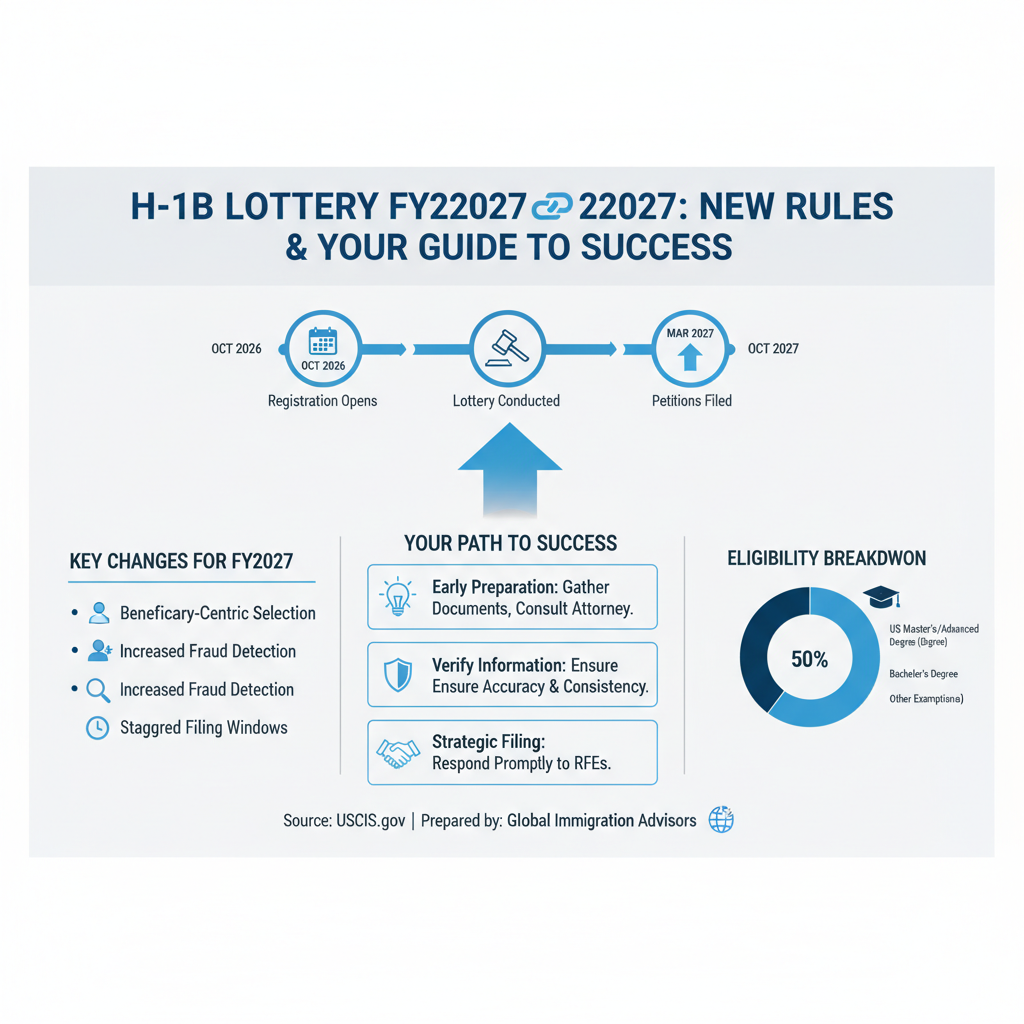
While specific dates for FY2027 will be announced by USCIS, the general timeline typically follows this pattern:
- Early March 2026: H-1B electronic registration period opens (e.g., March 1-17).
- Late March 2026: Lottery selection results announced.
- April 1, 2026 – June 30, 2026 (approximate 90-day window): Petition filing period for selected registrations.
- October 1, 2026: Start of Fiscal Year 2027; earliest date H-1B employment can begin for approved petitions.
Reminder: Processing times vary. Check USCIS Processing Times regularly for updates.

How Imigrar Helps Immigrants in Orlando and Nationwide Navigate H-1B Changes
The changes to the H-1B lottery for FY2027 underscore the critical need for experienced legal counsel. At Imigrar, we are dedicated to providing clear, accurate, and actionable immigration advice to individuals and businesses in Orlando, Central Florida, and across the nation.
Our team of expert immigration attorneys possesses deep knowledge of H-1B regulations and a proven track record of success. We understand the nuances of the new per-beneficiary rule and the heightened scrutiny from USCIS. We offer


