


The journey to obtaining a Green Card in the United States is a significant milestone for countless individuals and families. While often a long process involving numerous forms and waiting periods, one of the most critical steps for many applicants is the Green Card interview. This interview, conducted by a U.S. Citizenship and Immigration Services (USCIS) officer, is your opportunity to demonstrate your eligibility for permanent residency and clarify any aspects of your application.
For those living in Orlando, across Florida, or anywhere in the U.S., preparing thoroughly for this interview is paramount. It’s not just a formality; it’s a detailed examination of your case, and your preparedness can significantly impact the outcome. At Imigrar, we understand the stakes, and our mission is to help you "Keep Families Together" by guiding you through every step, including this crucial interview.
Need Help? Our Orlando immigration team is ready to assist. Call +1 786-791-3106 for a free consultation, or message us online. Se Habla Español.
The Reporting That Sparked This Guide
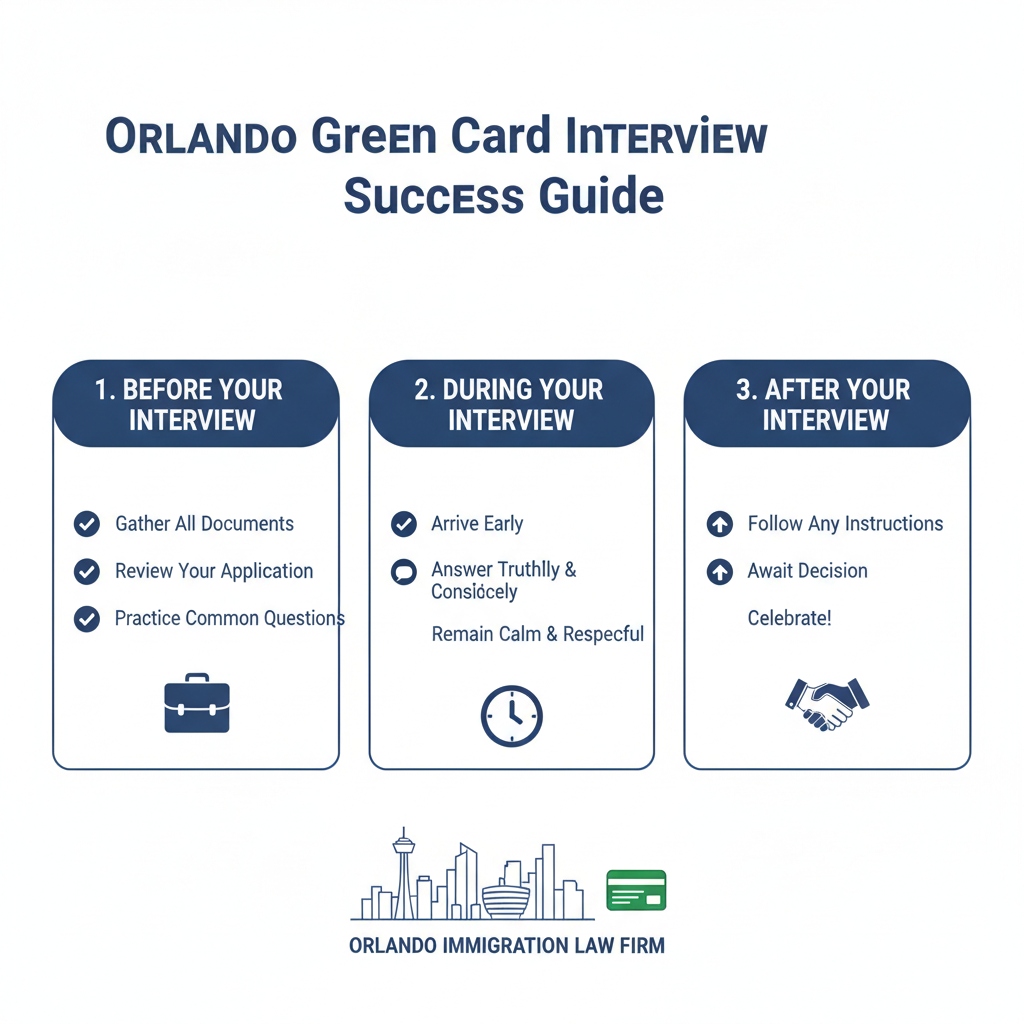
The continuous focus on immigration processes, particularly the Green Card interview, remains a trending topic in legal news and for immigrant communities. The demand for clear, actionable advice on preparing for this critical step is constant. This guide is inspired by the ongoing discussions and inquiries surrounding Green Card Interview Preparation Tips (Immigration Law), reflecting the enduring need for comprehensive resources to help applicants navigate this essential stage of their immigration journey.
What This News Means for Immigrants in Orlando and Across Florida
For immigrants residing in Orlando, Central Florida, and throughout the Sunshine State, understanding the importance of the Green Card interview is crucial. Florida is one of the nation's most diverse states, home to a large and vibrant immigrant population. This means many individuals and families are actively pursuing lawful permanent residency through various avenues, making the Green Card interview a common, yet often nerve-wracking, experience.
Why this news is showing up now
The topic of Green Card interview preparation is perennially relevant because the interview itself is a fundamental part of the immigration process for most Green Card applicants. While specific policies or processing times may shift, the core requirement of demonstrating eligibility and integrity to a USCIS officer remains constant. In 2026, as immigration policies continue to evolve and application backlogs are addressed, the emphasis on thorough and accurate interviews is arguably stronger than ever. USCIS aims to ensure the legitimacy of every application, and the interview serves as a primary tool for this verification. Therefore, the need for robust preparation guides like this one is timeless.
How it can affect Florida residents
Florida residents, particularly those with cases processed through the Orlando USCIS Field Office, directly feel the impact of interview requirements. The Orlando office handles a significant volume of Adjustment of Status applications from across the region, including Orange County and the wider I-4 corridor. This high volume means that while interviews are standard, proper preparation is essential to avoid delays or potential issues. For families in Florida, whose lives are deeply rooted in their communities, the outcome of a Green Card interview directly affects their ability to remain together, work, study, and contribute to the state's economy and culture. Furthermore, local USCIS field offices can have specific nuances in their interview procedures or document preferences, making region-specific advice particularly valuable.
What the Green Card Interview Is (and Why It Matters)
The Green Card interview is a mandatory step for most individuals seeking lawful permanent residency in the United States, particularly those applying for Adjustment of Status from within the U.S. or through Consular Processing abroad. It is a face-to-face meeting with a USCIS officer (or a Consular Officer if outside the U.S.) who will review your application, verify the information you’ve provided, and ask questions to confirm your eligibility for a Green Card.
A plain-English definition
Think of the Green Card interview as your formal meeting with the U.S. government to prove that you qualify to live permanently in the United States. It's where an immigration officer checks that all the information on your forms is true and correct, and that you meet all the legal requirements for a Green Card. For family-based applications, it’s also a chance to confirm the authenticity of your relationship. It’s a serious step, but with proper preparation, it’s a hurdle you can clear successfully.
Key terms you need to know
- Adjustment of Status (AOS): The process of applying for a Green Card from within the United States without having to return to your home country. This is typically what leads to a USCIS Field Office interview, such as at the Orlando USCIS Field Office.
- Consular Processing: The process of applying for an immigrant visa (which becomes a Green Card upon entry) at a U.S. Embassy or Consulate in your home country. While similar, the interview process has distinct differences. This guide primarily focuses on AOS interviews within the U.S.
- USCIS Field Office: A local office of U.S. Citizenship and Immigration Services where interviews, biometrics appointments, and other in-person services are conducted. For many Central Florida residents, this is the Orlando USCIS Field Office.
- Priority Date: The date your immigrant petition (e.g., Form I-130) was properly filed with USCIS. This date determines your place in the visa queue, especially for family preference categories and employment-based categories, impacting when your interview might be scheduled.
- Petitioner: The U.S. citizen or lawful permanent resident who files an immigrant petition on behalf of a foreign national (e.g., a spouse filing for their partner).
- Beneficiary: The foreign national who is seeking an immigration benefit, such as a Green Card, and for whom the petition is filed.
- Affidavit of Support (Form I-864): A legally binding document signed by the petitioner (and sometimes a joint sponsor) to accept financial responsibility for the immigrant, ensuring they will not become a "public charge." This is a crucial financial document reviewed during the interview.
- Inadmissibility: Grounds under immigration law that can make an individual ineligible for a Green Card, such as certain criminal convictions, health issues, or past immigration violations.
The Green Card interview matters because it’s often the final substantive review of your case before a decision is made. It’s your chance to present yourself, clarify any ambiguities, and demonstrate your eligibility directly to an immigration officer. A successful interview moves you closer to permanent residency, while issues during the interview can lead to delays, Requests for Evidence (RFEs), or even denial.
Need Help? Our Orlando immigration team is ready to assist. Call +1 786-791-3106 for a free consultation, or message us online. Se Habla Español.
Current Immigration Law: The Foundation
The Green Card interview process is governed by federal immigration law, primarily the Immigration and Nationality Act (INA). This comprehensive statute sets forth the eligibility requirements, procedures, and grounds of inadmissibility that officers must consider when adjudicating Green Card applications.
Federal requirements
At the federal level, the core legal framework for Green Card eligibility is found in the INA. For individuals applying for Adjustment of Status (AOS) from within the U.S., the key provision is INA § 245, which outlines who is eligible to adjust their status to that of a lawful permanent resident. Generally, to be eligible for AOS, an applicant must have been inspected and admitted or paroled into the U.S., be eligible for an immigrant visa, and have an immigrant visa immediately available at the time of filing and adjudication. Certain categories, like immediate relatives of U.S. citizens, often have visas immediately available.
Other crucial federal requirements that are reviewed during the interview include:
- Admissibility: USCIS officers must determine if an applicant is admissible to the United States. INA § 212 lists various grounds of inadmissibility, which include health-related issues, criminal grounds, security and related grounds, public charge considerations, and prior immigration violations. If an applicant has an inadmissibility issue, they may need to file a waiver (e.g., Form I-601, Application for Waiver of Grounds of Inadmissibility).
- Bona Fide Relationship: For marriage-based Green Cards, the INA requires the marriage to be legitimate and entered into in "good faith" (bona fide), not solely for immigration purposes. This is a significant focus of the interview, with officers looking for compelling evidence of a shared life.
- Financial Sponsorship: INA § 213A mandates that most family-based immigrants and some employment-based immigrants have a financial sponsor who files Form I-864, Affidavit of Support. The sponsor must demonstrate sufficient income or assets to support the immigrant at 125% of the federal poverty guidelines.
- Good Moral Character: While not explicitly required for all Green Card categories, demonstrating good moral character is often an implicit expectation and can be relevant in certain inadmissibility determinations.
Florida-specific considerations
It's important to clarify that there are no state-specific immigration laws in Florida that alter federal Green Card requirements. Immigration law is primarily federal. However, how federal law is applied can have regional nuances based on the specific USCIS Field Office and its caseload. For Central Florida residents, the Orlando USCIS Field Office is where your interview will take place. While the legal standards are federal, the local office's procedures, the specific officers conducting interviews, and the volume of cases can influence the experience. For instance, the Orlando office, serving a densely populated and diverse area, processes a high volume of cases, which can sometimes affect scheduling and processing times. It's also worth noting that local legal aid organizations and attorneys like Imigrar are deeply familiar with the practices of the Orlando Field Office, offering valuable insights.
Important: Always refer to the official government resources for the most up-to-date information. For all official forms and instructions, visit the USCIS official website.
Key USCIS forms relevant to the Green Card process and interview include:
- Form I-130, Petition for Alien Relative
- Form I-485, Application to Register Permanent Residence or Adjust Status
- Form I-864, Affidavit of Support Under Section 213A of the INA
- Form I-693, Report of Medical Examination and Vaccination Record
- Form I-797C, Notice of Action (often the interview notice)

How to Prepare for Your Green Card Interview: A Complete Step-by-Step Guide
The Green Card interview is a critical step in your journey to permanent residency. Proper preparation is key to a smooth and successful experience. Follow this detailed guide to ensure you’re ready for your interview, whether it’s at the Orlando USCIS Field Office or another location.
1) Understand Your Interview Notice (Form I-797C)
Your first step begins the moment you receive your interview notice, typically Form I-797C. This document is not just a date and time; it's your roadmap for what to bring and what to expect.
- Review Details Carefully: Check the date, time, and location of your interview. For Central Florida residents, this will likely be the Orlando USCIS Field Office.
- Required Documents List: The notice will include a list of original documents you must bring. This list is crucial and often includes your passport, birth certificates, marriage certificates, and all forms you previously submitted.
- Confirm Attendance: While not always explicitly required to confirm, mark your calendar and ensure you have no conflicting appointments. If you absolutely cannot make the scheduled time due to an emergency, contact USCIS immediately to request a reschedule, but be aware that this can significantly delay your case.
2) Gather and Organize All Required Documents
This is arguably the most time-consuming but vital step. You must bring original versions of all documents relevant to your application, along with a complete set of photocopies. Organize them neatly in a folder or binder with tabs for easy access.
- Personal Identification & Travel Documents:
- Valid Passport (for applicant and petitioner, if applicable)
- Birth Certificates (applicant, petitioner, and any children)
- Marriage Certificate (if applicable)
- Divorce Decrees or Death Certificates for all prior marriages (for applicant and petitioner, if applicable)
- Any previous immigration documents (e.g., I-20s, I-94s, EAD cards, previous visa stamps)
- Application Forms:
- Your complete application package, including copies of Form I-130, Form I-485, Form I-864, Form I-693, and all supporting documents you originally submitted.
- The original sealed Form I-693 (Medical Examination) if you haven't submitted it yet, or if USCIS specifically requests a new one.
- Financial Documents:
- Original Form I-864, Affidavit of Support (signed by petitioner and any joint sponsor)
- Petitioner’s federal income tax returns (IRS transcripts preferred) for the last three years.
- W-2s, 1099s, and recent pay stubs for the petitioner (and joint sponsor, if applicable).
- Proof of assets (bank statements, property deeds) if relying on assets to meet income requirements.
- Proof of Relationship (for family-based cases, especially marriage-based): This is critical for marriage-based cases to prove a bona fide marriage.
- Joint bank accounts statements
- Joint leases or mortgage statements
- Utility bills in both names
- Joint insurance policies (health, life, auto)
- Birth certificates of children born to the marriage
- Photos together (over time, with family/friends)
- Affidavits from friends/family attesting to the relationship
- Any other evidence of commingled finances or shared life.
- Criminal Records (if applicable):
- Certified copies of arrest records, court dispositions, and police reports for any arrests, citations, or convictions, even if expunged or dismissed.
- Translated Documents: Any document not in English must be accompanied by a certified English translation.
- Photos: Recent passport-style photos of the applicant (and petitioner if specified).
Reminder: Bring originals AND copies of everything. The officer may keep the copies and return the originals.
3) Review Your Application Forms Thoroughly
You must be intimately familiar with every answer you provided on your application forms, especially Form I-130 and Form I-485. The interviewing officer will compare your verbal answers to the information on these forms.
- Read Every Question and Answer: Go through your entire submitted application package page by page.
- Identify Potential Discrepancies: If there have been any changes since you filed (e.g., new address, new job, new child), be prepared to explain them honestly and provide updated documentation.
- Memorize Key Dates and Details: Dates of entry, marriage, previous addresses, and employment history are common topics.
4) Practice Answering Potential Questions
Role-playing the interview can significantly reduce anxiety. Practice with your attorney, spouse, or a trusted friend.
- General Biographical Questions: Name, date of birth, place of birth, parents' names, addresses, employment history.
- Immigration History Questions: How you entered the U.S., previous visas, any prior immigration applications, any past immigration violations.
- Relationship-Specific Questions (for marriage-based cases): How you met, first date, proposal, wedding details, daily routines, spouse's family, shared life, future plans. These can be very detailed and personal.
- Criminal History Questions: Any arrests, citations, or convictions, no matter how minor or old. Always be truthful.
- Inadmissibility Questions: Questions related to health, financial support, or any other potential grounds of inadmissibility.
Important: Practice answering clearly, concisely, and truthfully. Do not guess. If you don't know an answer, say so. If you don't understand a question, ask for clarification.
5) Prepare for the Day of the Interview
The day of your interview requires meticulous planning.
- Dress Professionally: Treat this like an important professional meeting. Business casual attire is appropriate.
- Arrive Early: Aim to arrive at the Orlando USCIS Field Office (or other location) at least 30 minutes before your scheduled appointment. This allows time for parking, security screening, and finding the correct waiting area.
- Bring All Documents: Double-check your organized binder of original documents and copies before leaving home.
- Attorney Presence: If you are represented by an attorney, ensure they are present with you. Their presence can provide comfort, clarify legal issues, and protect your rights.
6) During the Interview: Be Honest, Calm, and Respectful
Your demeanor during the interview is as important as the information you provide.
- Take an Oath: You and your petitioner (if present) will be sworn in to tell the truth.
- Answer Truthfully: This cannot be stressed enough. Any misrepresentation can have severe consequences, including denial and future bars to immigration benefits.
- Listen Carefully: Pay close attention to each question. If you don't understand, politely ask the officer to repeat or rephrase it.
- Be Concise: Answer the question asked, and stop. Do not volunteer extra information unless it's directly relevant or asked for.
- Stay Calm and Respectful: Maintain a respectful attitude, even if you feel nervous or the questions are challenging.
- Let Your Attorney Speak: If you have an attorney, they will advise you on when and how to respond, and can object to inappropriate questions or clarify answers.
- Document Review: The officer will review your original documents and may ask for additional copies or specific items.
7) After the Interview: Follow-up and Decision
The outcome of your interview may not be immediate.
- Immediate Decision: Sometimes, the officer may approve your case on the spot or indicate that it will be approved shortly.
- Request for Evidence (RFE): If the officer needs more information or documentation, they will issue an RFE, usually in writing. You will have a specific deadline (e.g., 90-day window) to respond.
- Decision by Mail: Most decisions are sent by mail within a few weeks or months. You can check your case status online using your receipt number on the USCIS official website.
- Potential for Second Interview: In rare cases, especially for marriage-based petitions, USCIS might schedule a second interview or a "Stokes interview" if they have doubts about


