


The reporting that sparked this guide
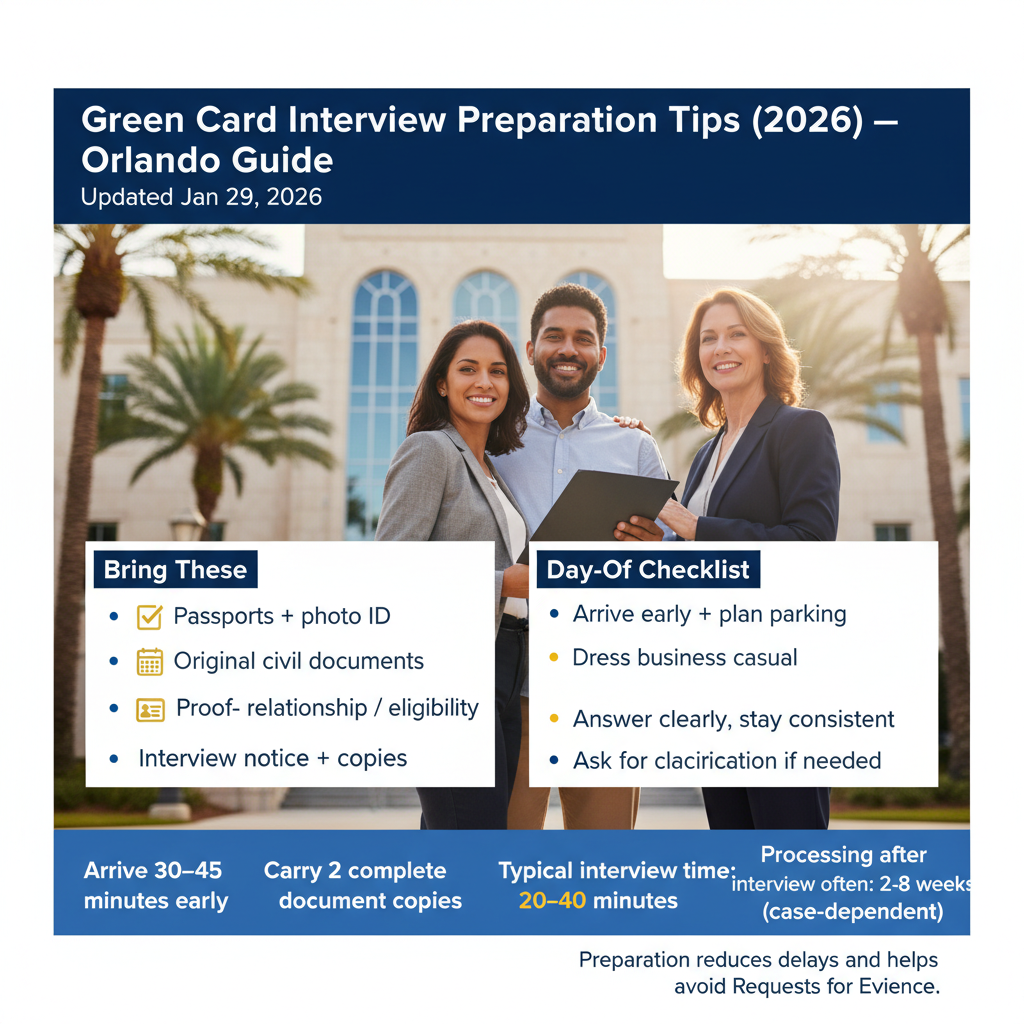
Green card interviews are trending again in immigration coverage—especially as USCIS continues adjusting interview practices, fraud screening, and case processing priorities. This guide was inspired by:
Need Help? Our Orlando immigration team is ready to assist. Call +1 786-791-3106 for a free consultation, or message us online. Se Habla Español.
What This News Means for Immigrants in Orlando and Across Florida
Why this news is showing up now
Green card interview preparation is “trending” because many applicants are seeing renewed interview scheduling—particularly for family-based cases filed with Form I-130 and Form I-485 (when filing inside the U.S.). USCIS has also emphasized integrity measures and consistency in adjudications, which can translate into more detailed questioning and closer review of documents.
Reminder: Even when an interview feels routine, it is still a legal proceeding that can determine whether your application is approved, delayed (Request for Evidence), or denied.
How it can affect Florida residents
For Florida residents—especially in Central Florida along the I-4 corridor (Orlando, Kissimmee, Lake Mary, Sanford, Winter Park, and surrounding Orange County areas)—interview preparation matters because:
- The Orlando USCIS Field Office may request updated proof of eligibility since filing (new addresses, new jobs, travel, tax filings, children, etc.).
- Many applicants have complex histories (prior visas, overstays, prior marriages, prior petitions) that can lead to tougher questions.
- Florida’s diverse immigrant community often relies on foreign documents—making certified translations and document authenticity especially important.
If your case is in Orlando, you should plan for logistics too: arrival time, parking, security screening, and having a clean, organized interview packet that makes it easy for the officer to verify facts quickly.
What Green Card Interview Preparation Tips Is (and Why It Matters)
A plain-English definition
“Green card interview preparation” means getting ready for the USCIS interview where an officer verifies your identity, reviews your application (usually Form I-485 for Adjustment of Status), confirms eligibility, and checks for any issues that could make you inadmissible or ineligible.
The interview is not just about “answering questions.” It’s about proving—through consistent testimony and documents—that you qualify under the law, that your relationship (if family-based) is real, and that your application is truthful and complete.
Key terms you need to know
- Adjustment of Status: Applying for a green card from inside the U.S. (often using Form I-485).
- Consular Processing: Applying for an immigrant visa through a U.S. embassy/consulate abroad (interview is with the Department of State, not USCIS).
- Form I-130: Petition for Alien Relative (often filed by a U.S. citizen or lawful permanent resident spouse/parent/child).
- Form I-485: Application to Register Permanent Residence or Adjust Status.
- Priority Date: Your place in line for certain visa categories (more relevant in family preference and employment cases).
- Inadmissibility: Legal reasons you may be denied a green card (health, certain crimes, immigration violations, misrepresentation, public charge rules, etc.).
- RFE (Request for Evidence): USCIS asks for more documents.
- NOID (Notice of Intent to Deny): USCIS plans to deny unless you respond with strong evidence/legal arguments.
Important: A well-prepared interview can prevent delays and reduce the risk of inconsistent answers that can trigger fraud concerns or requests for additional evidence.
Current Immigration Law: The Foundation
Green card interview rules come from federal immigration law, USCIS regulations, and policy guidance. While officers have discretion in how they conduct interviews, the legal eligibility requirements are set primarily by the Immigration and Nationality Act (INA) and federal regulations.
Federal requirements
Most family-based green card interviews involve confirming eligibility under the INA and related regulations, including:
- INA § 245 (8 U.S.C. § 1255): Governs Adjustment of Status eligibility and bars.
- INA § 212 (8 U.S.C. § 1182): Lists grounds of inadmissibility (unlawful presence, misrepresentation, certain crimes, health-related grounds, etc.).
- INA § 204 (8 U.S.C. § 1154): Governs immigrant visa petitions like Form I-130.
- 8 C.F.R. § 245: Federal regulations implementing adjustment rules and procedures.
- 8 C.F.R. § 103.2: General filing and evidence rules (burden of proof, RFEs, interviews).
USCIS forms commonly involved in interview-based cases include:
- Form I-130 (family petition)
- Form I-485 (adjustment application)
- Form I-864 (Affidavit of Support)
- Form I-693 (medical exam and vaccination record)
- Form I-765 (work permit, if filed)
- Form I-131 (advance parole travel document, if filed)
For official instructions and updates, rely on the USCIS official website and form pages at USCIS Forms.
Florida-specific considerations
Immigration is federal law, so Florida does not set the legal green card requirements. However, Florida residents often face practical, case-specific issues that affect interview outcomes:
- Address history and moves: Central Florida residents frequently relocate along the I-4 corridor; inconsistent address history can raise questions. File AR-11 address updates promptly when required.
- Name variations: Hispanic naming customs and inconsistent surname usage across foreign documents can require careful explanation and supporting evidence.
- Document availability: Some countries’ civil registries have delays; plan early for birth/marriage/divorce certificates and certified translations.
- Orlando interview logistics: The Orlando USCIS Field Office expects timely arrival and complete originals—missing originals can cause rescheduling or an RFE.
Warning: If you have any arrest history (even dismissed charges), prior immigration issues, or prior marriage/petition history, interview prep should include a legal review before you appear.
How to Prepare for Your Green Card Interview: A Complete Step-by-Step Guide
1) Confirm what type of interview you have and what USCIS is deciding
Start by identifying whether your interview is for Adjustment of Status (USCIS) or for an immigrant visa abroad (Department of State). This guide focuses on USCIS green card interviews, most commonly tied to Form I-485.
Read your interview notice carefully—USCIS often lists what to bring and whether both spouses must attend.
- Required documents to gather (baseline):
- USCIS interview notice (original)
- Government-issued photo ID (passport, driver’s license)
- All passports (current and expired), travel documents
- Any USCIS receipt notices (I-797) for Form I-130, Form I-485, Form I-765, Form I-131
- Copy of the entire filing packet you submitted (or as complete as possible)
2) Rebuild your “filing-day snapshot” and update everything that changed
Officers compare your interview answers to what you filed months (sometimes years) earlier. Your job is to ensure nothing is inconsistent and that you can explain changes clearly.
- Required documents to gather (updates since filing):
- Updated lease/mortgage, utility bills, and proof of shared address
- Updated employment letters and recent pay stubs (petitioner/sponsor and applicant as applicable)
- Updated tax transcripts (preferably IRS transcripts) for the sponsor
- Birth certificates of children born since filing
- Evidence of any legal name change
- Any new immigration documents (new I-94 records, approvals, EAD/AP cards)
Important: If something material changed—like separation, new arrest, new unauthorized work, extended travel, or a new address—get legal advice before the interview.
3) Organize your evidence like an officer-friendly binder (and bring originals)
A clean, tabbed binder reduces stress and helps the officer verify facts quickly. Bring originals and a copy set. If you hand over originals, you may not get them back immediately—ask politely how the officer prefers to review them.
- Required documents to gather (civil documents):
- Birth certificates (petitioner and beneficiary, if relevant)
- Marriage certificate
- Divorce decrees/annulments/death certificates for all prior marriages (both spouses)
- Certified translations for any non-English documents (with translator certification)
- Required documents to gather (identity and entry):
- Passport biographic page
- Visa page(s) and entry stamps
- I-94 record (printout if available)
- Prior EAD cards, advance parole documents
4) Prepare for relationship and eligibility questions (practice the “story”)
In marriage-based cases, the officer is evaluating whether the marriage is bona fide (real) and not entered into for immigration benefits. In other cases (parent/child), the officer is confirming the qualifying relationship and eligibility.
- Required documents to gather (bona fide marriage evidence):
- Joint bank statements (ideally spanning months)
- Joint lease/mortgage, deed, or property records
- Joint insurance policies (health, auto, renters/homeowners, life)
- Joint tax returns or IRS transcripts showing “married filing jointly” (when applicable)
- Photos over time (not just one event), with brief captions (date/place/people)
- Evidence of shared life: travel itineraries, memberships, mail to both at same address
- Children’s birth certificates listing both parents (if applicable)
Practice answering: how you met, timeline of dating/engagement/marriage, daily routines, finances, family relationships, and major life events. The goal is consistency—not perfection.
5) Review the “yes/no” security and admissibility questions carefully
Many interviews include reviewing the inadmissibility and security questions from Form I-485 (and sometimes other forms). These include questions about crimes, immigration violations, misrepresentation, membership in certain organizations, and other sensitive topics.
- Required documents to gather (if applicable):
- Certified court dispositions for any arrest/citation (even if dismissed)
- Police reports (if available and relevant)
- Evidence of sentence completion (probation end, payment of fines)
- Prior immigration filings/decisions (RFEs, denials, removal proceedings documents)
- If ever in immigration court: EOIR case documents (see Executive Office for Immigration Review)
Warning: Do not guess. If you do not understand a question, ask the officer to repeat or clarify. Incorrect answers can create misrepresentation issues.
6) Prepare for the day-of interview logistics and communication
Plan your route, parking, and arrival time. Expect airport-style security screening. Bring only what you need and keep documents organized. If you need an interpreter, confirm USCIS rules and whether you can bring your own interpreter (policies can change; verify with the interview notice and USCIS guidance).
- Required documents/items to bring (day-of essentials):
- Interview notice
- Photo IDs
- Organized binder with originals + copies
- Pen and small notepad
- Interpreter information (if applicable)
If your case is in Orlando, plan extra time for traffic on I-4 and downtown congestion. Late arrival can lead to rescheduling, which can add months.
7) Know what happens after the interview (and how to respond fast)
Outcomes typically include approval on the spot, “case held for review,” an RFE, or (less commonly) a NOID/denial. The officer may also request additional documents like an updated Form I-693 medical or additional relationship evidence.
- Required documents to be ready after interview:
- Ability to quickly obtain updated bank statements/leases/insurance
- Updated sponsor income proof for Form I-864 issues
- New medical exam if USCIS requests a current sealed Form I-693
Track timelines using USCIS Processing Times and your USCIS online account (if you have one). Consular cases should reference U.S. Department of State resources.
Need Help? Our Orlando immigration team is ready to assist. Call +1 786-791-3106 for a free consultation, or message us online. Se Habla Español.
Practical Steps You Can Take Today
The best interview prep starts weeks before your appointment—not the night before. Here’s a practical checklist you can begin today.
Actionable checklist (do these now)
- Create a shared digital folder (PDF scans) plus a physical binder with tabs: IDs, civil docs, immigration filings, financials, relationship evidence.
- Print your most recent statements (bank, insurance, lease) covering the last 3–6 months.
- Request IRS tax transcripts for the sponsor (often stronger than self-prepared copies).
- Review every answer on Form I-485 and Form I-130 for consistency (addresses, dates, prior marriages, entries/exits).
- Write a one-page relationship timeline (how you met → key dates → living arrangements → major events).
- If you have any arrest/charges, order certified dispositions now (some courts take weeks).
- Check your medical exam status (Form I-693) and whether USCIS may need a current sealed exam.
Document preparation guidance
Officers prefer clear, official records. Prioritize quality over quantity:
- Strong evidence: joint taxes, joint bank accounts with real activity, lease/mortgage, insurance, children’s records, beneficiary designations.
- Supportive evidence: photos over time, travel, messages (select samples), affidavits from friends/family (if needed).
- Translations: Any non-English document should include a certified translation with a translator’s certification statement.
Important: Never submit altered documents. If a document is unavailable, obtain an official “no record” letter when possible and discuss alternative evidence.
Timeline expectations
Timelines vary widely based on category, field office workload, and background checks. As a planning framework:
- 2–6 weeks before interview: start building your binder, request missing records, practice questions.
- 7–10 days before interview: print updated statements and recent pay stubs; confirm addresses and IDs match.
- 48 hours before interview: re-check your notice, route, and required originals; rest and avoid last-minute document chaos.
You can monitor general processing benchmarks at USCIS Processing Times, but remember that an interview notice is case-specific and does not guarantee immediate approval.
How Imigrar Helps Immigrants in Orlando
At Imigrar, we help families prepare for green card interviews with a strategy focused on clarity, consistency, and credibility—so you can walk into your appointment organized and confident. We serve clients in Orlando and nationwide, with special attention to local logistics and expectations at The Orlando USCIS Field Office.
- Case review for Form I-130 and Form I-485 consistency (dates, addresses, prior immigration history)
- Customized document checklists based on your case type (marriage, parent/child, employment-based AOS)
- Mock interview preparation (typical questions + red-flag topics)
- RFE/NOID support and post-interview follow-up
- Se Habla Español — bilingual support for you and your family
If your case is in Orlando or anywhere in Florida, we can help you prepare the right way—before small issues become big delays.
Need Help? Our Orlando immigration team is ready to assist. Call +1 786-791-3106 for a free consultation, or message us online. Se Habla Español.
Frequently Asked Questions
Q: I’m worried I’m not eligible—what issues usually come up at the green card interview?
A: The most common eligibility concerns involve prior immigration violations (overstay, unauthorized work), prior marriages, criminal history, and inconsistencies between your interview answers and what was filed in Form I-485 and Form I-130. Bring certified court dispositions if you have any arrests, and review your entire filing packet for accuracy. If you suspect an inadmissibility issue under INA § 212, speak with an immigration attorney before the interview.
Q: Will the interview affect my current immigration status or my work permit?
A: If you filed Form I-485 and received an EAD through Form I-765, your work authorization is typically based on the pending adjustment application. An interview itself does not cancel your EAD. However, a denial of the Adjustment of Status application can affect your ability to renew benefits and may place you at risk depending on your underlying status. Warning: If you are not maintaining another lawful status, get legal advice about the consequences of a potential denial.
Q: How long after the interview will I get a decision?
A: Some cases are approved the same day or within days. Others are held for review due to background checks or missing documents. If USCIS issues an RFE, your timeline depends on how quickly you respond and how long USCIS takes to review the response. You can check general timelines at USCIS Processing Times, but your case may vary significantly.
Q: What documents are absolutely required at the interview?
A: Bring your interview notice, photo IDs, passports, originals of civil documents (birth/marriage/divorce), and updated relationship/financial evidence. If the notice requests a sealed medical exam, bring the sealed Form I-693. Also bring updated sponsor evidence for Form I-864 issues (tax transcripts, pay stubs, employment letter). If you’re unsure, confirm on the USCIS official website and your specific notice.
Q: How much does it cost to prepare for a green card interview?
A: USCIS does not charge a separate “interview fee”—it is part of the filing process. Costs usually come from obtaining documents (certified copies, translations), medical exam fees (Form I-693), and attorney assistance if you choose representation. If you need updated evidence quickly (court records, international civil docs), expedited services can add cost.
Q: What happens if my green card is denied after the interview?
A: USCIS may deny immediately or after issuing an RFE/NOID. Next steps depend on the reason for denial: you may file a motion to reopen/reconsider, refile, or pursue other relief. In some cases, USCIS may issue a Notice to Appear (NTA) placing you in immigration court—handled under EOIR (see Executive Office for Immigration Review). Important: If you receive a NOID or denial, speak with an attorney immediately—deadlines can be short, and responses must be well-supported.
Q: Do we both have to attend the marriage-based green card interview?
A: Usually, yes. USCIS typically requires both spouses to appear for a marriage-based Adjustment of Status interview unless the notice states otherwise. If a spouse cannot attend due to emergency, contact USCIS following the instructions on the notice and consider legal guidance to avoid a missed interview and denial.
Q: Can I bring an interpreter to the Orlando USCIS Field Office?
A: USCIS policies on interpreters can vary by interview type and may change. Read your interview notice carefully and check guidance on USCIS official website. If you need language help, plan early. Imigrar can help you prepare and understand what to expect. Se Habla Español.
Q: Does my Priority Date matter for the interview?
A: It depends. Immediate relatives of U.S. citizens generally do not wait for a visa number, so the Priority Date is less of an interview issue. For family preference and employment categories, the Priority Date and visa bulletin availability can control when Form I-485 can be approved. If your category is backlogged, USCIS may still interview you but cannot approve until a visa number is available.
Common Mistakes (and How to Avoid Them)
Mistake #1: Treating the interview like a casual conversation
Even friendly officers are documenting your answers and comparing them to your forms. Avoid joking, guessing, or “rounding” dates. If you don’t know, say you don’t know and offer to provide the information later if appropriate.
Mistake #2: Showing up with messy or missing documents
Missing originals (marriage certificate, divorce decrees) or bringing unorganized stacks can trigger delays or RFEs. Use a binder with labeled tabs and bring originals plus copies. For Central Florida residents, build in time to obtain certified copies from Orange County or other jurisdictions if needed.
Mistake #3: Not addressing red flags before the interview
Prior arrests, prior removals, prior misrepresentation, short courtships, large age differences, or inconsistent addresses can all be “red flags” that require careful preparation and strong evidence. Warning: Waiting until the interview to “explain” can backfire—prepare a documented, consistent explanation in advance.
Additional Official Resources (Use These, Not Rumors)
- USCIS official website
- USCIS Forms
- USCIS Processing Times
- U.S. Department of State
- Executive Office for Immigration Review
Reminder: Social media tips can be incomplete or wrong. Always verify with official sources and your specific interview notice.
Need Help? Our Orlando immigration team is ready to assist. Call +1 786-791-3106 for a free consultation, or message us online. Se Habla Español.

Closing: Get Interview-Ready with Imigrar (Orlando, Florida)
A green card interview is one of the most important appointments in your immigration journey. The best results come from preparation: organized documents, consistent answers, and a plan for any legal issues that might arise.
If your case is in Orlando, if you’re anywhere in Orange County, or if you live along the I-4 corridor in Central Florida, Imigrar can help you prepare step-by-step—so you walk into the interview ready to succeed and protect your family.
Need help preparing for your green card interview? Call Imigrar at +1 786-791-3106 for a free consultation, or message us online. Se Habla Español. Our mission is to Keep Families Together.


