


The reporting that sparked this guide
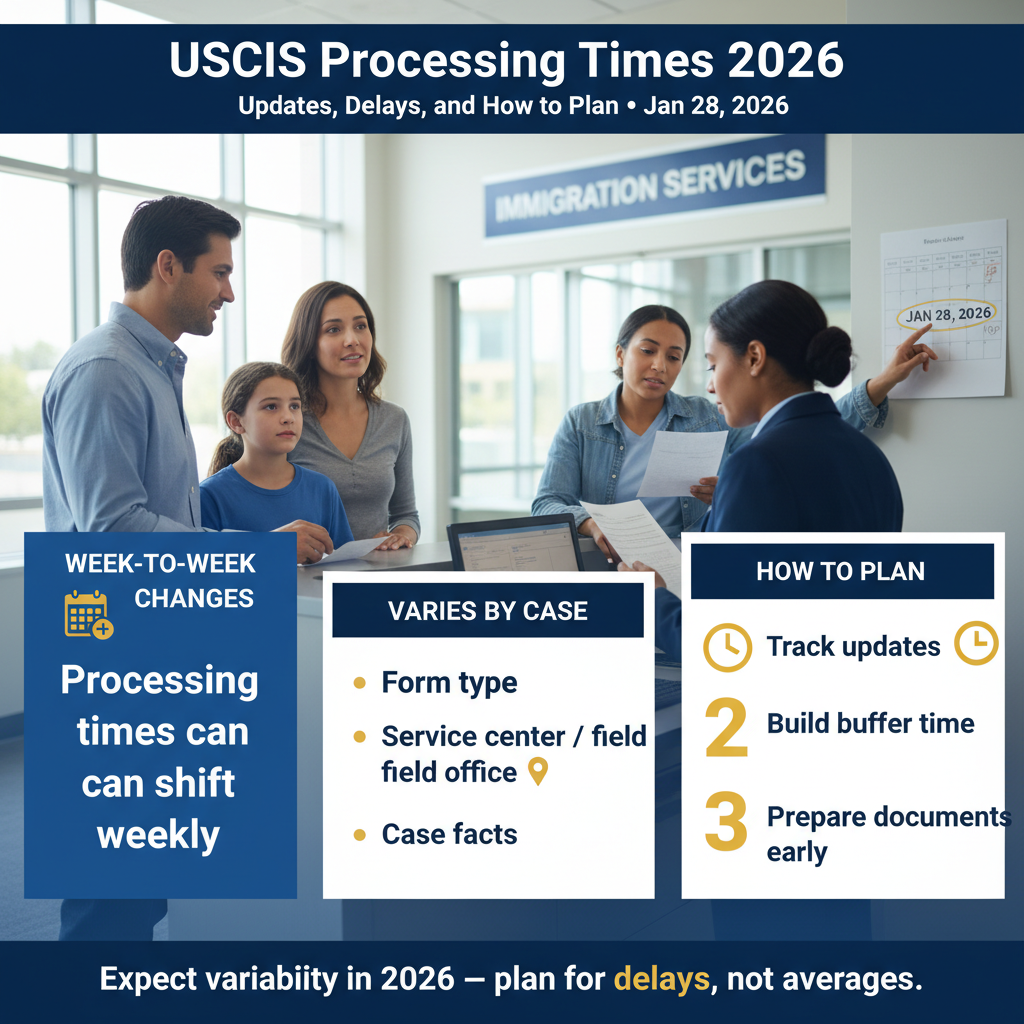
The reporting that sparked this guide: USCIS Processing Times and Updates for 2026 (USCIS)
Important: USCIS processing times can change week-to-week and vary by form type, service center/field office, and your specific case facts. This article explains how USCIS processing times work in 2026, what to watch for, and how to reduce avoidable delays—especially for families and workers in Florida.
Need Help? Our Orlando immigration team is ready to assist. Call +1 786-791-3106 for a free consultation, or message us online. Se Habla Español.
What This News Means for Immigrants in Orlando and Across Florida
Why this news is showing up now
USCIS processing times are a recurring headline because they affect nearly every immigration path—family petitions, Adjustment of Status, work permits, travel documents, naturalization, asylum-related benefits, and more. In 2026, the attention is heightened for a few practical reasons:
- Backlog pressure and uneven workloads: Different USCIS offices and service centers experience different volumes, staffing levels, and case complexity.
- More applicants tracking “real” timelines: Applicants increasingly compare their cases to the public ranges shown on USCIS Processing Times and to community reports.
- Higher consequences for delay: A delayed receipt notice, biometrics appointment, or interview can affect employment authorization, travel plans, driver’s license renewals, and even lawful status in time-sensitive filings.
- Ongoing digital changes: USCIS continues expanding online filing, online accounts, and digital notices—helpful for many, but confusing if you miss messages or upload the wrong evidence.
Reminder: “Processing time” is not a promise. It’s an estimate based on recently completed cases and can move up or down even if your case is progressing normally.
How it can affect Florida residents
For Florida residents—especially in Central Florida—the impact of shifting USCIS timelines is very practical:
- If your case is in Orlando... your interview (for cases like Form I-485 or Form N-400) may be scheduled through the local field office, and local appointment availability can affect your timeline.
- For Central Florida residents... life planning is tied to USCIS milestones: work authorization renewal windows, travel for family emergencies, and school/work deadlines along the I-4 corridor (Orlando–Kissimmee–Lakeland–Tampa).
- The Orlando USCIS Field Office... may have different interview scheduling patterns than Miami, Tampa, Jacksonville, or out-of-state field offices—so state-level “averages” can be misleading.
- Orange County realities: A growing population and high demand for immigration benefits can mean more competition for appointments and longer queues for certain case types.
The most important takeaway: in 2026, you should treat processing time as a planning tool—then build a buffer and a strategy to prevent delays you can control.
What USCIS Processing Times and Updates for 2026 Is (and Why It Matters)
A plain-English definition
USCIS “processing times” are public estimates showing how long it has recently taken USCIS to complete cases for a specific form type (for example, Form I-130 or Form I-485) at a specific office (a service center or field office). USCIS updates these estimates periodically on its official tool: USCIS Processing Times.
In 2026, “updates��� also includes USCIS operational changes that affect how quickly cases move—such as staffing levels, interview policies, evidence requests, online filing expansion, and how cases are routed between service centers.
Key terms you need to know
- Receipt Notice (Form I-797C): Proof USCIS accepted your filing and assigned a receipt number. Delays here can delay everything else.
- Biometrics Appointment: Fingerprints/photo appointment used for background checks. Missing it can cause denial.
- RFE (Request for Evidence): USCIS asks for missing/insufficient documents. Responding late can lead to denial.
- NOID (Notice of Intent to Deny): A serious warning that USCIS plans to deny unless you respond with strong evidence.
- Interview: Required for many cases (especially Adjustment of Status and naturalization). Scheduling time varies by field office.
- Priority Date: Your place in line for a visa category (especially family preference and employment-based). A current Priority Date is often required before filing or approval.
- Case Outside Normal Processing Time: A threshold shown in the USCIS tool; if your case is beyond it, you may submit an inquiry.
- 180 days and the 90-day window:
180 days and the 90-day window appear in different contexts (and people often confuse them). For example, many applicants plan EAD renewals around a 90-day window or more before expiration, while other rules and benefits in immigration law can involve 180 days (for example, certain portability rules in employment-based cases may reference 180 days). The right strategy depends on your benefit type.
Warning: Don’t rely on social media “average timelines.” Always check the official USCIS tool and your receipt number history in your USCIS online account.
Current Immigration Law: The Foundation
USCIS processing times are not a “law” by themselves—they reflect how USCIS administers immigration benefits under existing law. Understanding the legal foundation helps you see what USCIS can require, what deadlines matter, and why missing evidence can slow or derail a case.
Federal requirements
Most USCIS benefits are governed by the Immigration and Nationality Act (INA) and federal regulations in Title 8 of the Code of Federal Regulations (8 C.F.R.). Common legal foundations include:
- INA § 201–203: Immigrant visa categories and numerical limits (drives backlogs and Priority Date movement).
- INA § 245: Adjustment of Status rules for applicants filing Form I-485.
- INA § 204: Family- and employment-based petitions, including Form I-130.
- INA § 316 & § 319: Naturalization eligibility rules (often tied to Form N-400).
- 8 C.F.R. § 103: General USCIS filing, evidence, and adjudication procedures (why RFEs/NOIDs happen).
Many applications also depend on Department of State visa availability and consular processing rules. For official resources, see: U.S. Department of State.
If your matter involves immigration court or removal proceedings, the governing agency is EOIR: Executive Office for Immigration Review.
Florida-specific considerations
Immigration law is federal, but Florida-specific realities can affect your case planning:
- Local field office scheduling: Interview appointment availability varies. The Orlando area (Orange County and the broader I-4 corridor) can experience high demand.
- State ID/driver’s license timing: Florida DMV requirements often hinge on valid immigration documents with unexpired dates. A delayed EAD or green card can create practical problems.
- Travel and emergencies: Florida residents often travel internationally through major hubs; traveling without proper advance parole (when required) can abandon a pending Adjustment of Status case.
Reminder: Always use the USCIS official website for current filing addresses, fees, policy updates, and form editions. For forms and instructions, use: USCIS Forms.
Examples of common USCIS filings discussed in this guide include Form I-130, Form I-485, Form I-765, Form I-131, Form N-400, and Form I-90.
Need Help? Our Orlando immigration team is ready to assist. Call +1 786-791-3106 for a free consultation, or message us online. Se Habla Español.
How to Track and Improve Your USCIS Timeline in 2026: A Complete Step-by-Step Guide
This step-by-step guide focuses on what most applicants can do—legally and practically—to track their case correctly and reduce avoidable delays. It applies broadly to family-based cases (Form I-130), Adjustment of Status (Form I-485), EAD/AP filings, and naturalization.
1) Identify your case type, office, and “anchor form”
Start by identifying the primary form that drives the timeline. For example:
- Family petition: Form I-130
- Adjustment of Status: Form I-485 (often filed with Form I-765 and Form I-131)
- Naturalization: Form N-400
- Replace green card: Form I-90
Next, confirm whether your case is handled by a USCIS service center or a field office (for interviews). If your case is in Orlando, interview-based steps may depend on the Orlando field office’s calendar.
Documents to gather:
- Receipt number(s) for every filing (example: IOE, MSC, WAC, LIN, SRC prefixes)
- Copies of all filed forms (PDF or paper)
- USCIS receipt notices (Form I-797C)
- Any RFE/NOID notices received
2) Use the official USCIS Processing Times tool the right way
Go to USCIS Processing Times and select:
- The correct Form I-XXX (for example, Form I-130 or Form I-485)
- The correct office (service center or field office)
- The correct category (USC spouse vs. LPR spouse; immediate relative vs. preference category; etc.)
USCIS will display a range or a typical completion time and will show a “Receipt date for a case inquiry” threshold. If your receipt date is earlier than that threshold, you may qualify to submit an “outside normal processing time” request.
Documents to gather:
- Your receipt notice date(s)
- Screenshot/PDF of the processing time page for your exact selection
- Your USCIS online account history (if available)
3) Confirm your mailing address and USCIS online account settings
Many “delays” are actually missed notices: biometrics appointments, RFEs, interview notices, or reschedule instructions. In 2026, USCIS continues using a mix of paper notices and online updates.
Important: If USCIS mails a notice to an old address and you miss a deadline, the case can be denied—even if you never saw the letter.
Documents to gather:
- Proof of current address (lease, utility bill, bank statement)
- Copy of any address change confirmation you submitted
- USCIS online account login and recovery email/phone
4) Front-load evidence to prevent RFEs (especially for family and AOS cases)
RFEs are one of the most common reasons cases move slower than the posted estimates. The best strategy is to file a “decision-ready” packet.
Examples:
- Form I-130: strong relationship evidence (marriage bona fides), correct civil documents, translations, and clear identity proof.
- Form I-485: complete medical exam (when appropriate), lawful entry evidence, and complete affidavit of support package.
- Form I-765/Form I-131: correct eligibility category and consistent biographic information across all forms.
Documents to gather (typical examples):
- Passports, visas, I-94 records (if applicable)
- Birth certificates, marriage/divorce certificates
- Certified translations (if not in English)
- Financial evidence for support (tax returns, W-2s, pay stubs)
- Relationship evidence (photos, joint lease, joint bank/insurance, children’s birth certificates)
5) Prepare for biometrics, interview, and post-interview follow-up
Many cases stall at predictable points:
- Biometrics scheduling: Appointment availability and rescheduling can add weeks or months.
- Interview queue: Field office backlogs vary; the Orlando area may have different timing than other cities.
- Post-interview review: Some cases require supervisor review, additional background checks, or updated evidence.
Warning: Missing a biometrics appointment or interview can lead to denial for abandonment. If you must reschedule, follow the notice instructions immediately and keep proof.
Documents to gather:
- Government-issued photo ID for entry to the appointment
- Original civil documents (birth/marriage/divorce certificates)
- Updated relationship/financial evidence since filing
- Copies of your entire filing packet
6) Escalate correctly when a case is truly outside normal times
If your case is beyond the USCIS “case inquiry” date, consider these options (in the right order):
- Submit an “outside normal processing time” e-request through USCIS.
- Call USCIS Contact Center and request escalation when appropriate.
- If there is an urgent need (serious illness, humanitarian emergency, severe financial loss), ask about expedite criteria and evidence requirements.
- If you are in removal proceedings, coordinate strategy carefully because filings can affect court posture (EOIR).
Reminder: Expedite requests are discretionary and require proof. Submitting weak expedite requests can waste time and attention.
Documents to gather:
- USCIS processing time screenshot showing you qualify for inquiry
- Evidence supporting expedite (doctor letters, employer letters, bills, affidavits)
- Proof of prior attempts to resolve (service request numbers)
7) Keep your case “clean” while it’s pending (status, travel, and renewals)
In 2026, many applicants are affected by delays not because USCIS is “stuck,” but because the applicant’s situation changes during processing. Common examples include moving, traveling without proper permission, arrests/charges, or letting a key document expire.
Documents to gather:
- Copies of current immigration documents (EAD, advance parole, I-94, visa stamp)
- Renewal filing calendar with expiration dates
- Any court disposition records if an arrest/charge occurs (seek legal advice immediately)
Practical Steps You Can Take Today
Below is a practical checklist to help you navigate USCIS processing times in 2026—whether you’re filing Form I-130, Form I-485, or another benefit.
Actionable checklist
- Create a “USCIS master file” (paper + PDF): receipts, notices, copies of every form, and all evidence.
- Track every deadline and expiration date (passport, I-94, EAD, advance parole). Build buffers of 90-day window or more for renewals when allowed.
- Check USCIS Processing Times monthly and save screenshots so you can prove “outside normal” eligibility later.
- Use a consistent name format across all forms (including accents, hyphens, multiple last names). Inconsistent spelling can trigger delays.
- Prepare for likely RFEs: translations, civil documents, and financial support evidence should be organized before you file.
- If you move, update your address promptly and keep proof. Missed notices are a top cause of denials.
Document preparation guidance
- Identity: passport biographic page, prior U.S. visas, I-94, driver’s license/state ID.
- Family: birth certificates, marriage certificates, divorce decrees, adoption records.
- Financial: tax returns, W-2s/1099s, pay stubs, employer verification letters, bank statements.
- Proof of residence together (marriage cases): joint lease/mortgage, utility bills, insurance policies, joint accounts.
Timeline expectations (planning guidance, not a guarantee)
In 2026, you should plan in phases rather than focusing on a single “approval date”:
- Phase 1: Filing to receipt notice (days to weeks)
- Phase 2: Biometrics scheduling (weeks to months)
- Phase 3: Interim benefits (EAD/AP) if filed (varies widely)
- Phase 4: Interview scheduling (field-office dependent; can be months)
- Phase 5: Final decision (sometimes same day; sometimes additional review)
Important: If your case involves visa availability and a Priority Date, your timeline may depend on movement of the Visa Bulletin and category limits, not just USCIS workload.
Need Help? Our Orlando immigration team is ready to assist. Call +1 786-791-3106 for a free consultation, or message us online. Se Habla Español.
How Imigrar Helps Immigrants in Orlando
At Imigrar, we help clients in Orlando, throughout Central Florida, and nationwide navigate USCIS timelines strategically—without guessing. Our approach is built around preventing delays before they happen and responding quickly when USCIS requests more information.
- Case strategy built for timing: We plan filings to reduce RFEs and avoid common “traffic jams” that slow cases.
- Document organization: We help you prepare a clear, consistent, decision-ready packet—especially for Form I-130 and Form I-485.
- Interview preparation: If your case is in Orlando, we help you prepare for what local officers typically focus on and how to present updated evidence.
- Escalation support: When a case is truly outside normal processing time, we help you choose the right escalation path and build evidence for expedite when appropriate.
Our mission is simple: Keep Families Together. And we make legal support accessible with a free consultation. Se Habla Español.
Frequently Asked Questions
Q: Am I eligible to file Form I-485 if my USCIS case is taking a long time?
A: Eligibility for Adjustment of Status depends on the immigration category, how you entered the U.S., your current status, and whether an immigrant visa is available (often tied to your Priority Date). Processing delays do not create eligibility by themselves. Before filing, confirm the correct category and review the current requirements on the USCIS official website. If you’re unsure, consult an immigration attorney to avoid a denial that could trigger immigration consequences.
Q: Does a long processing time affect my immigration status while I wait?
A: It depends on what you filed and your current status. A pending application may provide authorized stay in some situations (for example, a properly filed Form I-485), but it does not automatically protect everyone in every category. Warning: If you are in a temporary nonimmigrant status (like F-1 or H-1B), you may need to maintain that status unless your filing changes your situation. Talk to a lawyer before traveling, changing jobs, or letting documents expire.
Q: How do I estimate my timeline in 2026 for Form I-130 or Form I-485?
A: Use the official tool at USCIS Processing Times, selecting the correct form, category, and office. Then plan in phases (receipt → biometrics → EAD/AP → interview → decision). Reminder: If your case is in Orlando, local interview scheduling can be a major variable.
Q: What documents most often cause RFEs and delays in 2026?
A: Common triggers include missing civil documents (birth/marriage/divorce), insufficient financial sponsorship evidence, missing translations, unclear proof of lawful entry (for Adjustment of Status), and weak relationship evidence in marriage cases. Using the correct edition from USCIS Forms and following the instructions closely reduces RFEs.
Q: How much does it cost to deal with delays (expedites, inquiries, refiling)?
A: USCIS service requests and “outside normal processing time” inquiries generally do not have a separate USCIS fee, but they can require time and documentation. Costs often come from avoidable mistakes—like needing to refile after a rejection, paying new medical exam fees, or losing work authorization. Attorney fees vary by case complexity. During a free consultation, we can help you understand likely costs and the most cost-effective plan.
Q: What happens if USCIS denies my case after a long wait?
A: A denial can have serious consequences depending on your status and whether you have other pending benefits. Some denials can be addressed through a motion to reopen/reconsider, an appeal (where available), refiling, or alternative strategies. Important: Denial timing can also affect unlawful presence and your ability to remain in the U.S. If you receive a denial, NOID, or RFE, speak with an attorney immediately and do not miss the response deadline.
Q: Can I travel internationally while my Form I-485 is pending?
A: Many applicants need advance parole (often filed on Form I-131) before traveling; leaving without it can be treated as abandoning the Adjustment of Status application. Some nonimmigrant statuses may allow travel and return with specific documents, but this is highly fact-specific. Get legal guidance before booking travel—especially for emergencies.
Q: If my case is in Orlando, does that change anything?
A: Yes. The Orlando USCIS Field Office’s interview availability can influence timelines for interview-based cases. For Central Florida residents in Orange County and along the I-4 corridor, planning ahead for interview notice timing, document updates, and transportation/work scheduling is important.
Common Mistakes (and How to Avoid Them)
Mistake #1: Trusting unofficial timelines and ignoring the USCIS inquiry date
Many applicants panic because someone online got approved faster—or assume something is wrong because their case is not moving. Use the official tool and focus on the “Receipt date for a case inquiry.” If you’re not past that date, repeated inquiries usually don’t help.
Mistake #2: Filing incomplete packets that trigger RFEs
Missing translations, unclear civil documents, weak financial sponsorship evidence, or inconsistent biographic info can add months. A decision-ready filing is one of the best ways to protect your timeline in 2026.
Mistake #3: Missing notices due to address/account problems
A surprising number of denials happen because applicants miss biometrics or interview appointments. Keep your address updated, monitor your USCIS online account, and save every notice. Warning: If you miss a deadline, the fix may be difficult or impossible.
USCIS Resources to Use in 2026 (Official Links)
Planning Notes for 2026: How to Think About Delays Without Losing Your Place
The healthiest way to approach USCIS processing in 2026 is to plan for variability while protecting your eligibility. That means:
- Filing the right case the first time (correct category, correct forms, correct fees, correct evidence).
- Avoiding avoidable delays (RFEs, missed appointments, inconsistent information).
- Building a renewal strategy for work/travel documents and tracking the 90-day window or other recommended lead times.
- Understanding when Priority Date movement—not USCIS speed—is the real driver of your timeline.
- Getting help early if you receive an RFE/NOID or if your case goes beyond normal time.
Important: If you have a complex history (prior denials, immigration violations, criminal issues, or removal proceedings), don’t wait until you’re “stuck.” The right legal strategy often shortens the timeline by preventing a denial.
Need Help? Our Orlando immigration team is ready to assist. Call +1 786-791-3106 for a free consultation, or message us online. Se Habla Español.

Closing: Get a 2026 USCIS Timeline Plan You Can Trust
USCIS processing times in 2026 may feel unpredictable—but your preparation doesn’t have to be. Whether you’re filing Form I-130, pursuing Adjustment of Status with Form I-485, renewing a work permit, or preparing for an interview at the Orlando field office, the right strategy can prevent months of delay.
If your case is in Orlando, if you live in Orange County, or if you’re anywhere along the I-4 corridor and want clear guidance, Imigrar is here to help.
Need help now? Call +1 786-791-3106 for a free consultation or contact us online. Se Habla Español. Our mission is to Keep Families Together.


