
Bond Hearings for Detained Immigrants: Key Ruling
Federal court ruling affirms bond hearings for detained immigrants. Discover the implications for families facing separation.
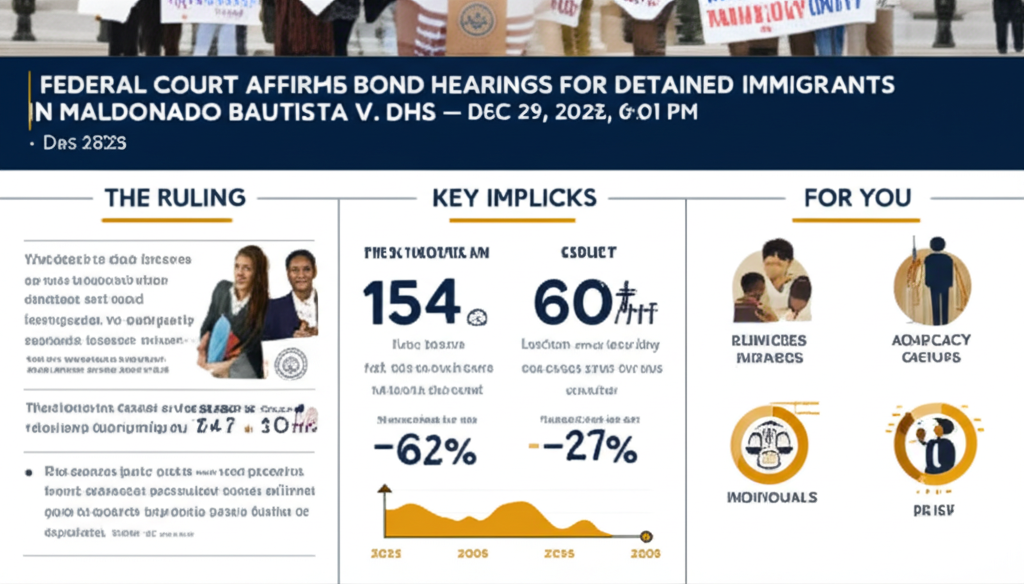
Federal Court Affirms Bond Hearings for Detained Immigrants in Maldonado Bautista v. DHS
In a landmark ruling on December 22, 2025, a federal court affirmed that a nationwide class of detained immigrants retains the right to bond hearings, directly countering recent DHS policies on indefinite detention.[7] This decision in Maldonado Bautista v. DHS, led by the ACLU of Southern California, provides critical protections for families facing separation amid intensified immigration enforcement under the Trump administration.[7] For immigrants and mixed-status families in Florida and nationwide, this ruling marks a pivotal shift in detention practices.
The Ruling: What Happened in Maldonado Bautista v. DHS
The federal court's decision addresses a surge in detentions without bond opportunities since July 2025, affecting thousands across the U.S.[7] DHS had implemented policies jailing individuals indefinitely while immigration cases dragged on for months or years, often separating parents from U.S. citizen children.[7] Over 220 immigration judges in hundreds of cases ruled these practices unlawful, violating immigration law and constitutional due process, yet most detainees lacked access to hearings.[7]
The court certified a nationwide class, ensuring bond hearings for those impacted, including families torn apart by raids and enforcement actions.[7] This aligns with reports of U.S. citizens and legal residents detained erroneously, as highlighted in congressional scrutiny of DHS Secretary Kristi Noem on December 12, 2025.[2] Cases like an Irish immigrant married to a Navy veteran, held over minor charges, underscore the human toll on families.[2]
Legal Background and Key Precedents
Under INA Section 236, noncitizens are entitled to bond hearings unless subject to mandatory detention under specific crimes or national security risks.[5] The Laken-Riley Act, signed January 29, 2025, expanded mandatory detention for those entering without inspection, fueling disputes.[5] However, Maldonado Bautista reaffirms that even expanded categories require individualized bond assessments, echoing Supreme Court precedents like Zadvydas v. Davis (2001), which limits indefinite detention.[7]
- Nationwide Class Certification: Covers detainees denied hearings since July 2025, prioritizing family unity cases.[7]
- Judicial Consensus: 220+ judges deemed DHS policy unconstitutional, building momentum for this ruling.[7]
- Enforcement Context: Ties to mass deportation operations, with quotas of 3,000 daily detentions reported.[3]
Legal Implications for Families and Immigrants
This ruling disrupts the administration's aggressive detention strategy, potentially slowing family separations reported in ICE operations.[6] With 6 million U.S. citizen children having unauthorized immigrant parents and 14 million living with such family members, the stakes are immense.[3] It challenges policies like expanded expedited removal and asylum restrictions from USCIS PM-602-0192 (December 2, 2025), which added scrutiny for "high-risk" country applicants.[1]
For Florida families, where enforcement mirrors Texas surges in habeas petitions, outcomes now hinge more on court access than agency discretion.[1] The decision may influence related litigation, including Supreme Court review of birthright citizenship restrictions (docketed December 5, 2025), affecting U.S.-born children of noncitizens.[1][2] It also counters public charge rule proposals expanding officer discretion on benefits use, chilling family program access.[2]
Broader Policy Ripple Effects
Congressional hearings exposed flaws, with Democrats citing U.S. citizen detentions and veteran family deportations.[2] Meanwhile, DHS terminated Syria's TPS on September 22, 2025, via Federal Register, ending protections without court stay.[1] Bond hearing rights could extend pauses, allowing time for appeals or adjustments like VAWA petitions, recently updated by USCIS.[9]
| Policy Change | Impact on Families | Court Response |
|---|---|---|
| Indefinite Detention (Post-July 2025) | Separates parents from citizen children | Bond hearings mandated nationwide[7] |
| Laken-Riley Act (Jan 2025) | Mandatory detention for unlawful entry | Individualized hearings required[5][7] |
| USCIS PM-602-0192 (Dec 2) | Review of asylum from high-risk countries | Potential habeas relief via bonds[1] |
Actionable Guidance: Steps for Affected Individuals and Families
If you or a loved one faces detention, act swiftly to leverage this ruling. Imigrar, your Orlando immigration law firm, urges immediate consultation.
Immediate Actions for Detained Individuals
- Request Bond Hearing: File a motion citing Maldonado Bautista v. DHS (December 22, 2025) through counsel; over 220 judges have precedent.[7]
- Habeas Petition: Challenge unlawful detention in federal court, especially in high-enforcement areas like Florida or Texas.[1]
- Gather Evidence: Document family ties, U.S. citizen children, employment, and community roots to argue for release.[3]
Family Preparedness Plans
Proactively protect against separation using vetted resources:
- CLINIC’s 50-State Emergency Preparedness for Immigrant Families[5]
- Immigrant Legal Resource Center’s Step-by-Step Plan (adapt for Florida docs like powers of attorney)[5]
- Women’s Refugee Commission: Essential Steps for Migrant Parents[5]
For Those at Risk of Detention
- Consult an Attorney: Schedule with Imigrar for VAWA, asylum, or adjustment reviews amid policy shifts.[9]
- Prepare Documents: Secure birth certificates, school records for children, and financial proofs against public charge fears.[2]
- Monitor Status: Check USCIS for holds on pending apps; file FOIA for records.[1]
- Avoid Risks: Designate guardians for children; limit travel near enforcement zones.[6]
Florida residents face heightened scrutiny with new parole fees and EB-5 adjustments.[4][8] Act before quotas escalate separations.
Why This Matters for Florida Immigrant Families
In Orlando and beyond, 2025 updates like higher fees for parole and family visas compound pressures.[8] The Reuniting Families Act (S. 3419) proposes doubling visas and 10-year processing caps, but passage is uncertain.[2] Maldonado Bautista buys time, enabling pursuits of bills like H.R. 6565.[2]
Families report nursing mothers separated from infants and parents forced to choose between U.S. care and deportation.[3][6] This ruling restores due process, but enforcement persists—3,000 daily detentions signal urgency.[3]
Next Steps and Monitoring Developments
Appeal risks remain; DHS may seek stays. Track Supreme Court birthright case for citizenship impacts.[1] Imigrar monitors daily, offering free consultations. Contact us at (407) 955-4001 or via our site to safeguard your family.
Stay informed: Outcomes depend on litigation as much as policy.[1] With 82% of affected children U.S. citizens, unity is legally winnable.[3]
Disclaimer: This article provides general guidance; consult licensed counsel for case-specific advice. Sources verified as of December 29, 2025.
Related Topics
Need Legal Assistance?
Our experienced immigration attorneys are here to help with your case. Contact Imigrar today for a free consultation and let us guide you through the legal process with confidence.
📍 Orlando, Florida • Serving clients nationwide
📧 info@imigrar.com