


As an immigrant in the United States, securing and maintaining your legal right to work is paramount. For many, this means obtaining an Employment Authorization Document (EAD), often referred to as a work permit. The process for applying for or renewing an EAD can be complex and ever-changing, making it crucial to stay informed about the latest updates from U.S. Citizenship and Immigration Services (USCIS).
At Imigrar, an immigration law firm based in Orlando, Florida, we understand the anxieties and challenges that come with navigating the immigration system. Our mission is to "Keep Families Together" by providing expert legal guidance and compassionate support. Today, we're diving deep into recent developments concerning EAD processing, offering a comprehensive guide designed to empower you with the knowledge you need.
The reporting that sparked this guide
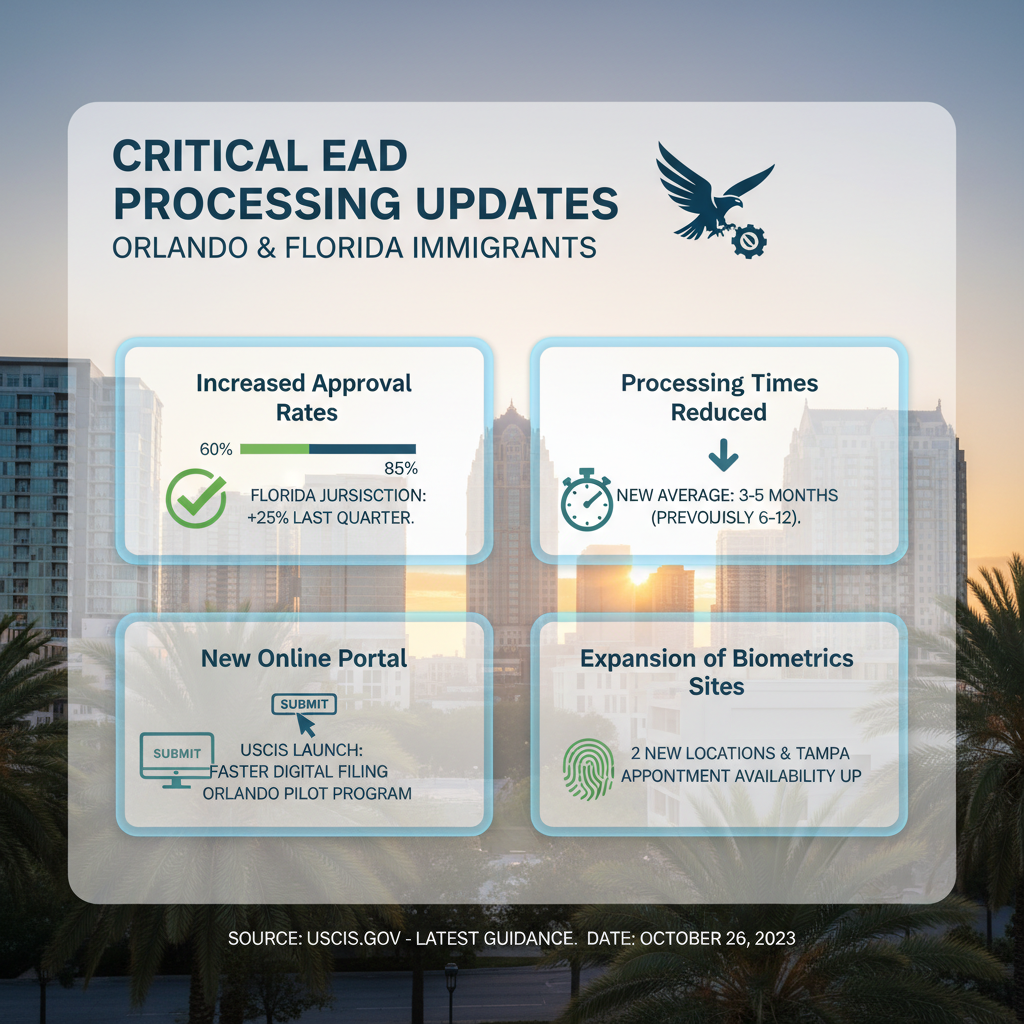
Recent discussions and announcements from USCIS regarding efforts to streamline application processing, address backlogs, and clarify policies have brought Employment Authorization Document processing into the spotlight. These updates are a response to ongoing challenges and an attempt to improve efficiency for applicants nationwide.
You can track general immigration news and updates through various sources, including:
Employment Authorization Document Processing (USCIS)What This News Means for Immigrants in Orlando and Across Florida
Understanding the implications of USCIS updates is vital for anyone seeking or renewing an EAD. These changes can significantly impact your timeline, eligibility, and the steps you need to take.
Why this news is showing up now
The past few years have presented unprecedented challenges for immigration processing, largely due to the COVID-19 pandemic, staffing shortages, and a surge in application volumes. In response, USCIS has been actively working on initiatives to improve efficiency and reduce processing backlogs across various form types, including Form I-765, Application for Employment Authorization. As of early 2026, these efforts are continuing, with a focus on:
- Implementing advanced technology for digital processing and online filing.
- Adjusting validity periods for certain EAD categories to reduce renewal frequency.
- Prioritizing certain application types, particularly those for healthcare workers or applicants with concurrent Adjustment of Status applications.
- Streamlining internal procedures and training for adjudicators.
These ongoing adjustments are part of a broader strategy by USCIS to modernize its operations and meet the demands of a growing number of immigration applications. Consequently, public announcements and policy clarifications are frequent, making it essential for applicants to stay updated.
How it can affect Florida residents
For immigrants living in Orlando, Central Florida, and throughout the state, these EAD processing updates have direct implications:
- Job Security and Employment Opportunities: Faster or more predictable EAD processing times can mean less uncertainty for individuals and families relying on work authorization to maintain their livelihoods. This is particularly crucial in Florida's dynamic job market, from tourism to tech.
- Economic Impact: Delays in EAD processing can lead to job losses or an inability to start new employment, impacting personal finances and the broader Florida economy. Conversely, efficient processing supports the integration of immigrants into the workforce.
- Family Stability: Many families in Orlando and along the I-4 corridor depend on an EAD holder's income. Processing updates that reduce wait times or provide automatic extensions can offer significant relief and stability, aligning with Imigrar's mission to "Keep Families Together."
- Local USCIS Engagement: While EAD applications are primarily processed by USCIS Service Centers, issues related to underlying immigration benefits (like Adjustment of Status) often involve the Orlando USCIS Field Office. Understanding processing trends can help manage expectations for related applications.
- Planning and Preparation: Knowing about potential automatic extensions or changes in required documentation allows Florida residents to plan their renewals and avoid lapses in work authorization more effectively.
The Orlando metropolitan area, with its diverse population, sees a significant number of EAD applications annually. Being informed about these national trends is key to successfully navigating your own immigration journey here in the Sunshine State.
Need Help Navigating EAD Updates? The immigration landscape can be complex. Our Orlando immigration team at Imigrar is ready to assist you with the latest EAD requirements and processing. Call +1 786-791-3106 for a free consultation, or message us online. Se Habla Español.
What Employment Authorization Document (EAD) Processing Is (and Why It Matters)
For many non-citizens in the U.S., the ability to legally work is essential for self-sufficiency, contributing to the economy, and building a life. An Employment Authorization Document (EAD) is the key to this ability.
A plain-English definition
An Employment Authorization Document (EAD), often called a work permit, is a card issued by USCIS that provides temporary authorization for certain non-citizens to work legally in the United States. It's a physical card, similar to a driver's license, that proves your eligibility to be employed.
It's important to understand that an EAD is not a visa and does not grant you immigration status. Instead, it's a benefit granted to individuals who already have a specific underlying immigration status or application pending that allows for work authorization. For example, individuals applying for a Green Card (Adjustment of Status), asylum seekers, or certain visa holders' dependents may be eligible for an EAD.
The processing of an EAD involves USCIS reviewing your application, verifying your eligibility under immigration law, conducting background checks, and then issuing the card. This process is critical because without a valid EAD, most non-citizens are prohibited from working legally in the U.S., which can have severe consequences for both the individual and their employer.
Key terms you need to know
Navigating EAD processing requires familiarity with several important terms:
- USCIS (U.S. Citizenship and Immigration Services): The government agency responsible for processing immigration benefits, including EADs. USCIS official website
- Employment Authorization Document (EAD): The official name for the work permit card.
- Form I-765, Application for Employment Authorization: The specific application form you must file with USCIS to request an EAD. You can find this and other forms on the USCIS Forms page.
- Adjustment of Status (AOS): The process by which eligible individuals already in the U.S. can apply for lawful permanent resident status (a Green Card) without having to return to their home country. Applicants for AOS are often eligible for an EAD.
- Asylum Applicant: An individual who has applied for asylum in the U.S. and whose application has been pending for at least 180 days may be eligible for an EAD.
- TPS (Temporary Protected Status): A temporary immigration status granted to eligible nationals of certain countries designated by the Secretary of Homeland Security. Individuals with TPS are eligible for EADs.
- DACA (Deferred Action for Childhood Arrivals): An immigration policy that allows certain undocumented immigrants who entered the U.S. as minors to receive a renewable two-year period of deferred action from deportation and eligibility for a work permit.
- H-4 Dependent: The spouse of an H-1B nonimmigrant who has an approved Form I-140, Immigrant Petition for Alien Worker, or whose H-1B spouse has been granted an extension of stay beyond the six-year limit under AC21 may be eligible for an EAD.
- Concurrent Filing: When multiple immigration forms (e.g., Form I-485 for Adjustment of Status and Form I-765 for an EAD) are filed together at the same time.
- Receipt Notice: A notice from USCIS confirming they have received your application. This notice contains your receipt number, which is essential for tracking your case status.
- Biometrics Appointment: An appointment at a local Application Support Center (ASC) where USCIS collects fingerprints, photos, and a signature for background checks. Not all EAD applications require biometrics, but many do.
- RFE (Request for Evidence): A notice from USCIS asking for additional information or documents to support your application. Responding to an RFE accurately and promptly is crucial.
- Automatic Extension: For certain EAD categories, if you file a renewal application before your current EAD expires, your work authorization may be automatically extended for a specific period (e.g., up to 540 days in some cases as of recent policy changes) while your renewal is pending.
Current Immigration Law: The Foundation of EADs
The ability to obtain an EAD is rooted in federal immigration law, specifically the Immigration and Nationality Act (INA) and its implementing regulations in Title 8 of the Code of Federal Regulations (8 CFR).
Federal requirements
The primary regulation governing eligibility for employment authorization is 8 CFR § 274a.12, which lists numerous categories of non-citizens who are eligible to apply for an EAD. These categories are diverse and depend entirely on your underlying immigration status or the nature of your pending application. Key federal requirements include:
- Eligibility Category: You must fit into one of the specific eligibility categories defined by USCIS. Common categories include:
- Applicants for Adjustment of Status (c)(9)
- Asylum applicants (c)(8)
- Recipients of Deferred Action for Childhood Arrivals (DACA) (c)(33)
- Spouses of certain H-1B nonimmigrants (c)(26)
- Students with Optional Practical Training (OPT) (c)(3)
- Individuals granted Temporary Protected Status (TPS) (a)(12)
- Parolees (c)(11)
- Proper Filing of Form I-765: All applicants must correctly complete and submit Form I-765, Application for Employment Authorization, along with all required supporting documentation and the correct filing fee (or an approved fee waiver).
- Maintenance of Underlying Status/Application: Your eligibility for an EAD is generally tied to your underlying immigration status or the ongoing adjudication of another immigration benefit. If that underlying status or application is denied or terminated, your EAD may also be revoked.
- Background Checks: All applicants undergo security and background checks, including biometrics collection, to ensure they do not pose a national security risk or have a disqualifying criminal history.
It's crucial to consult the official USCIS website for the most current regulations and eligibility criteria for your specific category. The rules can change, and what was true last year may not be true today.
Important: Always use the latest version of Form I-765 from the USCIS Forms page. Filing an outdated form can lead to rejection and delays.
Florida-specific considerations
While EAD eligibility and processing are governed by federal law, there are some practical considerations for Florida residents:
- Identification: An approved EAD card is a primary document used by Florida residents to obtain a Florida driver's license or state identification card, which is crucial for daily life and employment in Orange County and beyond. The validity period of your Florida ID will typically match the expiration date on your EAD.
- Local Resources: While EAD applications are processed by USCIS Service Centers (which are not in Florida), the Orlando USCIS Field Office handles interviews for underlying applications like Adjustment of Status (Form I-485), which are often concurrently filed with an EAD. Understanding the local office's procedures can be helpful for related benefits.
- Employer Compliance: Florida employers, like all U.S. employers, must comply with federal requirements for verifying employment eligibility using Form I-9, Employment Eligibility Verification. A valid EAD is one of the acceptable documents for this purpose.
There are no Florida-specific laws that alter federal EAD eligibility or processing. However, state-level policies regarding professional licenses or public benefits may require a valid EAD or specific immigration status. Always consult with an attorney regarding specific state-level impacts.
How to Apply for or Renew Your EAD: A Complete Step-by-Step Guide
Applying for or renewing an Employment Authorization Document (EAD) involves careful preparation and adherence to USCIS guidelines. This step-by-step guide will walk you through the process, whether it's your initial application or a renewal.
1) Determine Your Eligibility and Category
Before anything else, you must confirm that you are eligible for an EAD under a specific USCIS category. This is the most critical first step. Eligibility is tied to your immigration status or pending application. Refer to 8 CFR § 274a.12 and the Form I-765 instructions for a complete list of categories.
- Action: Identify your correct eligibility category (e.g., (c)(9) for Adjustment of Status applicants, (c)(8) for asylum applicants, (c)(26) for certain H-4 spouses).
- Required Documents (for determination):
- Your current immigration documents (e.g., visa, I-94 Arrival/Departure Record, asylum application receipt, Form I-797C, Notice of Action for other benefits).
- Proof of your underlying status (e.g., marriage certificate for a spouse, birth certificate for a child, Form I-140 approval notice for H-4 EAD).
2) Gather All Required Documents
Once you know your category, collect all necessary supporting documents. This is where many applications get delayed due to missing or incorrect information. Organize everything meticulously.
- Action: Collect every document specified in the Form I-765 instructions for your eligibility category.
- Required Documents (general):
- Two identical passport-style photos (taken within 30 days of filing, with a white background).
- Copy of your last EAD (if renewing).
- Copy of your government-issued identification (e.g., passport biographic page, birth certificate with photo ID, state ID).
- Copy of Form I-94 Arrival/Departure Record (front and back, if applicable).
- Copy of your visa (if applicable).
- Copy of your birth certificate (with certified translation if not in English).
- Marriage certificate (if applying as a spouse).
- Evidence of your underlying immigration status or application (e.g., Form I-485 Receipt Notice, asylum interview notice, Form I-130 approval, Form I-140 approval, TPS designation notice).
- If applying for a fee waiver (Form I-912), documentation proving inability to pay (e.g., proof of means-tested benefit, household income below 150% poverty line).
- Any other documents specific to your category (e.g., for OPT, your Form I-20 with the DSO's recommendation).
3) Complete Form I-765 Accurately
Fill out Form I-765, Application for Employment Authorization, completely and accurately. Use the latest version from the USCIS website. Incomplete or incorrect forms are a leading cause of rejection or delays.
- Action: Download the current Form I-765 from USCIS Forms. Read all instructions carefully.
- Tips for completion:
- Type your answers or print clearly in black ink.
- Answer all questions, even if the answer is "N/A" (Not Applicable).
- Double-check your eligibility category code (Item 27 on the form).
- Sign the form with a wet signature. Electronic signatures are generally not accepted unless specified by USCIS for online filings.
4) Prepare Your Application Package and File
Assemble your application package according to USCIS guidelines. This typically involves placing the forms and documents in a specific order.
- Action: Assemble your application package and mail it to the correct USCIS lockbox facility, or file online if your category allows.
- Package contents (recommended order):
- Cover letter (optional, but recommended for clarity).
- Payment (check or money order) or Form I-912, Request for Fee Waiver.
- Form I-765, signed.
- Two passport-style photos in a small envelope stapled to the form or in a clear baggie.
- Copies of all supporting documents (do NOT send originals unless specifically requested).
- If filing online, follow the instructions on the USCIS online portal.
- Filing Fee: Check the USCIS fees page for the current Form I-765 fee.
- Mailing Address: The filing address depends on your eligibility category and the state you live in. Always check the "Where to File" section of the Form I-765 instructions. For Central Florida residents, this usually means sending to a lockbox in Dallas or Chicago.
- Reminder: Keep a complete copy of your entire application package for your records.
5) Attend Your Biometrics Appointment (If Required)
After filing, USCIS will send you a Form I-797C, Notice of Action, acknowledging receipt of your application. If biometrics are required for your case, you will receive a separate appointment notice for an Application Support Center (ASC).
- Action: Attend your biometrics appointment as scheduled.
- What to bring:
- The appointment notice.
- A valid photo ID (e.g., passport, driver's license).
- Important: Do not miss this appointment. If you have an unavoidable conflict, follow the instructions on the notice to reschedule, but be aware this may cause delays.
6) Monitor Your Case Status
Once USCIS receives your application, you can track its progress online.
- Action: Regularly check your case status using the receipt number provided on your Form I-797C.
- Online Tools:
- Use the "Check Case Status" tool on the USCIS official website.
- Sign up for email and text message notifications.
- Check USCIS Processing Times for your specific form and Service Center.
7) Respond to RFEs and Receive Your EAD Card
During processing, USCIS may issue an RFE (Request for Evidence) if they need more information. If your application is approved, your EAD card will be mailed to you.
- Action: If you receive an RFE, respond completely and within the given deadline. If approved, await your card.
- Responding to RFEs:
- Read the RFE carefully and understand exactly what is requested.
- Gather the requested documents.
- Include a copy of the RFE notice with your response.
- Mail your response to the address provided on the RFE.
- Keep a copy of your response.
- Receiving Your EAD: Once approved, USCIS will mail your EAD card. Ensure your address on file with USCIS is current.
Overwhelmed by the EAD Application Process? Don't go through it alone. Imigrar's experienced immigration lawyers in Orlando can guide you through each step, ensuring accuracy and minimizing delays. Contact us today for a free consultation at +1 786-791-3106. Se Habla Español.

Practical Steps You Can Take Today for Your EAD Application
Pro


