
DACA Renewal Guide 2026: Updates & Eligibility for Florida
Stay informed on DACA renewals. This comprehensive 2026 guide covers eligibility, the step-by-step process, crucial deadlines, and legal insights for Dreamers in Orlando and nationwide.

Navigating the complexities of immigration law can be challenging, especially for those relying on programs like Deferred Action for Childhood Arrivals (DACA). At Imigrar, we understand the anxieties and uncertainties that come with legal updates and renewal processes. This comprehensive guide is designed to provide clarity, practical advice, and actionable steps for DACA recipients in 2026, drawing on the latest information from official sources.
Our commitment is to "Keep Families Together," and that includes supporting Dreamers who are vital members of our communities here in Orlando, across Florida, and throughout the nation. We aim to equip you with the knowledge needed to successfully renew your DACA status and maintain your ability to live and work in the U.S.
The reporting that sparked this guide
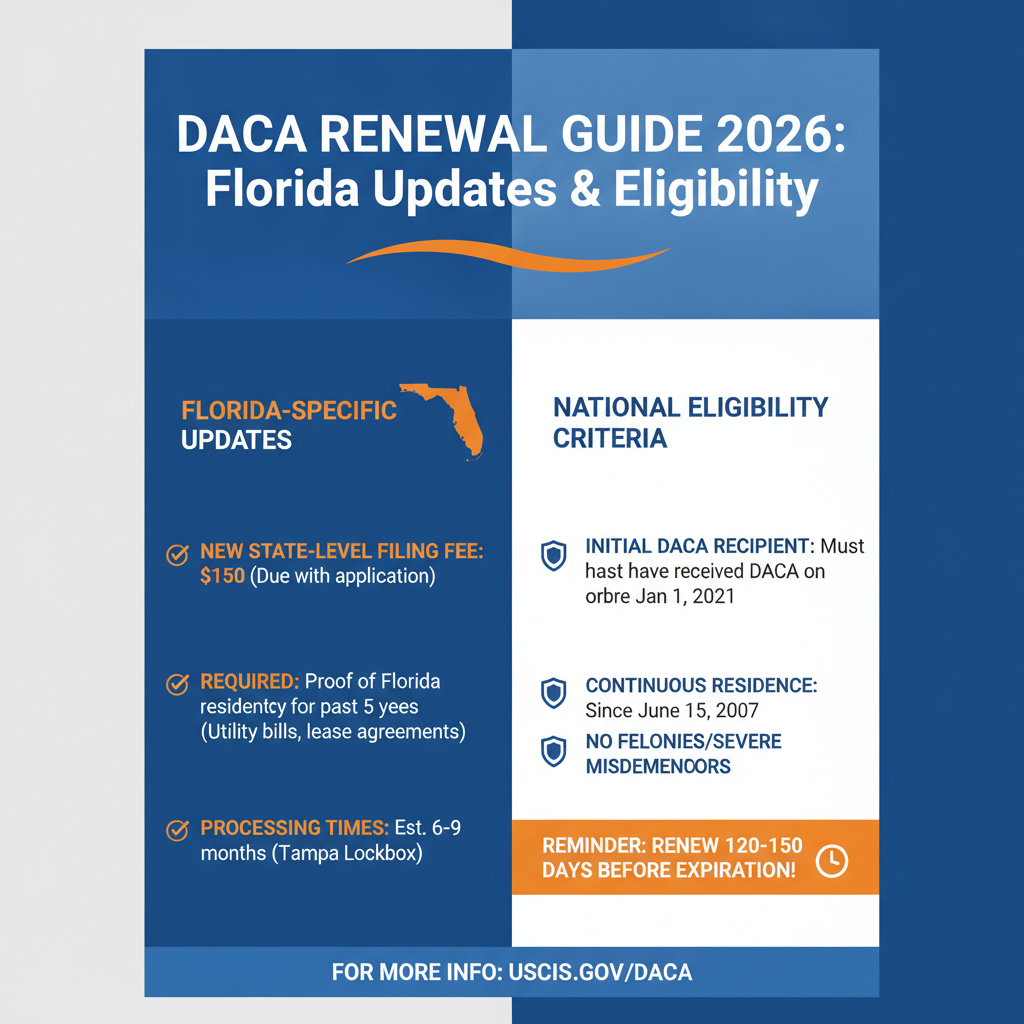
The information provided in this article is based on ongoing developments and official guidance regarding the DACA program. We closely monitor news and updates from authoritative sources to ensure our advice is timely and accurate. For the latest official information, please refer to the:
DACA Program Updates and Renewal Information (USCIS)
What This News Means for Immigrants in Orlando and Across Florida
The landscape of DACA has been in constant flux since its inception in 2012. For beneficiaries, every news cycle can bring a mix of hope and apprehension. As of late 2026, the program continues to face legal challenges, yet USCIS continues to accept and process DACA renewal requests. This ongoing situation means vigilance and proactive planning are more critical than ever.
Why this news is showing up now
The current state of the DACA program is a direct result of various legal battles and court decisions. Most notably, a federal court ruling in Texas v. United States in July 2021, affirmed by the Fifth Circuit Court of Appeals in October 2022, declared DACA unlawful. This ruling effectively prohibited USCIS from approving new DACA applications but allowed for the continued processing of renewal requests for current DACA recipients. The case has been subject to further review, including a new DACA regulation finalized by the Department of Homeland Security (DHS) in August 2022, which codifies the DACA policy. However, the legal challenge from Texas persists, and the Fifth Circuit has remanded the case back to the district court for further consideration of this new regulation. This complex interplay of administrative action and judicial review means that while renewals are safe for now, the program's long-term future remains uncertain, making any and all updates significant for Dreamers.
For DACA recipients, this means staying informed about the legal proceedings is crucial, even as the day-to-day process of renewal remains relatively stable. The constant legal scrutiny keeps DACA in the news, reminding everyone of its precarious but vital status for hundreds of thousands of individuals nationwide.
How it can affect Florida residents
Florida is home to a significant population of DACA recipients, often referred to as Dreamers, many of whom reside in the bustling Central Florida region, including Orlando, Kissimmee, and along the I-4 corridor. The ongoing DACA updates directly impact their lives in several key ways:
- Continued Work Authorization: Renewing DACA allows recipients to maintain their Employment Authorization Document (EAD), which is essential for working legally in Florida. This enables them to contribute to the state's economy, support their families, and pursue their careers.
- Driver's Licenses: In Florida, DACA recipients are eligible to apply for a driver's license, which is fundamental for daily life, commuting to work or school, and accessing essential services. Timely renewal ensures this privilege is not interrupted.
- Educational Opportunities: While Florida does not offer in-state tuition for all DACA recipients without additional residency requirements, many Dreamers pursue higher education at institutions across the state. Renewed DACA status ensures they can continue their studies without fear of deportation and often qualifies them for certain scholarships or aid programs.
- Community Stability: For families in Orange County and surrounding areas, DACA provides a degree of stability, allowing them to plan for the future without the immediate threat of family separation. Any disruption to DACA would have profound social and economic consequences for these communities.
- Local USCIS Field Office: The Orlando USCIS Field Office serves a vast number of immigrants in Central Florida. Understanding the DACA renewal process helps to streamline interactions with this office, though DACA renewals are typically processed by USCIS service centers, not local field offices.
The news surrounding DACA serves as a critical reminder for Florida's Dreamers to be proactive, understand their renewal options, and seek expert legal guidance to navigate this complex environment. Imigrar is deeply committed to serving this community, ensuring that families can remain together and individuals can continue to thrive in Florida.
Need Help? Our Orlando immigration team is ready to assist with your DACA renewal. Call +1 786-791-3106 for a free consultation, or message us online. Se Habla Español.
What DACA Is (and Why It Matters)
To fully understand the current updates and renewal process, it's essential to grasp the fundamentals of the DACA program itself. DACA stands for Deferred Action for Childhood Arrivals, a policy implemented in 2012 under the Obama administration.
A plain-English definition
At its core, DACA is a policy that offers temporary protection from deportation and provides work authorization to certain undocumented immigrants who came to the United States as children. It is not a path to citizenship, nor does it grant lawful immigration status. Instead, it offers "deferred action," meaning the government agrees to defer or postpone any enforcement action against an eligible individual for a renewable period, typically two years. During this period, recipients are eligible to apply for an Employment Authorization Document (EAD), commonly known as a work permit.
Essentially, DACA allows eligible young people, often referred to as Dreamers, to legally work, obtain a driver's license, and pursue education without the constant fear of being removed from the country they consider home. It provides a measure of stability and opportunity for individuals who grew up in the U.S. and have strong ties to American communities.
Key terms you need to know
Understanding the following terms is crucial when discussing DACA:
- Deferred Action: This is a discretionary determination by USCIS to defer removal (deportation) proceedings against an individual. It does not confer lawful status or any pathway to permanent residency or citizenship. It is temporary and can be revoked.
- Dreamer: A colloquial term referring to young undocumented immigrants who were brought to the U.S. as children. The term originated from the "DREAM Act" (Development, Relief, and Education for Alien Minors Act), a legislative proposal that would have provided a path to legal status for these individuals.
- Employment Authorization Document (EAD): Also known as a work permit, this card proves an individual is authorized to work in the United States. DACA recipients receive an EAD, typically valid for two years, which must be renewed along with their deferred action.
- USCIS: The U.S. Citizenship and Immigration Services is the federal agency that oversees lawful immigration to the United States. USCIS processes DACA applications and renewals. You can find more information on their USCIS official website.
- Advance Parole: A document issued by USCIS that allows certain non-citizens to travel abroad and return to the United States without jeopardizing their immigration status. DACA recipients can apply for Advance Parole (using Form I-131) for specific humanitarian, educational, or employment reasons, though approval is discretionary and not guaranteed.
- Continuous Residence: A key eligibility requirement for DACA, referring to the uninterrupted physical presence in the U.S. for a specified period. For DACA, this generally means residing in the U.S. from a certain date (e.g., June 15, 2007) up to the present. Brief, casual, and innocent absences from the U.S. do not break continuous residence.
DACA matters because it affects the lives of over 600,000 individuals nationwide, allowing them to pursue education, careers, and contribute to society. For many, it represents the only opportunity to live openly and without constant fear in the country they've always known as home. Its continued existence, even in a limited capacity, is crucial for economic stability and social integration for these individuals and their families.
Current Immigration Law: The Foundation for DACA
It's important to clarify that DACA itself is not a formal statute passed by Congress. Instead, it is an exercise of prosecutorial discretion by the executive branch, formalized through policy memoranda. The legal framework surrounding DACA has been intensely debated and challenged, leading to its current, complex status.
The original DACA policy was announced by the Secretary of Homeland Security on June 15, 2012. It was based on the premise that the Department of Homeland Security (DHS) has the inherent authority to exercise prosecutorial discretion in immigration enforcement, allowing it to prioritize certain cases for removal while deferring action on others. This discretion is a long-standing principle in immigration law.
However, this executive action has been challenged in federal courts. As mentioned, the 2021 ruling in Texas v. United States declared the 2012 DACA memorandum unlawful. While the Biden administration attempted to codify DACA through a new regulation in 2022, the Fifth Circuit Court of Appeals upheld the district court's finding that the original DACA policy was unlawful and remanded the case back for further review of the new regulation. This means that while the DACA policy is currently operational for renewals, it remains under a cloud of legal uncertainty, preventing USCIS from accepting new initial applications.
Federal requirements for DACA Renewal
To be eligible for DACA renewal, applicants must generally meet the criteria established in the original 2012 memorandum, with an emphasis on maintaining continuous eligibility. Specifically, you must demonstrate that you:
- Were under the age of 31 as of June 15, 2012.
- Came to the United States before reaching your 16th birthday.
- Have continuously resided in the United States since June 15, 2007, up to the present time.
- Were physically present in the United States on June 15, 2012, and at the time of making your request for deferred action.
- Had no lawful immigration status on June 15, 2012.
- Are currently in school, have graduated or obtained a certificate of completion from high school, have obtained a General Education Development (GED) certificate, or are an honorably discharged veteran of the Coast Guard or Armed Forces of the United States.
- Have not been convicted of a felony, a significant misdemeanor, or three or more other misdemeanors, and do not pose a threat to national security or public safety.
Important: For renewals, USCIS will primarily check for any changes in your criminal record or continuous residence since your last DACA approval. Any new arrests or convictions, even minor ones, must be disclosed and could impact your eligibility. Similarly, significant periods outside the U.S. without proper authorization (i.e., Advance Parole) can break continuous residence.
The forms required for DACA renewal are:
- Form I-821D, Consideration of Deferred Action for Childhood Arrivals
- Form I-765, Application for Employment Authorization
- Form I-765 Worksheet, Instructions for Form I-765
All these forms, along with detailed instructions, can be found on the USCIS Forms page on the USCIS official website.
Florida-specific considerations
For DACA recipients residing in Florida, understanding the statewide context is key. While DACA is a federal program, its benefits interact with state laws and policies:
- Driver's Licenses: The Florida Department of Highway Safety and Motor Vehicles (FLHSMV) issues driver's licenses to DACA recipients who present a valid EAD and other required identification documents. Renewing DACA promptly ensures uninterrupted driving privileges, which are essential for many in car-dependent areas like Orlando.
- In-State Tuition: Florida state colleges and universities generally require lawful permanent residency or other specific lawful statuses for in-state tuition eligibility. DACA recipients, while having deferred action, do not have a lawful immigration status. However, some individual institutions or specific programs might have policies or scholarships that benefit DACA students. It is crucial for students in Central Florida to check with their specific educational institution regarding tuition residency requirements and financial aid options.
- Local Resources: Organizations and legal aid groups in Orlando and throughout Florida often provide assistance and resources tailored to the DACA community, including renewal clinics and educational workshops. These local networks can be invaluable.
- Healthcare Access: DACA recipients in Florida generally do not qualify for federal health insurance programs like Medicaid or Affordable Care Act (ACA) subsidies. Access to healthcare often relies on employer-sponsored plans or community health clinics.
Understanding these Florida-specific considerations, alongside the federal requirements, is vital for DACA recipients to fully leverage their deferred action status and navigate life in the Sunshine State.
Confused about DACA eligibility or the renewal process? Don't risk a delay or denial. Our experienced Orlando immigration lawyers can help. Call +1 786-791-3106 for a free consultation. Se Habla Español.
How to Renew Your DACA: A Complete Step-by-Step Guide
Renewing your DACA is a critical process that requires attention to detail and timely action. USCIS recommends filing your renewal application between 120 and 150 days before your current DACA and EAD expire. Filing within this window helps prevent gaps in your work authorization and deferred action. If your DACA has already expired, you can still renew, but filing after 365 days of expiration might be treated as an initial request, which is generally not being accepted.
1) Determine Your Eligibility for Renewal
Before gathering any documents, confirm your continued eligibility. The criteria are largely the same as for initial DACA, but with a focus on any changes since your last approval.
- Continuous Residence: Have you maintained continuous residence in the U.S. since your last DACA approval? Any unauthorized travel outside the U.S. can break this and lead to denial.
- Criminal History: Have you been arrested, charged, or convicted of any crimes since your last DACA approval? Even minor offenses must be disclosed. A felony, significant misdemeanor, or three or more other misdemeanors will likely disqualify you.
- Physical Presence: Were you physically present in the U.S. when you filed your renewal request?
- Expiration Date: Note the expiration date on your current Employment Authorization Document (EAD) and DACA approval notice (Form I-797). Plan to file within the 120-150 day window.
Required Documents for this step (for self-assessment):
- Your most recent DACA approval notice (Form I-797)
- Your current Employment Authorization Document (EAD)
- Any arrest or court records since your last DACA approval
- Records of any travel outside the U.S. (if applicable, with Advance Parole)
2) Gather Required Forms and Documents
Accuracy and completeness are paramount. Missing forms or documents are common reasons for delays or denials. You will need:
- Form I-821D, Consideration of Deferred Action for Childhood Arrivals: Complete all sections thoroughly. Ensure all questions are answered honestly.
- Form I-765, Application for Employment Authorization: This is your application for the work permit.
- Form I-765 Worksheet: This form helps you determine if you need to submit additional evidence for your employment authorization.
- Two Passport-Style Photos: Taken within 30 days of filing, unmounted, glossy, unretouched, and printed on thin paper. Write your name and Alien Registration Number (A-Number) lightly in pencil on the back of each photo.
- Copies of Previous DACA Approval Notices: Include copies of your most recent Form I-797 (Approval Notice for DACA) and your last Employment Authorization Document (EAD), front and back.
- Proof of Identity and Entry: Copies of your birth certificate, passport, or national identity document with photo. If you entered without inspection, include evidence of your entry date.
- Proof of Continuous Residence: Provide documents proving you have continuously resided in the U.S. since June 15, 2007, and since your last DACA approval. Examples include:
- School transcripts or enrollment records (from schools in Orlando or other Florida cities)
- Employment records (pay stubs, W-2 forms)
- Medical records (doctor's visits, hospital stays)
- Utility bills (electricity, water, gas) in your name or your parents' name
- Rent receipts or mortgage statements
- Bank statements
- Tax returns
- Dated photographs with location information
- Affidavits from individuals who can attest to your continuous presence.
- Criminal History Records: If you have any arrests, charges, or convictions since your last DACA approval, you must include certified copies of all court dispositions, police reports, and sentencing documents, even if charges were dismissed or expunged. Failure to disclose can lead to severe consequences.
Reminder: Do not send original documents unless specifically requested by USCIS. Always send copies.
3) Complete All Forms Accurately
This is where many applicants make mistakes. Take your time and be meticulous.
- Read Instructions Carefully: Review the USCIS Forms instructions for Form I-821D and Form I-765 thoroughly.
- Type or Print Neatly: Use black ink. If handwriting, print clearly. Typing is preferred.
- Answer All Questions: Do not leave any questions blank. If a question does not apply to you, write "N/A" (Not Applicable) or "None."
- Sign and Date: Ensure you sign and date all forms where required. An unsigned form will be rejected.
- Review: Have someone else review your forms for errors, especially an experienced immigration attorney.
4) Prepare Your Application Packet and Fees
Organizing your application packet correctly can prevent delays.
- Order of Documents: While USCIS doesn't mandate a strict order, a logical arrangement helps. A common order is:
- Cover Letter (optional, but recommended, listing contents)
- Payment (check/money order)
- Form I-821D
- Supporting documents for Form I-821D (e.g., identity, continuous residence, educational proof, criminal history records)
- Form I-765
- Form I-765 Worksheet
- Supporting documents for Form I-765 (e.g., previous EAD copy, photos)
- Fees: The current fee for DACA renewal typically includes the Form I-765 fee ($410) and the biometric services fee ($85), totaling $495. Fees are subject to change, so always check the USCIS Fees page.
- Submit a single check or money order payable to "U.S. Department of Homeland Security."
- Do not send cash.
- Write your full name and A-Number on the check or money order.
- Fee Waivers: In very limited circumstances, a fee waiver might be available for Form I-765 if you meet strict poverty guidelines. However, fee waivers for DACA are generally very difficult to obtain and should be discussed with an attorney.
5) Mail Your Application to the Correct USCIS Lockbox
The correct mailing address depends on your state of residence and the carrier you use (USPS vs. private courier). Always check the "Where to File" section on the USCIS website for Form I-821D. For Florida residents, the mailing address is typically a USCIS Lockbox facility.
- USPS Address (for Florida residents):
USCIS
Attn: DACA
P.O. Box 20900
Phoenix, AZ 85036-0900 - Courier Service Address
Related Topics
Need Legal Assistance?
Our experienced immigration attorneys are here to help with your case. Contact Imigrar today for a free consultation and let us guide you through the legal process with confidence.
📍 Orlando, Florida • Serving clients nationwide
📧 info@imigrar.com