The reporting that sparked this guide: USCIS Processing Times and Updates for 2026 (USCIS)
What This News Means for Immigrants in Orlando and Across Florida
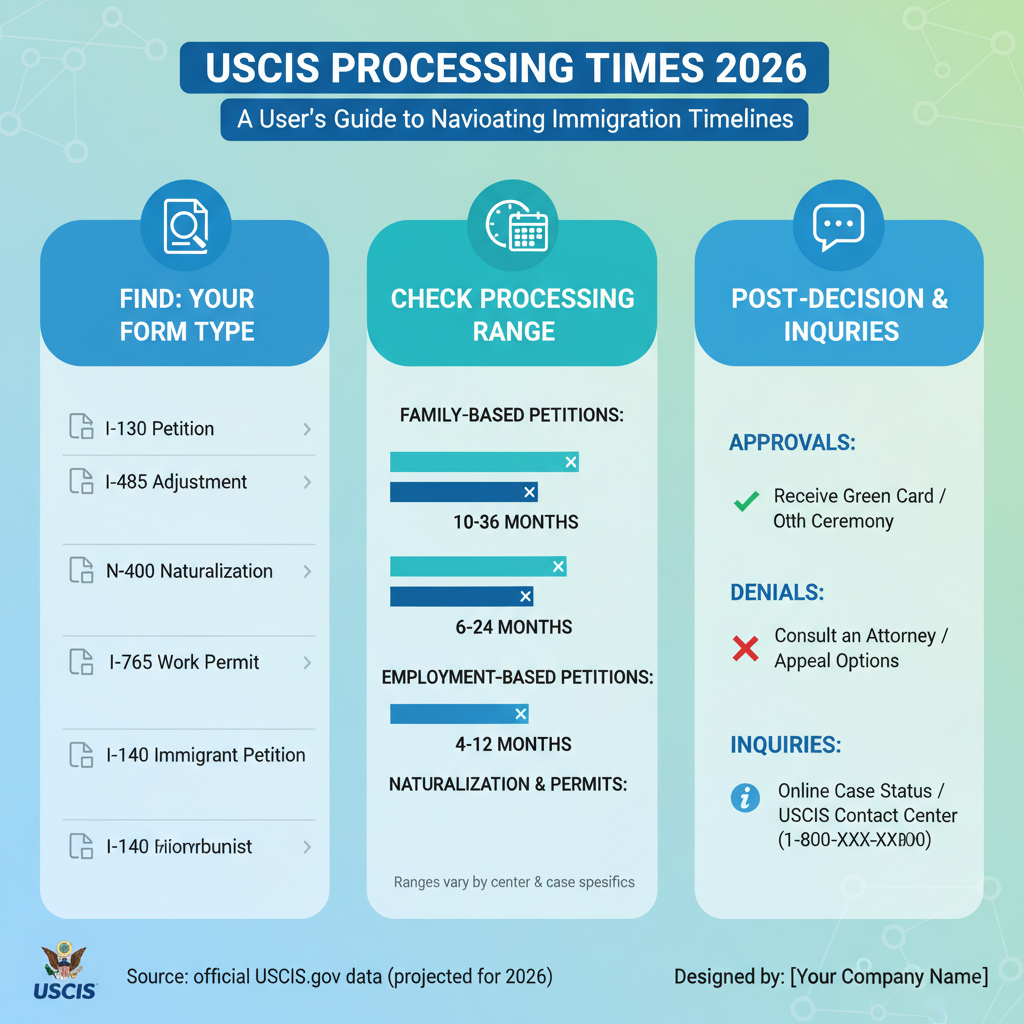
Why this news is showing up now
USCIS processing times are not static; they are a dynamic reflection of several factors, including application volume, staffing levels, budget constraints, and operational efficiencies. In early 2026, the conversation around processing times remains particularly pertinent for several reasons:- Post-Pandemic Backlogs: While significant efforts have been made, the lingering effects of the COVID-19 pandemic continue to contribute to backlogs in certain application categories.
- Increased Application Volume: The demand for immigration services remains consistently high, with many seeking family reunification, employment-based visas, or naturalization.
- Technological Upgrades and Policy Changes: USCIS is continually implementing new technologies and adapting to policy shifts, which can temporarily impact processing speeds as new systems are integrated or procedures are refined.
- Congressional Scrutiny and Funding: The agency's efficiency is often a subject of congressional oversight, leading to ongoing discussions about funding and resource allocation, all of which influence processing capabilities.
How it can affect Florida residents
Florida, with its diverse population and strategic location, is a hub for immigrants from around the globe. The impact of USCIS processing times on Florida residents is profound:- Family Reunification: For those in Orlando and across Central Florida sponsoring family members, delays in processing forms like Form I-130 (Petition for Alien Relative) can mean prolonged separation from loved ones, directly challenging Imigrar's mission to "Keep Families Together."
- Economic Stability: Delays in obtaining work authorization (Form I-765) or employment-based green cards can disrupt careers, impact financial stability, and affect the state's economy.
- Planning and Uncertainty: Uncertainty about when an application will be adjudicated makes it difficult for individuals and families to plan their lives, whether it's buying a home, enrolling children in school, or making career decisions.
- Orlando USCIS Field Office: The local USCIS Field Office in Orlando handles interviews and certain local adjudications for residents of Orange County and surrounding areas. Fluctuations in national processing times can create localized bottlenecks or surges in interview scheduling, directly affecting our clients.
- Naturalization Delays: Residents applying for U.S. citizenship via Form N-400 may experience extended waits, delaying their ability to vote and fully participate in civic life.
Need Help? Our Orlando immigration team is ready to assist. Call +1 786-791-3106 for a free consultation, or message us online. Se Habla Español.
What USCIS Processing Times Are (and Why They Matter)
When you submit an immigration application to USCIS, you embark on a process that has a beginning and an end, but the middle part—the processing time—is often the most opaque. Understanding what these times represent and why they are so crucial is fundamental to managing your expectations and planning your future.A plain-English definition
Simply put, **USCIS processing times** refer to the estimated duration it takes for the agency to review and make a decision on an immigration application or petition, from the date of receipt to the date of adjudication. These are not guarantees but rather estimates based on historical data for completed cases.USCIS publishes these estimates online, typically showing a range (e.g., "6 to 12 months") for different forms at various service centers or field offices. The range reflects the time it took for 80% of adjudicated cases to be processed. The remaining 20% of cases may take longer.
It's crucial to understand that processing times can vary significantly based on:
- Form Type: Some forms, like a petition for a spouse (Form I-130), generally take longer than an application for a work permit (Form I-765).
- Service Center/Field Office: Different USCIS service centers (e.g., California, Nebraska, Texas, Vermont) and local field offices (like the Orlando USCIS Field Office) handle different caseloads and have varying backlogs, leading to different processing times for the same form.
- Case Complexity: Cases requiring additional review, evidence, or interviews may naturally take longer.
- Policy Changes: New policies or priorities can shift resources, impacting certain application categories.
Key terms you need to know
Navigating USCIS processing times requires familiarity with specific terminology:- Receipt Date: This is the date USCIS officially receives your application. It's the starting point for calculating your processing time. You'll find this on your Form I-797C, Notice of Action.
- Priority Date: Primarily relevant for family-sponsored and employment-based green card applications, the Priority Date is the date your petition (usually Form I-130 or Form I-140) was properly filed with USCIS. For many categories, you must wait until your Priority Date becomes current in the U.S. Department of State's Visa Bulletin before you can apply for a green card (Adjustment of Status via Form I-485). This is a separate wait from USCIS processing times.
- National Benefits Center (NBC): Often acts as a central intake and processing facility for many applications, especially those involving Adjustment of Status, before forwarding them to local field offices like Orlando for interviews.
- Field Office: A local USCIS office, such as the Orlando USCIS Field Office, that handles interviews, local adjudications, and certain in-person services.
- Adjudication: The final decision-making process by a USCIS officer on an application or petition.
- Request for Evidence (RFE): A notice from USCIS asking for additional documents or information to support your application. Responding promptly and completely to an RFE is critical to avoid further delays or denial.
- Notice of Intent to Deny (NOID): A notice indicating USCIS intends to deny your application unless you provide specific information or explanation. This is a serious notice requiring immediate attention.
- Case Status Online: The USCIS online tool where you can enter your receipt number to track the status of your application. While helpful, it doesn't always provide detailed explanations for delays.
- Service Request: An inquiry you can make with USCIS if your case is outside the normal processing times shown on their website.
- Backlog: The accumulation of pending cases that USCIS has not yet processed, often leading to extended processing times.
Current Immigration Law: The Foundation for Processing
The processing of immigration applications by USCIS is not an arbitrary function; it is governed by a complex framework of federal laws and regulations. Understanding this legal foundation is key to appreciating why certain procedures exist and why processing times can be lengthy.Federal requirements
The primary legal basis for immigration in the United States is the **Immigration and Nationality Act (INA)**. This comprehensive federal statute, along with subsequent amendments and regulations, dictates who is eligible for various immigration benefits, the procedures for applying, and the responsibilities of USCIS in adjudicating these applications.Key aspects of federal law impacting processing include:
- Categorical Eligibility: The INA defines specific categories for visas and green cards, such as family-sponsored, employment-based, refugee/asylee, and diversity visa programs. Each category has distinct eligibility criteria and numerical limitations (quotas), which directly influence how many applications can be processed annually and, consequently, the wait times.
- Application Requirements: Federal regulations specify the forms that must be filed (e.g., Form I-130 for family petitions, Form I-485 for Adjustment of Status, Form N-400 for naturalization), the supporting documentation required, and the filing fees. Incomplete applications are a common cause of delays.
- Background Checks and Security Screenings: All applicants for immigration benefits undergo rigorous background checks and security screenings mandated by federal law. These checks are conducted by various federal agencies and are a non-negotiable part of the process, often contributing to overall processing times.
- Adjudicatory Standards: USCIS officers are bound by federal law and agency policy to review each application fairly and consistently, ensuring that all legal requirements are met before an immigration benefit is granted. This meticulous review process, while necessary for national security and immigration integrity, inherently takes time.
- Visa Bulletin: For numerically limited visa categories, the U.S. Department of State publishes the Visa Bulletin monthly. This bulletin indicates when a Priority Date becomes current, allowing an applicant to move forward with their green card application. This federal mechanism can impose significant waiting periods completely separate from USCIS's internal processing times.
Florida-specific considerations
While immigration law is federal, its implementation has local nuances, especially in a state like Florida.- Orlando USCIS Field Office: Residents of Orange County, Seminole County, Osceola County, and other Central Florida areas typically interact with the Orlando USCIS Field Office for interviews related to Adjustment of Status, naturalization, and other benefits. The workload and scheduling at this specific office can affect local processing times.
- High Volume of Certain Cases: Florida has a large population of individuals applying for family-based immigration, asylum, and temporary protected status (TPS), given its diverse demographics. High volumes of these specific application types can influence the processing capacity of local offices and service centers that handle a disproportionate number of Florida cases.
- Inter-Agency Coordination: For some cases, particularly those involving criminal history or complex issues, USCIS may coordinate with local law enforcement or state agencies. While rare, this can add to processing times.
How to Navigate USCIS Processing Times: A Complete Step-by-Step Guide
Dealing with USCIS processing times can be daunting, but with a structured approach, you can effectively manage your application and minimize potential delays. This guide offers actionable steps to empower you throughout your immigration journey.1) Understand Your Application Type and Form Numbers
Before anything else, clearly identify the specific immigration benefit you are seeking and the corresponding USCIS forms. Each form has unique requirements and often different processing pathways.- Identify Your Goal: Are you seeking family reunification, an employment visa, asylum, or U.S. citizenship?
- Determine the Correct Forms:
- For family-based petitions: Usually starts with Form I-130 (Petition for Alien Relative).
- For green card applications (within the U.S.): Form I-485 (Application to Register Permanent Residence or Adjust Status).
- For work authorization: Form I-765 (Application for Employment Authorization).
- For travel document (advance parole): Form I-131 (Application for Travel Document).
- For naturalization: Form N-400 (Application for Naturalization).
- And many others depending on your specific case.
- Understand the Interplay: Many immigration processes involve multiple forms filed concurrently or sequentially. For example, a spouse of a U.S. citizen living in Orlando might file Form I-130, Form I-485, Form I-765, and Form I-131 all at once.
- Your passport and visa information
- Birth certificate
- Marriage certificate (if applicable)
- Information about your petitioner/beneficiary
2) Check Official USCIS Processing Times Regularly
Once you know your form numbers, monitor the official USCIS processing times.- Visit the Official Tool: Go to the USCIS Processing Times page.
- Select Your Form: Choose the specific form number you filed (e.g., Form I-485).
- Select Your Field Office/Service Center: This is critical. For forms like Form I-485, you'll select the Field Office where your interview will be held (e.g., Orlando Field Office). For forms like Form I-130, you'll select the Service Center where it was mailed (e.g., Nebraska Service Center).
- Interpret the Range: The displayed range (e.g., "7 to 15 months") shows the time it took USCIS to process 80% of completed cases.
- Check Your Receipt Date: Compare your Receipt Date to the "Case Inquiry Date" provided. If your Receipt Date is *before* the Case Inquiry Date, your case is officially outside normal processing times, and you may be eligible to submit an inquiry.
3) Gather and Organize All Required Documentation Meticulously
This is arguably the most critical step to avoid delays. An incomplete or poorly organized application is a guaranteed way to receive an RFE or even a denial.- Read Instructions Carefully: Each USCIS form comes with detailed instructions. Read them thoroughly, multiple times.
- Create a Checklist: For each form and supporting document listed in the instructions, create your own checklist.
- Collect Originals and Copies: Generally, USCIS asks for copies of supporting documents, but be prepared to present originals at an interview. Never send original irreplaceable documents unless specifically requested.
- Obtain Certified Translations: Any document not in English must be accompanied by a complete and accurate English translation, certified by the translator. For Orlando residents with documents in Spanish, this is especially common.
- Organize and Label: Use tabs, dividers, and cover sheets to organize your submission logically. Make multiple copies of the entire application package – one for yourself, one for your attorney, and the one to be mailed.
- For Form I-130:
- Proof of U.S. citizenship or lawful permanent residency of the petitioner (e.g., birth certificate, passport, naturalization certificate, green card)
- Proof of relationship (e.g., marriage certificate, birth certificates of shared children, adoption decrees)
- Passport-style photos for petitioner and beneficiary
- Evidence of bona fide marriage (if applicable): joint bank statements, leases, utility bills, photos, affidavits from friends/family
- For Form I-485:
- Birth certificate
- Passport, visa, and I-94 records
- Medical examination report (Form I-693)
- Affidavit of Support (Form I-864) with tax returns and financial documents
- Passport-style photos
- Criminal history records (if applicable)
4) File Your Application Accurately and Completely
The accuracy of your submission directly impacts processing.- Complete All Fields: Answer every question truthfully and completely. If a question doesn't apply, write "N/A" (not applicable).
- Sign All Forms: Missing signatures are a common reason for rejection. Ensure all required forms are signed in blue ink.
- Pay Correct Fees: Use the USCIS Fee Calculator to ensure you submit the correct filing fees. Incorrect fees will lead to rejection. Pay by check, money order, or credit card (with Form G-1450).
- Mail Correctly: Send your application to the correct USCIS lockbox facility or service center, as specified in the form instructions. Use a reputable mail service with tracking (e.g., USPS Certified Mail, FedEx, UPS).
Need Help? Our Orlando immigration team is ready to assist. Call +1 786-791-3106 for a free consultation, or message us online. Se Habla Español.
5) Monitor Your Case Status and Respond to RFEs Promptly
After filing, proactive monitoring is key.- Receive Receipt Notices: Within a few weeks of filing, you should receive Form I-797C, Notice of Action, with your Receipt Number. This is your primary identifier.
- Use Case Status Online: Regularly check your case status using your Receipt Number on the USCIS Case Status Online tool.
- Biometrics Appointment: Most applicants will receive a notice for a biometrics appointment at an Application Support Center (ASC). Attend this appointment promptly. For Central Florida residents, this will likely be in Orlando or a nearby location.
- Respond to RFEs/NOIDs: If you receive a Request for Evidence (RFE) or a Notice of Intent to Deny (NOID), respond immediately and thoroughly within the specified deadline (often 30-90 days). This is often your last chance to provide crucial information. Failure to respond can lead to denial.
6) Know When and How to Inquire About Your Case
If your case goes beyond the normal processing times, you have options.- Submit an E-Request: If your Receipt Date is past the "Case Inquiry Date" on the USCIS processing times page, you can submit an online "e-request" inquiry.
- Call USCIS Contact Center: You can call the USCIS Contact Center, but be prepared for potentially long wait times and limited information.
- Contact the USCIS Ombudsman: For cases with significant delays or systemic issues, the DHS Office of the Citizenship and Immigration Services Ombudsman can provide assistance.
- Congressional Inquiry: Your U.S. Senator or Representative can sometimes make an inquiry on your behalf, especially if there's a compelling reason (e.g., humanitarian concern).
- Consult an Attorney: An immigration attorney can assess if your case is truly outside normal processing, help you phrase inquiries, and determine if other legal actions (like a Mandamus lawsuit) are appropriate, though these are rare.
7) Prepare for Potential Interviews and Next Steps
Many applications, especially those for green cards (Form I-485) and naturalization (Form N-400), require an interview at a local USCIS Field Office, such as the one in Orlando.- Review Your Application: Thoroughly review your entire application package before your interview.
- Gather Original Documents: Bring all original supporting documents, even those you sent copies of, to your interview.
- Practice English (if applicable): For naturalization, practice your English speaking and civics knowledge.
- Seek Legal Representation: Having an attorney accompany you to the interview can provide peace of mind and ensure your rights are protected.
Practical Steps You Can Take Today to Manage Your Immigration Journey
While USCIS processing times are largely out of your direct control, there are many proactive steps you can take to prepare, organize, and advocate for your case.Need Help? Our Orlando immigration team is ready to assist. Call +1 786-791-3106 for a free consultation, or message us online. Se Habla Español.
Actionable Checklist for Today:
- Start Gathering Documents: Even if you're not ready to file, begin collecting birth certificates, marriage certificates, passports, previous visa documents, and financial records. Ensure all foreign documents are ready for certified translation.
- Create a Master File: Designate a physical and digital folder for all your immigration documents. Keep it meticulously organized with copies of everything submitted to USCIS, along with all notices received.
- Bookmark USCIS Processing Times Page: Make it a habit to check the USCIS Processing Times page regularly for your specific form and service center/field office (e.g., Orlando Field Office).
- Set Realistic Expectations: Understand that immigration is a long process. Prepare mentally for potential delays and avoid making irreversible plans based on minimum processing time estimates.
- Consult with an Experienced Immigration Attorney: A consultation can clarify your eligibility, identify potential issues, and provide a roadmap for your specific situation. This is especially true for complex cases or if you're an Orlando resident facing a unique local challenge.
- Understand Your Priority Date (if applicable): If you are subject to the Visa Bulletin, regularly check the U.S. Department of State Visa Bulletin to know when your Priority Date might become current.
Document Preparation Guidance:
- Quality Over Quantity (but provide enough): Submit clear, legible copies. While you don't want to overwhelm USCIS, ensure you provide all requested evidence to establish eligibility.
- Certified Translations: For any document not in English, a certified translation is mandatory. The translator must attest that they are competent to translate from the foreign language into English and that the translation is complete and accurate.
- Affidavits: If you need to provide sworn statements from individuals (e.g., to prove a bona fide marriage), ensure they are detailed, signed, dated, and ideally notarized.
- Evidence of Bona Fide Relationship: For family petitions, gather strong evidence: joint bank accounts, joint leases/mortgages, joint utility bills, shared insurance policies, photos together over time, affidavits from friends and family.
- Financial Documents: For sponsors, ensure you have multiple years of tax returns, W-2s, pay stubs, and employment verification letters ready for Form I-864.
Timeline Expectations:
It's impossible to give precise timelines, but here's how to approach them:- Understand "Processing Time" vs. "Wait Time": Processing time is how long USCIS takes to *process* an application once received. Wait time can include the period before your Priority Date becomes current, which can be years for some categories.
- Interpret the USCIS Range: If USCIS lists "6 to 12 months," expect it to take anywhere within that range, or potentially longer. The 80% mark means 1 in 5 cases may take more than 12 months.
- Factor in RFEs: If you receive an RFE, expect at least an additional 30-90 days from the date you respond for USCIS to review your submission.
- Biometrics and Interviews: These appointments add separate steps to the timeline, often scheduled weeks or months after your initial filing.