


The reporting that sparked this guide
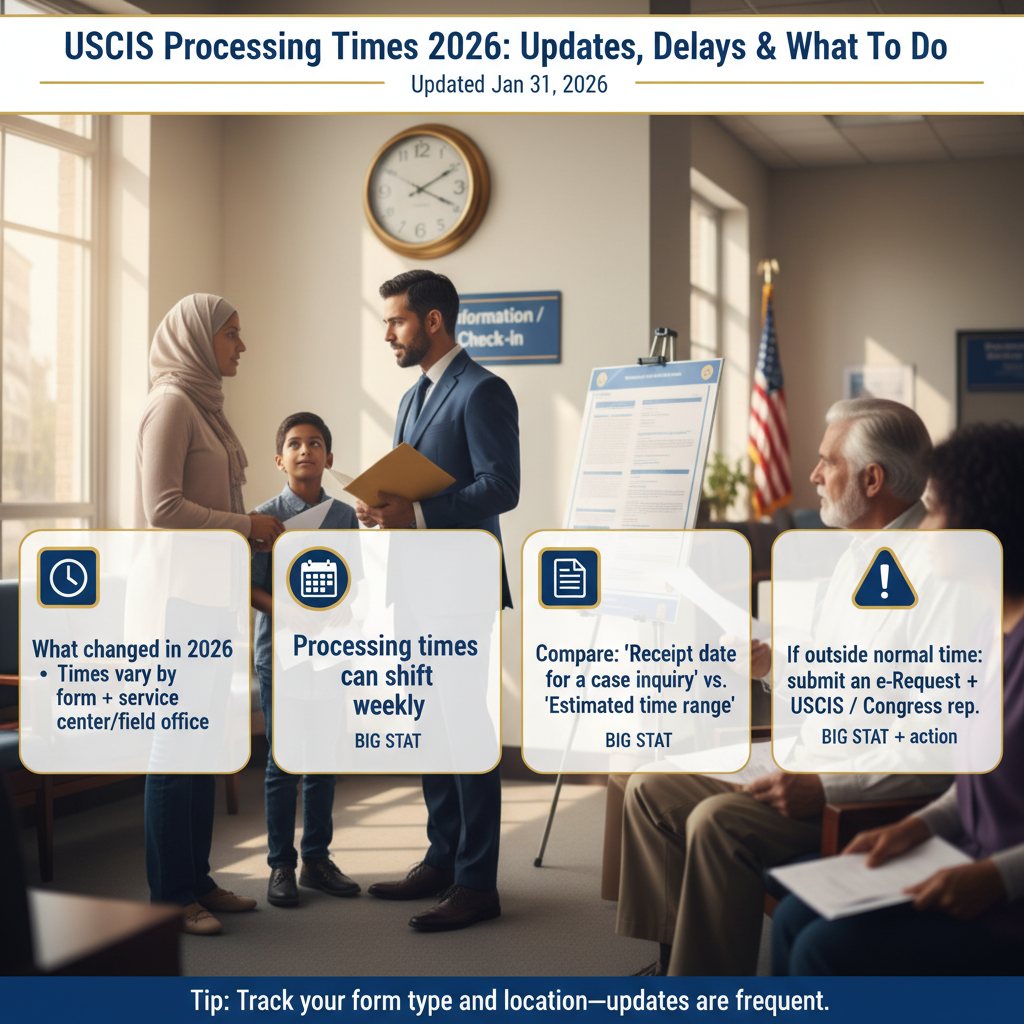
The reporting that sparked this guide comes from: USCIS Processing Times and Updates for 2026 (USCIS).
Reminder: USCIS processing times change frequently and vary by form type, service center/field office, and your case’s facts. This article explains how to interpret the 2026 updates, what drives delays, and what you can do right now—especially if your case is in Orlando or elsewhere in Florida.
Need Help? Our Orlando immigration team is ready to assist. Call +1 786-791-3106 for a free consultation, or message us online. Se Habla Español.
What This News Means for Immigrants in Orlando and Across Florida
Why this news is showing up now
USCIS processing times are a top immigration headline in 2026 because families and employers are feeling the real-world impact of timing: when you can work, travel, reunite with loved ones, or finalize a green card. In 2026, USCIS continues to publish and refine public-facing tools and internal triage practices that can cause visible “shifts” in posted timelines—sometimes improving one form while another slows.
Several factors commonly drive why processing time updates trend:
- Work authorization pressure: Many applicants rely on EADs (employment authorization documents) to keep jobs and support family.
- Case redistribution: USCIS may move workloads between service centers and field offices, changing averages.
- Policy and staffing adjustments: Hiring, training, security checks, and procedural changes can alter throughput.
- Surges in filings: When fees change, new programs launch, or visa bulletin movement increases, filing volume can spike.
- Backlog management: USCIS sometimes prioritizes certain categories (for example, humanitarian or time-sensitive cases), which affects others.
Important: The “processing time” posted online is not a guarantee. It is a statistical estimate based on recent completions and can lag behind real-time operational changes.
How it can affect Florida residents
For Central Florida residents along the I-4 corridor—Orlando, Kissimmee, Sanford, Winter Garden, and surrounding Orange County communities—processing time shifts can impact:
- Family unity timelines for petitions like Form I-130 (spouse/parent/child petitions).
- Adjustment of Status timing for Form I-485 when applying for a green card without leaving the U.S.
- Work permit timing for Form I-765 (often filed with Form I-485).
- Travel plans tied to advance parole (Form I-131)—especially for emergencies.
- Naturalization planning under Form N-400 when applicants need citizenship for family petitions or job requirements.
If your case is in Orlando, local field office capacity and interview scheduling can be a major variable. Many applicants see the biggest “unknown” not at filing, but at the interview/decision stage—particularly for Adjustment of Status.
What USCIS Processing Times and Updates for 2026 Is (and Why It Matters)
A plain-English definition
“USCIS processing times” are USCIS’s published estimates of how long it takes to complete different immigration applications and petitions. In 2026, USCIS continues to publish these estimates using its online tool, and applicants use them to:
- Set realistic expectations for when a case might be decided
- Decide when it’s appropriate to follow up with USCIS
- Plan work, travel, school, and family timelines
- Determine when a case may be considered “outside normal processing time”
These estimates matter because many immigration benefits are time-sensitive. For example, if you’re waiting for an EAD and your current work authorization expires, you may face a gap that affects income and stability.
Key terms you need to know
- Receipt Notice: The notice confirming USCIS received your filing (often Form I-797). Your “receipt date” starts many timelines.
- Biometrics: Fingerprints/photo appointment used for background checks; delays here can slow everything.
- RFE (Request for Evidence): USCIS asks for missing or additional documents. An RFE can add weeks or months.
- NOID (Notice of Intent to Deny): A warning that USCIS plans to deny unless you respond effectively.
- Priority Date: The place in line for many family and employment green card categories. Your Priority Date is often the filing date of the underlying petition (like Form I-130 or I-140).
- Visa Bulletin: The Department of State chart that controls when immigrant visas/green cards can be issued in many categories. See U.S. Department of State.
- Field Office vs. Service Center: Many interviews happen at a field office (like Orlando), while certain petitions are processed at service centers.
- Outside Normal Processing Time: A threshold USCIS publishes; after that date, you may submit a case inquiry.
- Warning: A case can be “within normal time” and still be unreasonably delayed for your personal situation—especially if you face job loss or urgent travel needs.
To monitor your category, use the official tool: USCIS Processing Times. For forms and instructions, use: USCIS Forms and the USCIS official website.
Need Help? Our Orlando immigration team is ready to assist. Call +1 786-791-3106 for a free consultation, or message us online. Se Habla Español.
Current Immigration Law: The Foundation
USCIS processing times don’t exist in a vacuum. They’re tied to the legal framework that governs eligibility, admissibility, quotas, and procedure. Below is a practical overview of the “legal backbone” that most processing-time questions connect to.
Federal requirements
Most family- and employment-based immigration processes come from the Immigration and Nationality Act (INA), implemented through federal regulations in Title 8 of the Code of Federal Regulations (8 C.F.R.). Common legal anchors include:
- INA § 245 (Adjustment of Status): The core statute behind Adjustment of Status using Form I-485.
- INA § 201–203 (Immigrant visa categories and numerical limits): Why Priority Date and the Visa Bulletin matter.
- INA § 212 (Inadmissibility): Medical, unlawful presence, misrepresentation, and other grounds that can trigger RFEs or denials.
- INA § 204 (Petitions): The basis for family petitions like Form I-130 and employment petitions like I-140.
- 8 C.F.R. § 103 (USCIS procedures): Filing rules, evidence, interviews, and notices.
Processing time is often extended by legally required steps: background checks, biometrics, interview requirements, and verification of eligibility under the INA. If USCIS must confirm a fact (a prior marriage termination, a lawful entry, a sponsor’s income), that legal duty can create delay—especially if documents are missing or inconsistent.
Common forms that tie directly to 2026 processing-time concerns include:
- Form I-130 (Petition for Alien Relative)
- Form I-485 (Application to Register Permanent Residence or Adjust Status)
- Form I-765 (Application for Employment Authorization)
- Form I-131 (Application for Travel Document / Advance Parole)
- Form I-864 (Affidavit of Support)
- Form N-400 (Application for Naturalization)
Official references and updates should be checked at the USCIS official website.
Florida-specific considerations
Immigration law is federal, but Florida residents often face state-level realities that affect case strategy and timing:
- Document access: Replacing vital records (birth/marriage/divorce) can take time—especially if records are from outside the U.S.
- Mobility and address changes: Many families move within Orange County or along the I-4 corridor for work. Address changes can cause missed notices if not promptly updated.
- Local interview scheduling: The Orlando USCIS Field Office interview calendar can affect Form I-485 and Form N-400 timelines.
- State court records: If you have any arrests or citations, obtaining certified dispositions from Florida courts is critical and can be time-consuming.
Important: If you move, file your address update immediately (generally via the USCIS online account or AR-11 process) and keep proof. Missing an interview notice can lead to a denial for abandonment.
How to Check and Respond to USCIS Processing Times in 2026: A Complete Step-by-Step Guide
This step-by-step guide shows how to use USCIS tools correctly, avoid common traps, and take action when a case is delayed. If your case is in Orlando, these steps help you track whether the Orlando USCIS Field Office or a service center is the main driver of your timeline.
1) Identify your exact form, category, and where USCIS is processing it
Processing times vary not just by form, but by sub-category (for example, family-based vs. employment-based Form I-485) and by processing location.
Documents to gather:
- Your USCIS receipt notice(s) (Form I-797) for each filing
- Your receipt number(s) (example format: IOE, MSC, LIN, SRC, WAC)
- A copy of what you filed (forms and supporting evidence)
- Any RFE/NOID notices and your responses
- Proof of your current address and any prior moves
Reminder: A single “case” may involve multiple filings (e.g., Form I-130 + Form I-485 + Form I-765 + Form I-131). Each has its own timeline.
2) Use the official USCIS Processing Times tool correctly
Go to: USCIS Processing Times. Choose your form, then select the correct category and office/service center.
Documents to have open while checking:
- Receipt notice to confirm your category
- Any online account screenshot showing your case type
- Notes of your filing date and any USCIS notices received
The tool typically shows:
- An estimated time range (or months)
- A “receipt date for a case inquiry” (the date after which you can request help)
Warning: If you select the wrong category or office, you may think your case is late when it is not—or miss the moment when you can file an inquiry.
3) Track your case status and build a timeline file (so you can prove delay)
In 2026, strong recordkeeping is one of the most effective ways to reduce stress and respond quickly to USCIS requests. Create a simple “case timeline” document.
Documents to include in your timeline file:
- Filing date(s) and delivery confirmation (courier proof)
- Receipt notice date(s)
- Biometrics appointment notice and completion date
- RFE/NOID issue date(s) and response delivery proof
- Medical exam date (if applicable) and whether you filed it initially or later
- Interview notice date and interview date (if applicable)
- Any expedite requests or congressional inquiries submitted
If your case is in Orlando, note whether your interview was scheduled at the Orlando USCIS Field Office and whether any rescheduling occurred.
4) Respond to RFEs fast and strategically (to avoid months of added time)
RFEs are one of the biggest “hidden” drivers of longer processing times. A weak or incomplete RFE response can lead to a denial or another request, compounding delays.
Documents commonly needed for RFE responses:
- Copy of the RFE notice (every page)
- Cover letter mapping each RFE item to your evidence
- Civil documents: birth/marriage/divorce certificates with certified translations
- Proof of lawful entry (I-94, visa stamp) when relevant to Form I-485
- Financial documents for Form I-864 (tax transcripts, W-2s, pay stubs)
- Relationship evidence for Form I-130 (photos, joint lease, joint bank, insurance)
Important: Follow the RFE instructions exactly (mailing address, barcode sheet, and deadline). Missing the deadline can lead to denial. If you have a hard deadline, do not assume USCIS will accept late evidence.
5) When eligible, submit a case inquiry or request escalation
Once your case passes the “receipt date for a case inquiry” shown on the processing times page, you may be able to submit an “outside normal processing time” request through USCIS.
Documents to prepare before you inquire:
- Receipt number
- Filing date and category
- Current address and contact info
- Evidence of harm if there is urgency (job offer, termination notice, medical need)
- Proof you responded to any RFE (delivery confirmation)
Reminder: A case inquiry is not an “expedite.” It is a request for USCIS to review why your case is taking longer than posted norms.
6) Consider expedite requests (only when you meet USCIS criteria)
Expedite requests may be available for certain filings (commonly Form I-765 or Form I-131) when you can document qualifying hardship or urgent circumstances. USCIS generally expects credible evidence.
Documents that can support an expedite:
- Job loss notice, eviction notice, or utility shutoff notice
- Medical records or doctor letters for urgent care needs
- Evidence of urgent travel (funeral, critical illness of a family member)
- Employer letter explaining severe financial loss to company (if applicable)
- Proof your application is properly filed and biometrics completed
Warning: Expedites are discretionary. Submitting weak expedite requests repeatedly can waste time and distract from fixing evidence issues that are actually delaying your case.
7) If delays become extreme, explore higher-level solutions (case-by-case)
When a case is far beyond normal time and standard inquiries fail, additional options may exist depending on the facts—such as involving a congressional office, requesting Ombudsman assistance where appropriate, or pursuing federal litigation (mandamus/APA) in truly unreasonable-delay situations.
Documents to gather for advanced escalation:
- Complete filing copy and all USCIS notices
- Detailed timeline (Step 3)
- Proof of repeated attempts to resolve (inquiry confirmations)
- Evidence of hardship and ongoing harm
- Any immigration court documents if you are in proceedings (see Executive Office for Immigration Review)
Important: If you are in removal proceedings, strategy must be coordinated carefully. A pending application with USCIS can interact with court deadlines and jurisdiction rules.
Need Help? Our Orlando immigration team is ready to assist. Call +1 786-791-3106 for a free consultation, or message us online. Se Habla Español.
Practical Steps You Can Take Today
Processing times in 2026 can feel unpredictable, but there are concrete steps that reduce delays and improve your ability to respond quickly if USCIS asks for more.
Actionable checklist (do these now)
- Check the correct processing time for your exact category and office at USCIS Processing Times.
- Create a “USCIS master folder” (digital + paper) with every filing, notice, and delivery confirmation.
- Pre-collect civil documents: passports, birth certificates, marriage certificates, divorce decrees, certified translations.
- Prepare financial evidence early for Form I-864 (tax transcripts are often stronger than self-prepared copies).
- Update your address immediately after moving and keep proof of the update.
- Set calendar alerts for biometrics, medical exam expiration planning, and the “outside normal processing time” inquiry date.
- Use consistent names and dates across all filings to avoid identity and records mismatches.
Document preparation guidance (what USCIS commonly checks)
Even when processing times are long, many delays are avoidable. USCIS commonly slows down cases because the record is incomplete or inconsistent. Focus on:
- Identity: passport bio page, national ID, prior names, and translations.
- Lawful entry and status history: I-94 records and prior approvals (critical for many Form I-485 filings).
- Relationship bona fides: for marriage-based cases—evidence across time, not just one month.
- Financial sponsorship: stable income evidence and correct household size on Form I-864.
- Criminal and court records: certified dispositions, not just online docket printouts.
Timeline expectations (realistic planning in 2026)
Because USCIS timelines vary by form and location, the best approach is to plan in “phases” rather than guessing a single finish date:
- Phase 1 (0–8 weeks): receipt notices, online account setup, initial biometrics scheduling (varies).
- Phase 2 (2–8+ months): EAD/advance parole processing for many applicants (varies widely by category).
- Phase 3 (6–24+ months): interview scheduling and final decision for many Adjustment of Status cases (field-office dependent).
Warning: If you have a time-sensitive need (job start date, international travel, expiring status), do not rely on averages. Build a strategy around your personal deadlines—sometimes within a 90-day window or less.
How Imigrar Helps Immigrants in Orlando
At Imigrar, we help individuals and families navigate USCIS delays with a practical, evidence-first approach. Our mission is simple: Keep Families Together.
We assist clients in Orlando, Orange County, and throughout Central Florida—and we also serve clients nationwide. Whether your case is pending at a service center or scheduled through the Orlando USCIS Field Office, we focus on reducing avoidable delays and positioning your case for approval.
- Case strategy to match the correct category and eligibility rules (especially for Form I-130 and Form I-485)
- Front-loaded document preparation to reduce RFEs
- RFE/NOID response drafting with organized exhibits
- Interview preparation for marriage-based and naturalization cases
- Delay troubleshooting: inquiries, expedite requests, and escalation planning when appropriate
Se Habla Español. If you feel stuck, overwhelmed, or unsure whether USCIS is taking too long, we can review your timeline and explain options in clear terms.
Call +1 786-791-3106 for a free consultation, or message us online at https://www.imigrar.com/contact.
Frequently Asked Questions
Q: How do I know if I’m eligible to file a case inquiry for USCIS delays?
A: Check the “receipt date for a case inquiry” for your form and category using the official tool at USCIS Processing Times. If your receipt date is earlier than that inquiry date, you can usually submit an “outside normal processing time” request. Keep your receipt notice, receipt number, and a timeline of events ready in case USCIS asks for more details.
Q: Does a long processing time affect my immigration status?
A: It depends on what you filed. A pending Form I-485 generally places you in a period of authorized stay while it’s pending, but it does not automatically give you permission to work or travel. Work authorization usually requires an approved Form I-765, and travel typically requires approved advance parole via Form I-131. If you have questions about your specific status, speak with an attorney before traveling or changing jobs.
Q: How long will my Form I-130 or Form I-485 take in 2026?
A: There is no single timeline for everyone. Form I-130 processing varies by petitioner type and service center. Form I-485 timelines often depend heavily on field office scheduling (including the Orlando USCIS Field Office if you live in Central Florida), background checks, and whether an interview is required. The most accurate public estimate is the category-specific range shown at USCIS Processing Times.
Q: What documents are most important to prevent delays and RFEs?
A: The most delay-preventing documents typically include: (1) clear identity documents (passport, prior names), (2) complete civil records with certified translations, (3) strong relationship evidence for marriage cases (joint lease, bank, insurance, photos over time), (4) solid sponsorship evidence for Form I-864 (tax transcripts, W-2s, pay stubs), and (5) certified court dispositions for any arrests/citations. Missing or inconsistent civil documents are a common reason cases stall.
Q: How much does it cost to deal with USCIS delays?
A: USCIS does not charge a fee to check processing times or to submit many standard case inquiries. However, delays can create indirect costs—missed work, repeated medical exams, re-filing after denials, or emergency travel changes. Attorney fees vary depending on complexity (for example, an RFE response vs. a full Adjustment of Status package). If you want a predictable plan, ask for a written scope of representation and fee agreement.
Q: What happens if my case is denied after a long wait?
A: A denial can have serious consequences depending on what was filed and your underlying status. Some denials can be re-filed with stronger evidence; others may require a motion to reopen/reconsider or an appeal (depending on the form and eligibility). If you are placed into removal proceedings, your case may be handled in immigration court—see Executive Office for Immigration Review. Get legal advice immediately because deadlines can be short—sometimes within a 30-day or 33-day window depending on the notice (varies by form and decision type).
Q: Can I travel while my Adjustment of Status case is pending?
A: Many applicants should not travel internationally while a Form I-485 is pending unless they have a valid basis to return (often advance parole approved via Form I-131, or certain dual-intent statuses in limited scenarios). Traveling without proper authorization can be treated as abandonment of the application. Before traveling, confirm your specific eligibility and risks with counsel.
Common Mistakes (and How to Avoid Them)
Mistake #1: Checking the wrong processing-time category or office
Many applicants panic because they selected the wrong category (for example, the wrong family relationship type) or the wrong office. Always match the processing-time selection to your receipt notice details. If your case is in Orlando, confirm whether the relevant step is at the Orlando USCIS Field Office or still at a service center.
Mistake #2: Treating RFEs like “optional paperwork”
An RFE is a legal request for evidence. A partial response or disorganized submission can lead to denial or months of delay. Respond with a structured cover letter, tabbed exhibits, and certified translations where needed. Keep delivery proof.
Mistake #3: Missing notices due to address changes or mail issues
Moving within Orange County or elsewhere in Florida is common. If USCIS mails a biometrics or interview notice to an old address, you can miss it and face denial. Update your address immediately, monitor your online account, and set mail forwarding as a backup.
Official Resources to Monitor in 2026
USCIS and other agencies publish the tools you should rely on—not social media rumors. Here are the most important official links:
- USCIS official website
- USCIS Processing Times
- USCIS Forms
- U.S. Department of State (Visa Bulletin and consular processing info)
- Executive Office for Immigration Review (immigration court information)
Reminder: If your case involves consular processing (interview abroad), timing can depend on both USCIS and the Department of State. That’s why it’s important to confirm where your file is and which agency has the next step.
Need Help? Our Orlando immigration team is ready to assist. Call +1 786-791-3106 for a free consultation, or message us online. Se Habla Español.

Closing: Protect Your Timeline in 2026
USCIS processing time updates in 2026 are more than “numbers on a page”—they affect real families, jobs, and futures. The best way to navigate delays is to (1) track the correct category and office, (2) file strong, complete applications, (3) respond quickly to RFEs, and (4) escalate strategically when your case is truly outside normal time.
For Central Florida residents, the Orlando USCIS Field Office scheduling environment can be a key factor—especially for Form I-485 interviews and Form N-400 naturalization interviews. If you’re unsure whether your case is delayed, or you need a plan within a 90-day window (or less), we can help you map next steps.
Need legal help now? Call Imigrar at +1 786-791-3106 for a free consultation, or message us online. Se Habla Español.


