


The reporting that sparked this guide
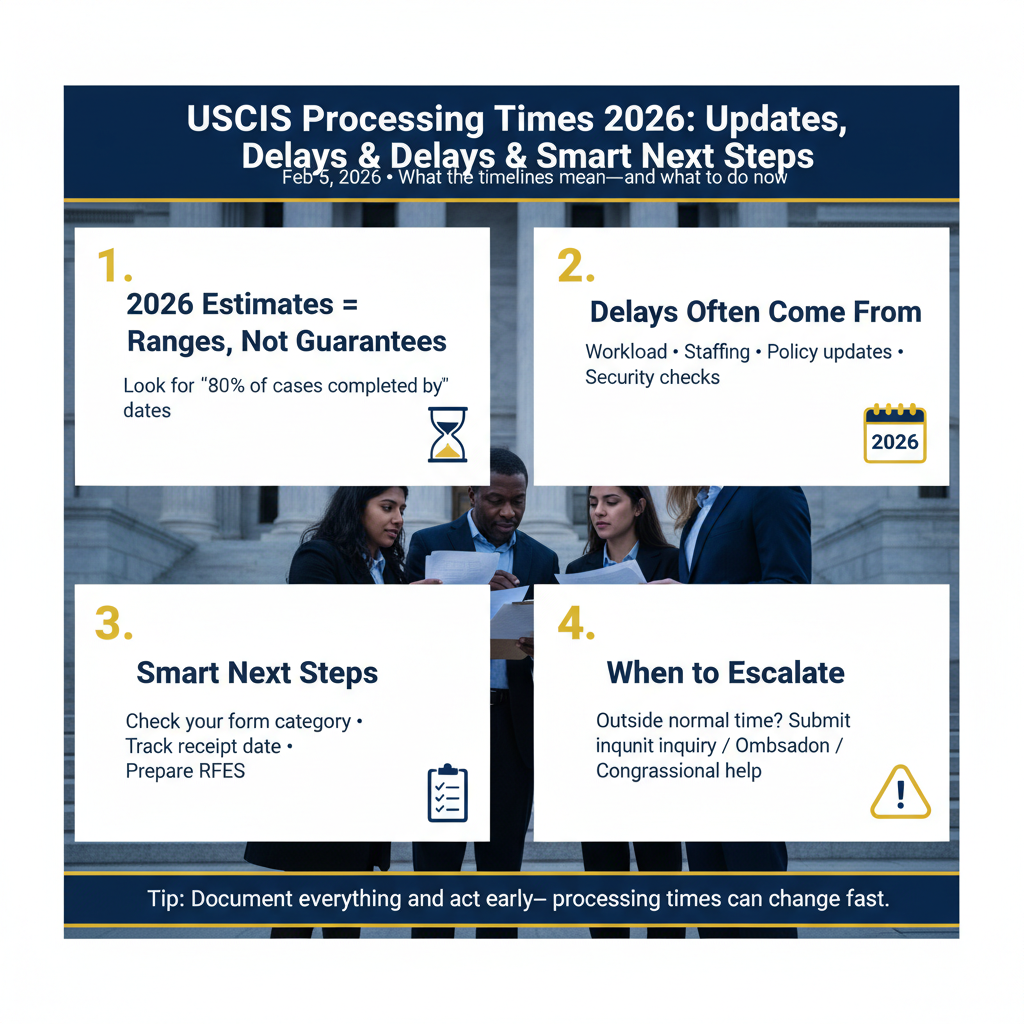
The reporting that sparked this guide comes from: USCIS Processing Times and Updates for 2026 (USCIS) .
Reminder: USCIS processing times can change quickly based on workload, staffing, policy updates, and security checks. This article explains how to read USCIS time estimates in 2026, what affects them, and what you can do to reduce delays.
Need Help? Our Orlando immigration team is ready to assist. Call +1 786-791-3106 for a free consultation, or message us online. Se Habla Español.
What This News Means for Immigrants in Orlando and Across Florida
Why this news is showing up now
USCIS processing times are a recurring national headline, but they are especially “trending” as we enter 2026 for a few practical reasons:
- USCIS workload shifts: Filing volumes change throughout the year (family petitions, employment cases, humanitarian filings, and naturalization surges). When volumes rise, average completion times often rise too.
- Digital modernization: USCIS continues expanding online filing and digital case handling. Some case types move faster; others slow down during transitions.
- Security checks and inter-agency coordination: Many applications require background checks and verification, which can add unpredictable time.
- Policy and operational updates: Even small USCIS policy adjustments can change how quickly cases move through intake, biometrics, interviews, and final decisions.
Important: “Processing time” is not a promise. It is an estimate based on historical completion data and current workloads. Two people filing the same form can still experience very different timelines.
How it can affect Florida residents
For Florida residents—especially those living along the I-4 corridor (Orlando, Kissimmee, Sanford, Lake Mary, and surrounding areas)—USCIS timing changes can affect daily life in real ways:
- Work authorization planning: If your Form I-765 (Employment Authorization Document) is delayed, it may affect job start dates, renewals, and employer compliance.
- Travel plans: If your Form I-131 (Advance Parole) is pending, leaving the U.S. may abandon certain applications (depending on your situation). Delays can disrupt family emergencies and travel.
- Green card timelines: Delays in Form I-485 can postpone permanent resident status, which impacts driver’s license renewals, tuition classification, and eligibility for certain benefits.
- Family separation: Delays in Form I-130 can extend the time families remain apart, especially when consular processing is involved.
- Orlando field office interviews: If your case is in Orlando, interview scheduling and local workload at the Orlando USCIS Field Office can influence your final timeline.
What USCIS Processing Times and Updates for 2026 Is (and Why It Matters)
A plain-English definition
“USCIS processing times” are USCIS’s published estimates of how long it typically takes to complete an immigration case—from the day USCIS receives a form to the day it makes a decision (approval, denial, or other action).
In 2026, the practical takeaway is this: you should treat processing times as a planning tool, not a guarantee. Your best strategy is to (1) file correctly, (2) respond quickly to USCIS requests, and (3) track your case using official tools like USCIS Processing Times.
Key terms you need to know
- Receipt Notice: The USCIS notice confirming it accepted your filing and assigned a receipt number (often shown on Form I-797).
- Processing Time Range: USCIS often shows a range (example: 10–18 months). Your case may fall inside or outside that range.
- Case Inquiry Date: The date when USCIS says you may submit a “case outside normal processing time” request.
- Request for Evidence (RFE): A letter from USCIS asking for missing documents or clarification. RFEs almost always add time.
- Biometrics Appointment: Fingerprints/photo appointment used for background checks (some applicants may have biometrics reused).
- Adjustment of Status: The process of applying for a green card from inside the U.S., typically using Form I-485.
- Priority Date: Your place in line for a visa category, especially in family- and employment-based cases subject to annual limits.
- 90-day window and 180 days:
- The 90-day window commonly matters for certain renewals or time-sensitive filings (for example, many people plan early renewals of work permits and green cards within practical timing windows).
- The 180 days concept often arises in employment-based contexts (such as job portability rules under AC21 for certain Adjustment of Status applicants) and in planning for extension/renewal buffers.
Warning: The terms above can mean different things depending on your immigration category. Before making travel, job, or filing decisions, confirm the rules for your specific case type.
Current Immigration Law: The Foundation
USCIS processing times sit on top of a legal framework that controls who may apply, what evidence is required, and how USCIS must adjudicate cases. Even when USCIS is backlogged, it still must follow the Immigration and Nationality Act (INA), federal regulations, and agency policy guidance.
Federal requirements
Key legal authorities that shape many common USCIS filings include:
- Immigration and Nationality Act (INA): The primary federal immigration statute (codified in Title 8 of the U.S. Code). It governs family-based immigration, employment-based immigration, inadmissibility, waivers, naturalization, and more.
- 8 C.F.R. (Code of Federal Regulations): Federal immigration regulations that define procedures for applications, evidence, and adjudications.
- USCIS policy guidance and form instructions: USCIS form instructions are legally important. Filing the wrong edition, paying the wrong fee, or missing required evidence can cause rejection or delays.
In practice, the “processing time” you experience is influenced by both law and operations:
- Eligibility rules: Whether you qualify under the INA for the benefit you requested.
- Admissibility rules: Whether any grounds of inadmissibility apply, and whether a waiver is available.
- Procedural compliance: Whether you filed the correct USCIS forms, signatures, fees, translations, and supporting evidence.
Common forms affected by 2026 processing time shifts include Form I-130 (family petition), Form I-485 (Adjustment of Status), Form I-765 (work permit), Form I-131 (travel document), Form N-400 (naturalization), and Form I-751 (remove conditions on residence).
For official guidance and updates, use the USCIS official website and the USCIS Forms page to confirm current editions, filing addresses, and instructions.
Florida-specific considerations
Immigration law is federal, but Florida residents face practical, location-specific issues that can affect timing and outcomes:
- Field office workload: The Orlando metro area continues to grow. Increased population can mean more filings and potential scheduling delays for interviews at the Orlando USCIS Field Office.
- Mailing and logistics: If you live in Orange County or nearby counties, make sure your mailing address is stable and you can receive USCIS notices promptly. Missed notices can lead to denials for “failure to appear.”
- State-level documentation timelines: Delays in immigration benefits can impact Florida driver’s license renewals, Real ID compliance, and employment onboarding timing.
- Local court and removal defense coordination: If you are in removal proceedings, your case may require coordination with the immigration court system under Executive Office for Immigration Review.
Important: If your case is in Orlando and you move, file your address update quickly. Address changes are commonly done through USCIS online tools and can be critical to avoid missing biometrics or interview notices.
Need Help? Our Orlando immigration team is ready to assist. Call +1 786-791-3106 for a free consultation, or message us online. Se Habla Español.
How to Track and Manage USCIS Processing Times in 2026: A Complete Step-by-Step Guide
1) Confirm your case type, form, and where it is being processed
Processing times vary by form type and by the office handling your case (service center vs. field office). Start by identifying:
- The exact form you filed (example: Form I-130, Form I-485, Form N-400).
- Your receipt number and receipt date (from Form I-797).
- The office or service center listed on your receipt notice.
- Whether your case requires an interview (often yes for Adjustment of Status).
Documents to gather:
- USCIS receipt notice(s) (Form I-797) for each filing
- A copy of the full application packet you submitted
- Government-issued ID (passport, driver’s license)
- Any prior USCIS approval notices or immigration documents
2) Check official USCIS processing time tools the right way
Use the official tool here: USCIS Processing Times. Choose your form and the office processing it. Then note:
- The posted time range (example: “80% of cases completed in X months”).
- The “case inquiry date” (when you can submit an inquiry).
- Whether your case is handled by a field office (often interview-based) or a service center (paper adjudication).
Reminder: Some forms show different metrics (for example, “80% completed by” versus “estimated time range”). Always read the page labels carefully.
Documents to gather:
- Receipt number
- Office/service center name from your receipt notice
- Screenshot or saved note of the processing time page for your records
3) Track your case status and set up a USCIS online account
Processing times are broad; your case status provides the most immediate signals (RFE issued, biometrics scheduled, interview scheduled, etc.). Create or use your USCIS online account when available, and track your receipt number updates.
Important: If you receive an RFE, respond by the deadline and with a complete packet. Partial responses often lead to more delays or denials.
Documents to gather:
- USCIS online account access details (email, login)
- Receipt numbers for all related filings (example: Form I-485 + Form I-765 + Form I-131)
- Any USCIS notices already received
4) Prepare for biometrics, interview, and medical timing (especially for Form I-485)
In 2026, many delays come from scheduling bottlenecks and missing/expired evidence. If you are applying for a green card through Adjustment of Status using Form I-485, plan for:
- Biometrics: Attend your appointment or properly reschedule.
- Interview: If your case is in Orlando, be ready for an interview at the Orlando USCIS Field Office.
- Medical exam: Submit the immigration medical exam when appropriate and ensure it is completed by a USCIS-designated civil surgeon.
Warning: Medical exams can expire depending on timing and USCIS policy. Filing too early or too late can create avoidable delays. Get legal guidance on the best timing for your situation.
Documents to gather:
- Biometrics appointment notice (if issued)
- Interview notice (if issued)
- Passports (all applicants), birth certificates, marriage/divorce records
- Proof of lawful entry (if applicable), I-94 record
- Updated relationship evidence (for marriage-based cases)
- Medical exam packet (sealed, if required by USCIS instructions)
5) Know when and how to escalate: inquiries, expedite, and congressional help
If your case passes the “case inquiry date,” you may submit a request for USCIS to review a case outside normal processing time. In limited situations, you may request expedited processing (for example, severe financial loss, urgent humanitarian reasons, or other USCIS criteria).
If you are stuck for a long time, you may also seek help through your congressional representative’s office. This does not guarantee approval, but it can prompt status clarification.
Documents to gather:
- Proof your case is outside normal processing time (USCIS tool screenshot + receipt date)
- RFE response proof (delivery confirmation, copy of response)
- Expedite evidence (job loss notice, medical letters, emergency documentation)
- Any prior correspondence with USCIS
6) Plan for the “next step” agency timelines: Visa Bulletin and consular processing
Some cases depend not only on USCIS, but also on the Department of State. For example, if you are doing consular processing after Form I-130 approval, you may need to wait for National Visa Center (NVC) steps and an interview appointment at a U.S. consulate abroad.
Track official information at: U.S. Department of State.
Important: If your category is subject to quotas, your Priority Date must be current before a visa can be issued or a green card can be approved.
Documents to gather:
- USCIS approval notice (if applicable)
- Visa category and Priority Date information
- Civil documents for consular processing (birth, marriage, police certificates where required)
- Affidavit of support documents (income evidence, tax returns, pay stubs)
7) Keep your status protected while you wait
Processing delays can create real risk if your underlying status expires or if you travel incorrectly while an application is pending. The right strategy depends on your case:
- Some applicants must maintain a separate nonimmigrant status while waiting.
- Others may be in a “period of authorized stay” based on a properly filed application.
- People in removal proceedings need coordinated strategy with immigration court timelines.
Warning: A pending application does not automatically protect everyone from unlawful presence or removal risk. Get individualized legal advice before letting a status expire.
Documents to gather:
- I-94 record and expiration date
- All approval notices for current status (H-1B, F-1, TPS, etc.)
- Pending application receipts
- Any immigration court documents (if applicable)
Practical Steps You Can Take Today
Whether you are filing soon or already waiting, you can reduce delays and protect your case by taking the following steps now.
Actionable checklist (do these this week)
- Create a single “USCIS folder” (digital + paper) with your receipts, notices, copies of filings, and evidence.
- Check your form edition dates and instructions on the USCIS Forms page before filing anything new.
- Save your processing time range and “case inquiry date” from the USCIS Processing Times tool.
- Prepare for address stability: if you move in Orange County or anywhere along the I-4 corridor, update your address immediately and set USPS mail forwarding.
- If your filing includes translations, confirm they meet USCIS requirements (complete and certified).
- If you are filing Form I-485, review whether you should file Form I-765 and Form I-131 together (when eligible) to reduce gaps in work/travel authorization.
Document preparation guidance
Many processing delays are self-inflicted: missing signatures, missing evidence, wrong fees, unclear copies, or inconsistent information across forms. Before filing:
- Ensure every form is signed in the correct place (wet signature when required).
- Provide clear copies of identity documents and civil records.
- Include proof of lawful entry where relevant (I-94, admission stamp).
- For marriage cases, include strong bona fide marriage evidence (joint lease, joint bank, insurance, photos, affidavits, children’s birth certificates if applicable).
Reminder: If you receive an RFE, treat it like a final exam: one complete, well-organized response is usually better than multiple partial submissions.
Timeline expectations in 2026 (realistic planning)
Because USCIS times vary by form and office, the best “timeline expectation” is a planning range rather than a single number. In 2026, many applicants should plan for:
- Weeks to months for receipt notices and initial intake steps (varies by filing method and workload).
- Several months for biometrics scheduling if required (sometimes faster, sometimes reused).
- Many months to over a year for interview-based benefits depending on category and local office capacity.
If your case is in Orlando, interview scheduling at the Orlando USCIS Field Office can be a major variable—especially for family-based Adjustment of Status.
Need Help? Our Orlando immigration team is ready to assist. Call +1 786-791-3106 for a free consultation, or message us online. Se Habla Español.
How Imigrar Helps Immigrants in Orlando
At Imigrar, we focus on practical, case-specific strategies to reduce delays and protect families—because our mission is to Keep Families Together. We serve clients in Orlando, throughout Central Florida, and nationwide.
Here’s how we help with USCIS processing time challenges in 2026:
- Front-end filing strategy: We build strong initial filings to reduce RFEs and preventable denials (especially for Form I-130 and Form I-485 packages).
- RFE and NOID responses: If USCIS requests more evidence, we help you respond clearly, completely, and on time.
- Interview preparation: If your case is in Orlando, we prepare you for what to expect at the Orlando USCIS Field Office and help organize your evidence.
- Status protection planning: We help you understand how pending applications affect your lawful presence, work authorization, and travel options.
- Escalation options: We advise when inquiries, expedite requests, and other escalation tools make sense—and when they could backfire.
We offer a free consultation to help you understand your options. Se Habla Español.
Frequently Asked Questions
Q: Can I speed up my USCIS case just because the processing time feels too long?
A: Not automatically. USCIS generally will not expedite a case just because it is stressful or inconvenient. First, compare your receipt date to the “case inquiry date” on the USCIS Processing Times page. If your case is outside normal processing time, you may submit an inquiry. Expedite requests are limited to specific criteria (such as urgent humanitarian reasons or severe financial loss) and require supporting evidence.
Q: Does a pending Form I-485 protect me from being out of status?
A: Sometimes, but not always in the way people assume. A properly filed Form I-485 may place you in a period of authorized stay while it is pending, but it does not necessarily “fix” every status problem, and it does not guarantee protection from enforcement in all circumstances. If you are unsure—especially if you entered without inspection, overstayed, or have prior immigration issues—get legal advice before relying on a pending application.
Q: If my case is in Orlando, will the Orlando USCIS Field Office timeline be different from other cities?
A: Yes. Field office timelines can differ significantly. For Central Florida residents, local interview capacity, staffing, and case volume can impact how quickly interviews are scheduled and how quickly decisions are issued after interviews. If your case is in Orlando, you should track the correct office in the USCIS processing time tool and plan for local scheduling variability.
Q: What documents most commonly cause delays or RFEs in 2026 filings?
A: Common issues include missing civil documents (birth/marriage/divorce records), missing translations, insufficient relationship evidence for marriage cases, incorrect fees, unsigned forms, and incomplete financial sponsorship evidence (when required). For Adjustment of Status cases, missing or improperly prepared medical exams and unclear proof of lawful entry can also trigger RFEs.
Q: How much does it cost to file, and do USCIS fees affect processing time?
A: USCIS filing fees vary by form and can change. Always confirm current fees and fee rules directly on the USCIS official website. Paying the wrong fee can lead to rejection, which restarts the clock and increases delays. Also budget for related costs such as medical exams, translations, passport photos, and legal representation if you choose to hire an attorney.
Q: What happens if USCIS denies my case after a long wait?
A: A denial can have serious consequences depending on your underlying status and whether you have other options. Some denials may be followed by a motion to reopen/reconsider, an appeal (where available), refiling, or—if you are in proceedings—litigation strategy coordinated with immigration court under Executive Office for Immigration Review. The best next step depends on the denial reason and your current status. Do not ignore a denial notice—deadlines can be short, and delays can limit your options.
Q: Will my immigration status be affected if I travel while my case is pending?
A: Travel can be risky. Some applicants must not leave the U.S. while certain applications are pending unless they have a valid travel document (often through Form I-131) or another lawful basis to re-enter. In some situations, departing the U.S. can be treated as abandoning an application. Before traveling, confirm your eligibility and risks with a qualified immigration attorney.
Q: How does the Visa Bulletin and Priority Date affect timing in 2026?
A: If your category is subject to annual limits, your Priority Date must be current before a green card can be approved (and sometimes before you can file). This is especially common in certain family and employment categories. USCIS and the Department of State coordinate these timelines. For consular processing and visa issuance steps, use U.S. Department of State resources and follow NVC instructions carefully.
Common Mistakes (and How to Avoid Them)
Mistake #1: Filing without a complete, consistent evidence packet
Many applicants submit minimal evidence and plan to “add more later.” In 2026, that approach often leads to RFEs, which can add months. Avoid this by preparing a well-organized filing from the start—especially for Form I-130 and Form I-485.
How to avoid it: Use a checklist, tab your exhibits, include translations, and ensure all dates/names match across every document.
Mistake #2: Misreading the USCIS processing time tool and escalating too early (or too late)
Many people look at the wrong office or wrong form category and think their case is late. Others wait far too long after the inquiry date.
How to avoid it: Confirm the exact office on your receipt notice, then use that same office in the USCIS Processing Times tool. Save the “case inquiry date” and act when eligible.
Mistake #3: Moving and missing USCIS notices
For Central Florida residents who relocate for work or housing, missing a biometrics or interview notice can lead to denial. This is one of the most preventable problems we see.
How to avoid it: Update your address immediately, keep copies of confirmations, and track your case online. If your case is in Orlando, be especially careful because interview notices can arrive with limited time to prepare.
Need Help? Our Orlando immigration team is ready to assist. Call +1 786-791-3106 for a free consultation, or message us online. Se Habla Español.
Additional Official Resources (Bookmark These)
Closing: Make 2026 Processing Times Work for You (Not Against You)
USCIS processing time updates in 2026 are more than just numbers—they affect job start dates, family unity, travel, and peace of mind. The best way to handle delays is to file strategically, respond quickly, track the right metrics, and protect your status while you wait.
If your case is in Orlando, if you live in Orange County, or if you are anywhere in Central Florida along the I-4 corridor, we can help you build a plan that matches your goals and your timeline.
Need Help? Our Orlando immigration team is ready to assist. Call +1 786-791-3106 for a free consultation, or message us online. Se Habla Español.


