


The reporting that sparked this guide
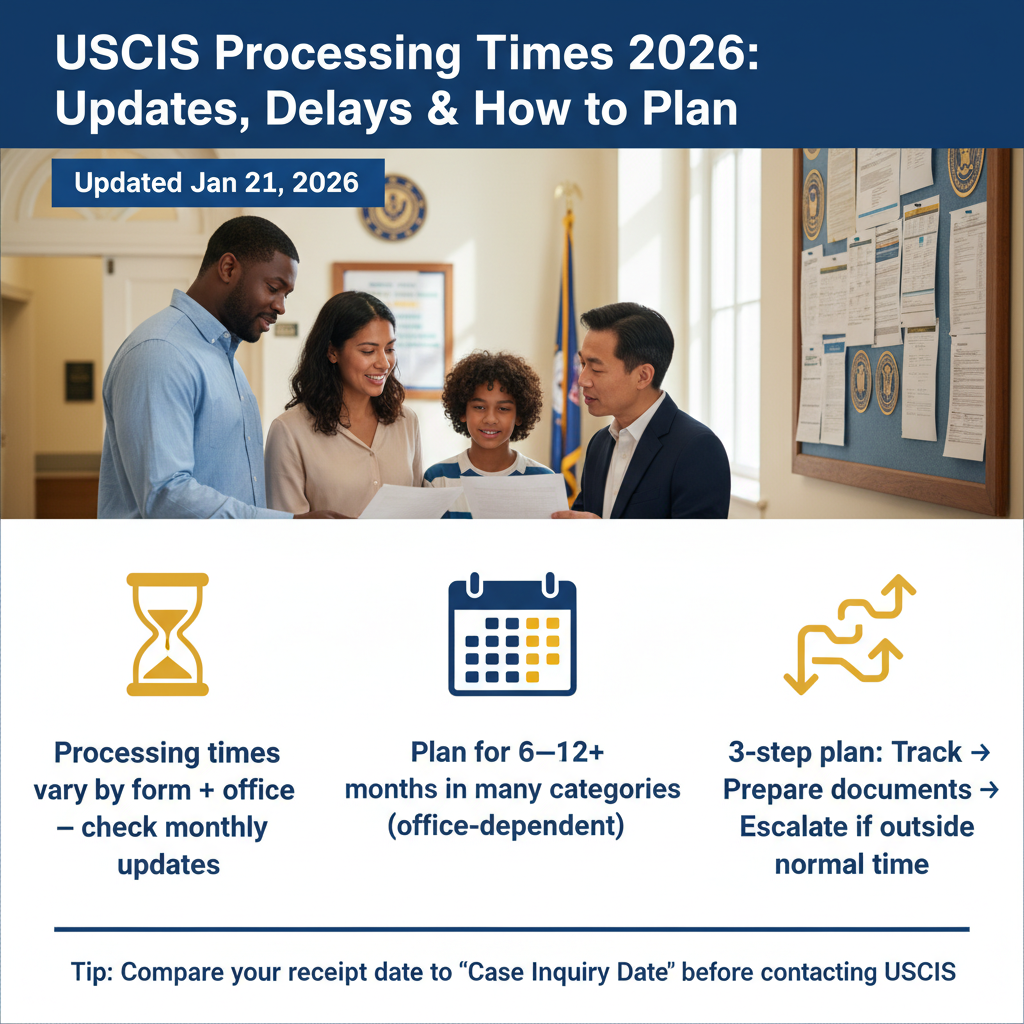
The reporting that sparked this guide: USCIS Processing Times and Updates for 2026 (USCIS)
Reminder: USCIS processing times can change frequently by form type, category, and office. This article explains how to interpret the latest 2026 updates and what practical steps you can take if your case is delayed—especially if you live in Orlando or elsewhere in Florida.
Need Help? Our Orlando immigration team is ready to assist. Call +1 786-791-3106 for a free consultation, or message us online. Se Habla Español.
What This News Means for Immigrants in Orlando and Across Florida
Why this news is showing up now
USCIS processing times are trending in 2026 because families, employers, and students are seeing real-world consequences from timing shifts: travel plans, work authorization renewals, interview scheduling, and visa availability can all depend on how fast (or slow) USCIS is moving.
In 2026, USCIS continues to emphasize “cycle time” goals, digital processing expansion, and workload balancing across service centers and field offices. At the same time, demand remains high for common filings like Form I-130 (family petitions), Form I-485 (Adjustment of Status), Form I-765 (work permits), and Form N-400 (naturalization). Even small changes in staffing, policy, or filing volume can shift published time ranges.
Important: USCIS “processing times” are not guarantees. They are estimates based on recent case completions and can vary by location and case complexity. Still, they are one of the best tools available for planning—and for knowing when you’re allowed to ask USCIS to take action.
How it can affect Florida residents
For Florida residents, processing time changes can hit especially hard because Florida has:
- Large family-based immigration demand (spouses, parents, children)
- High naturalization volume
- Many applicants who rely on timely work permits and travel documents
- Frequent moves along the I-4 corridor (Orlando–Kissimmee–Lakeland–Tampa), which can complicate address updates and interview scheduling
If your case is in Orlando, delays may affect when the Orlando USCIS Field Office schedules interviews for Form I-485 and Form N-400. For Central Florida residents, timing is also critical for keeping jobs, renewing driver’s licenses, and planning international travel.
Warning: A delay in a work permit renewal (often tied to Form I-765) can lead to employment interruptions if you don’t qualify for an automatic extension or if your category doesn’t receive one.
What USCIS Processing Times and Updates for 2026 Is (and Why It Matters)
A plain-English definition
“USCIS processing time” is the estimated amount of time USCIS takes to decide a specific application or petition—such as a green card application, a family petition, or a citizenship application. USCIS publishes these estimates so applicants can:
- Understand typical timelines
- Plan work authorization and travel
- Know when they can submit an “outside normal processing time” request
- Track whether a delay might be normal or a sign that something is missing
In 2026, “updates” can include changes to posted time ranges, changes to which office is handling a case, or procedural changes affecting how quickly USCIS issues receipts, schedules biometrics, or requests additional evidence.
Key terms you need to know
- Receipt Notice: The first formal confirmation from USCIS that they received your filing (often called “I-797C”). Your receipt number lets you track the case.
- RFE (Request for Evidence): USCIS asks for more documents before deciding. An RFE almost always extends processing time.
- NOID (Notice of Intent to Deny): USCIS believes you may be ineligible and gives you a chance to respond. This is more serious than an RFE.
- Biometrics Appointment: Fingerprints/photo/signature collection for background checks.
- Interview: Common for Form I-485 and Form N-400. Timing depends heavily on the local field office.
- Priority Date: A key date in many immigrant visa categories that helps determine your place in line. Your Priority Date can control when you can file or finalize a green card in some categories.
- 90-day window: A common planning concept—many people aim to file renewals or respond to USCIS issues well before deadlines. (Exact windows vary by benefit type.)
- 180 days: A frequent benchmark in immigration timing (for example, certain work authorization auto-extensions may reference periods like this, depending on category and rules).
Reminder: Processing times differ depending on whether your case is handled by a USCIS service center (often mail-in adjudication) or a field office (often interview-based), and whether you are applying through U.S. Department of State consular processing instead of USCIS.
Current Immigration Law: The Foundation
USCIS processing times sit on top of the legal framework that governs who qualifies, what evidence is required, and which agency decides what. Understanding that framework helps you avoid delays caused by incomplete filings or category mistakes.
Federal requirements
Most USCIS benefits are governed by the Immigration and Nationality Act (INA) and related federal regulations. Key legal foundations include:
- INA § 201–203: Family- and employment-based immigrant visa categories and numerical limits.
- INA § 204: Petition procedures (including family petitions like Form I-130).
- INA § 245: Adjustment of Status rules for filing Form I-485 inside the U.S.
- INA § 316: General naturalization requirements (often filed on Form N-400).
- 8 C.F.R. Parts 103, 204, 245, 316: Regulations on filings, evidence, interviews, and adjudications.
USCIS publishes benefit instructions, filing addresses, and policy guidance on the USCIS official website. Official forms and instructions are on USCIS Forms.
Important: Processing time changes do not change eligibility. But they can affect strategy—such as whether to file concurrently (when allowed), whether to request expedite, and how early to renew work authorization.
Florida-specific considerations
Immigration law is federal, but Florida residents face practical, location-specific issues that can impact timing:
- Field office scheduling: Interviews for Form I-485 and Form N-400 are scheduled locally. The Orlando USCIS Field Office workload can affect your timeline.
- Address changes: Moves across Orange County, Osceola County, Seminole County, and along the I-4 corridor can trigger transfer of your file or change your interview location—often adding time.
- State documentation: Driver’s license renewals and employment onboarding often depend on having valid EADs or proof of status. Delays can create real-life urgency.
- Removal proceedings: If you are in immigration court, your timeline may be affected by the Executive Office for Immigration Review (EOIR) schedule and whether USCIS has jurisdiction over your application.
Reminder: If your case is in Orlando and you receive an interview notice, attend as scheduled. Rescheduling often causes significant delays.
Need Help? Our Orlando immigration team is ready to assist. Call +1 786-791-3106 for a free consultation, or message us online. Se Habla Español.
How to Check and Respond to USCIS Processing Times in 2026: A Complete Step-by-Step Guide
This step-by-step plan helps you interpret USCIS processing time updates, track your case effectively, and take the right action at the right time—without creating avoidable delays.
1) Identify your exact case type, category, and office
USCIS processing times are only meaningful if you match your case to the correct form, category, and office. Many people accidentally check the wrong category and assume USCIS is “late” when it’s not.
Documents and information to gather:
- Your USCIS receipt notice (I-797C) with receipt number
- Form type (example: Form I-130, Form I-485, Form I-765, Form N-400)
- Filing category (example: immediate relative vs. preference category; EAD category code)
- Your processing office (service center or field office, as shown in notices)
- Your Priority Date (if applicable)
If your case is in Orlando, confirm whether your matter is being handled by a service center (paper review) or the Orlando USCIS Field Office (interview-based). The “office” selection on the processing times tool must match your case.
2) Check the official USCIS Processing Times tool (the right way)
USCIS publishes estimates on the official tool: USCIS Processing Times.
In 2026, the tool typically shows a time range and a “receipt date for a case inquiry.” That inquiry date is crucial—because it tells you when USCIS will accept a request that your case is outside normal time.
Documents and information to gather:
- Your form number and category details
- Your receipt date (from the I-797C)
- The office handling the case
- Any recent USCIS notices (biometrics reuse, RFE, transfer notice)
Important: If you recently received an RFE, your case may pause until USCIS receives and reviews your response. That can make the published range less predictive.
3) Compare your receipt date to the “case inquiry date”
The most practical way to use the tool is to ask: “Am I allowed to inquire yet?” If your receipt date is earlier than the posted inquiry date, USCIS generally considers your case beyond normal time (with exceptions).
Documents and information to gather:
- Receipt date
- Inquiry eligibility date from the USCIS tool
- Timeline of key events (biometrics date, RFE date, response date)
Reminder: A case can be “within normal processing time” even if it feels long—especially for family-based categories with interviews and background checks.
4) Make sure USCIS has everything it needs (prevent RFEs and delays)
Many processing delays are self-inflicted: missing translations, incomplete financial evidence, outdated medical exams, or unclear relationship proof can trigger RFEs and slow everything down.
Documents to review (examples by common filings):
- Form I-130: marriage certificate, divorce decrees, proof of bona fide relationship (leases, bank accounts, photos)
- Form I-485: identity documents, lawful entry proof, Form I-864 affidavit of support evidence, medical exam (as required)
- Form I-765: category eligibility proof, prior EAD copies, ID
- Form N-400: 5-year/3-year residence evidence, travel history, tax and selective service documents (if applicable)
Warning: Submitting duplicate filings “just in case” can create confusion, fee loss, or conflicting records. Get legal guidance before re-filing.
5) Submit a case inquiry, service request, or expedite request (when appropriate)
If you are outside normal processing time, you may be able to submit an online inquiry or call USCIS. In limited situations, you can request expedited processing (for example, severe financial loss, urgent humanitarian reasons, or compelling U.S. government interests).
Documents and information to gather:
- Proof you are outside normal processing time (screenshot or printout of inquiry date)
- Receipt number and notices
- Evidence supporting expedite (job loss letter, medical documentation, urgent travel need)
- Proof of identity
Important: Expedite is discretionary. A strong, well-documented request matters more than a long explanation.
6) Escalate strategically if the delay continues
If USCIS does not respond after a proper inquiry, additional tools may be available depending on the situation—such as contacting the USCIS Contact Center again, requesting help through a congressional office, or exploring Ombudsman assistance (where available and appropriate).
Documents and information to gather:
- Copies of all prior inquiries and responses
- Full filing packet copy (what was submitted)
- Timeline summary (dates of filing, biometrics, RFE, interview, etc.)
- Any urgent harm evidence (employment, medical, family separation)
For Central Florida residents, we often see delays tied to interview backlogs, file transfers after moving, or missing notices. If your case is in Orlando, confirm your address is correct and monitor mail closely.
7) Keep your case “interview-ready” and travel/work compliant
While waiting, keep documentation current and avoid actions that can create new delays—like missing biometrics, traveling without proper authorization, or letting a work permit expire.
Documents and information to gather:
- Updated relationship evidence (if marriage-based)
- Current pay stubs and employment letters (if relevant)
- Valid passport and state ID
- Copies of EAD/AP cards, notices, and receipts
Reminder: Many applicants should not travel internationally while a green card case is pending unless they have proper travel authorization or another lawful basis. Get legal advice for your specific situation.
Practical Steps You Can Take Today
Processing time updates can feel out of your control—but you can still reduce risk, prevent delays, and position your case for the fastest possible decision.
Actionable checklist
- Check your office and category on USCIS Processing Times and save a screenshot monthly.
- Create a case timeline with dates for filing, biometrics, RFEs, and interview notices.
- Update your address immediately after moving (especially common along the I-4 corridor). Missed mail can cause denials.
- Prepare for renewals early: plan a 90-day window (or more) for gathering documents, and aim to file as soon as eligible under your category’s rules.
- Organize a “USCIS-ready” document folder (digital + paper): IDs, passports, I-94s, prior approvals, tax returns, marriage/divorce records, translations.
- Respond fast to RFEs and keep proof of delivery. Do not wait until the last week.
- Track your work authorization expiration and confirm whether your category may qualify for an automatic extension up to 180 days (category-dependent).
Document preparation guidance
The best way to beat processing delays is to avoid preventable pauses. Common preparation best practices include:
- Use the most current form edition from USCIS Forms.
- Follow the form instructions exactly (signatures, fees, photo requirements, translations).
- Label evidence clearly (tabs or PDF bookmarks) and include a table of contents.
- Provide clean copies of civil documents and certified translations when required.
Important: If you are filing Form I-485 and your medical exam is required at filing (or you choose to submit it), ensure it’s completed by a USCIS-designated civil surgeon and sealed properly.
Timeline expectations (real-world planning)
Processing time ranges fluctuate. Instead of planning around the shortest number you see online, plan around:
- The posted “case inquiry date” (when you can take action)
- Your local field office interview capacity (if applicable)
- Mail delivery time and notice delays
- Potential RFE risk based on your evidence strength
For Central Florida residents, a practical approach is to plan for “buffer time” before major life events (job changes, travel, wedding plans, school enrollment). If your case is in Orlando, interview scheduling may be the pacing item for green cards and naturalization.
Need Help? Our Orlando immigration team is ready to assist. Call +1 786-791-3106 for a free consultation, or message us online. Se Habla Español.
How Imigrar Helps Immigrants in Orlando
At Imigrar, we help individuals and families navigate USCIS timelines with a strategy designed to reduce delays and protect eligibility. Our work often includes:
- Choosing the correct category and filing approach (including when concurrent filing is allowed)
- Building strong evidence packages to reduce RFE risk
- Preparing clients for biometrics and interviews at the Orlando USCIS Field Office
- Tracking cases and advising on when to submit inquiries or expedite requests
- Addressing complications like prior immigration violations, criminal issues, or removal proceedings
We are based in Orlando, Florida and serve clients nationwide. Our mission is simple: Keep Families Together.
Se Habla Español. If you feel stuck in processing delays—or you’re about to file and want to do it right the first time—call us for a free consultation.
Frequently Asked Questions
Q: How do I know if I’m eligible to file an “outside normal processing time” request?
A: Use the official tool at USCIS Processing Times, select your form, category, and office, and compare your receipt date to the “receipt date for a case inquiry.” If your receipt date is earlier than that inquiry date, you are generally eligible to inquire. Reminder: If you received an RFE and haven’t responded (or USCIS hasn’t logged your response), your case may not be considered ready for inquiry.
Q: Will checking processing times or submitting inquiries hurt my immigration status?
A: Checking processing times does not affect your case. Submitting a proper inquiry generally does not harm your status either. The bigger risk comes from missing deadlines, traveling without authorization, or filing incorrect forms. If you are in a sensitive situation (for example, you are in removal proceedings with EOIR—see Executive Office for Immigration Review), speak with an attorney before taking action.
Q: What’s the difference between USCIS processing and consular processing timelines?
A: USCIS processing applies to benefits handled by USCIS (like Adjustment of Status using Form I-485). Consular processing is handled through the Department of State after petition approval, using the National Visa Center and a U.S. consulate—see U.S. Department of State. A case can be “fast” at USCIS but slow at the consulate (or vice versa), depending on backlogs and visa availability tied to your Priority Date.
Q: What documents are most likely to cause delays if missing?
A: Common delay triggers include missing translations, unclear civil documents (birth/marriage/divorce), incomplete financial sponsorship evidence for Form I-864, and weak relationship evidence for marriage cases under Form I-130. For Form I-485, missing lawful entry proof or incomplete medical documentation can also cause delays. Always use current instructions from USCIS Forms.
Q: How much does it cost to file, and do processing delays increase costs?
A: Filing costs depend on the benefit type and whether you are filing multiple forms (for example, Form I-130 plus Form I-485 and related applications). USCIS fees can change, so confirm on the USCIS official website before filing. Delays can increase indirect costs—like needing updated documents, new medical exams, or lost wages if a work permit expires—so planning ahead is critical.
Q: What happens if USCIS denies my application after a long wait?
A: A denial can have serious consequences, including loss of filing fees, loss of lawful status (in some situations), or referral to immigration court depending on your circumstances. Some denials can be reopened or reconsidered, and some can be appealed, but deadlines are strict. Warning: Do not assume you can “just refile.” Speak with an immigration attorney immediately to evaluate options and risks.
Q: If my case is in Orlando, will my timeline be different than someone in another state?
A: Yes. Even with the same form, timelines can differ based on the local field office for interview-based cases. The Orlando USCIS Field Office scheduling capacity can affect interviews for Form I-485 and Form N-400. Service-center cases can also vary depending on which center has jurisdiction and whether USCIS transfers workloads.
Q: Can I request an expedite in 2026 if my work permit is taking too long?
A: Sometimes. Expedite requests are discretionary and typically require strong proof of urgent harm, such as severe financial loss to you or your employer, urgent humanitarian reasons, or other qualifying grounds. Provide clear documentation (termination notice, bills, employer letter). If you’re unsure whether your category qualifies or how to present evidence, legal guidance can improve your chances.
Common Mistakes (and How to Avoid Them)
Mistake #1: Checking the wrong processing time category or office
Many applicants select the wrong category (for example, the wrong family relationship type) or the wrong office. That leads to unnecessary panic—or false confidence.
- How to avoid it: Use your receipt notice to identify the office and confirm the exact category tied to your form.
Mistake #2: Moving without updating your address (and missing notices)
Moves are common in Orange County and along the I-4 corridor. Missing a biometrics or interview notice can cause denial for abandonment.
- How to avoid it: Update your address immediately and keep proof. Monitor your online account and mail.
Mistake #3: Treating RFEs casually or responding with disorganized evidence
An RFE is not a routine “extra step.” A weak response can lead to denial, and even a strong response adds time.
- How to avoid it: Respond early, follow the RFE checklist exactly, and submit a well-labeled packet with a cover letter and exhibits.
Need Help? Our Orlando immigration team is ready to assist. Call +1 786-791-3106 for a free consultation, or message us online. Se Habla Español.
USCIS Processing Times in 2026: What to Watch Next
As USCIS continues modernizing, here are the trends that often drive processing time changes:
- Workload transfers between service centers
- Field office interview capacity (relevant if your case is in Orlando)
- Policy updates that change evidence requirements or interview practices
- Surges in filings after major announcements or fee changes
- Background check timing and interagency coordination
The most reliable sources to monitor are:
- USCIS official website
- USCIS Processing Times
- USCIS Forms
- U.S. Department of State
- Executive Office for Immigration Review
Important: Social media timelines and “my friend got approved in 2 months” comparisons are not reliable. Always compare your form, category, office, and personal history.

Closing: Get a Plan for Your 2026 USCIS Timeline
USCIS processing time updates in 2026 can be stressful—but with the right strategy, many delays are preventable, and many “stuck” cases can be moved forward through proper inquiries and strong documentation.
If you’re preparing to file Form I-130 or Form I-485, waiting on Adjustment of Status, or concerned about your Priority Date and interview scheduling at the Orlando USCIS Field Office, we can help you understand your options and next steps.
Need help now? Call Imigrar at +1 786-791-3106 for a free consultation, or message us online. Se Habla Español.


