

Navigating the U.S. immigration system can be a complex and often lengthy journey. One of the most common concerns for immigrants and their families is the time it takes for their applications to be processed by U.S. Citizenship and Immigration Services (USCIS). As we move through 2026, USCIS continues to adapt its operations, leading to dynamic processing time updates that can significantly impact applicants nationwide, including right here in Orlando and across Florida.
At Imigrar, our mission is to Keep Families Together by providing expert legal guidance and support. We understand the anxiety that comes with waiting, and we’re committed to keeping you informed about the latest developments that could affect your case.
The reporting that sparked this guide
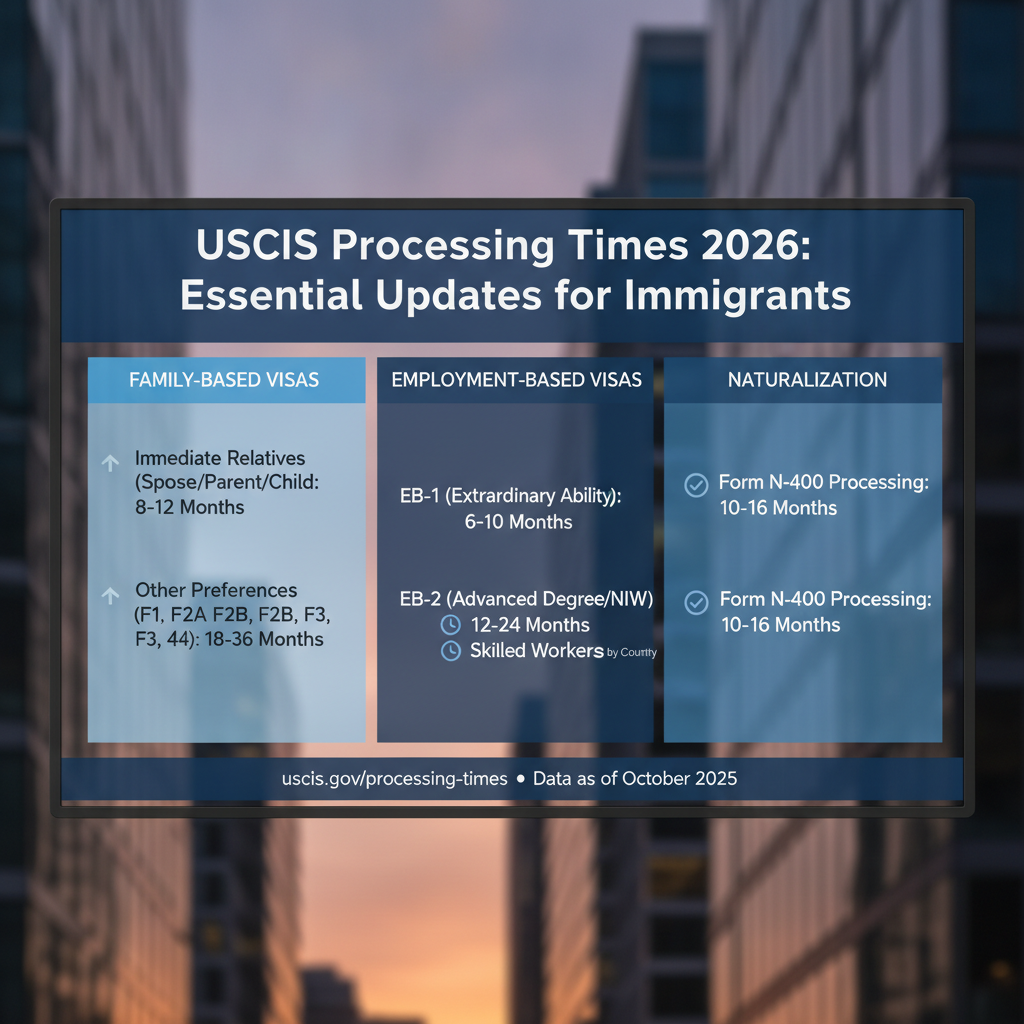
The information and guidance in this article are inspired by ongoing reports and analyses of USCIS Processing Times and Updates for 2026 (USCIS), reflecting the agency's continuous efforts to manage its caseload and provide timely adjudications.
What This News Means for Immigrants in Orlando and Across Florida
For individuals and families pursuing their immigration goals, understanding USCIS processing times isn't just about curiosity; it's about planning your life. These updates directly influence everything from employment opportunities to family reunification and long-term stability.
Why this news is showing up now
USCIS processing times are not static; they are dynamic metrics that reflect a multitude of factors, including:
- Caseload Volume: The sheer number of applications received. USCIS often sees fluctuations based on policy changes, economic conditions, and global events.
- Resource Allocation: The staffing levels, technological infrastructure, and budget available to USCIS for processing applications.
- Policy and Regulatory Changes: New directives or regulations can require changes in how applications are reviewed, potentially slowing down or speeding up certain categories.
- Interview Backlogs: For applications requiring interviews, such as Adjustment of Status (Form I-485) or naturalization (Form N-400), interview scheduling backlogs can significantly extend overall processing times, especially at local field offices like the one in Orlando.
- National Security and Fraud Prevention Measures: Enhanced vetting procedures, while crucial for national security, can add layers of review that extend processing durations.
In 2026, USCIS continues to grapple with the aftermath of past operational challenges, while simultaneously implementing new initiatives aimed at improving efficiency. This means that while some application types may see improvements, others might experience continued delays, making it crucial to stay informed.
How it can affect Florida residents
Florida, particularly Central Florida and the Orlando metropolitan area, is home to a vibrant and diverse immigrant community. The impact of USCIS processing times on Florida residents can be profound:
- Family Reunification Delays: For those sponsoring family members, extended processing times for forms like Form I-130 (Petition for Alien Relative) can mean longer separations from loved ones. Many families along the I-4 corridor rely on these petitions to bring their relatives to the U.S.
- Employment Authorization Gaps: Delays in processing Form I-765 (Application for Employment Authorization) can lead to gaps in employment for individuals awaiting their work permits, causing financial hardship for families in Orange County and beyond.
- Uncertainty for Businesses: Employers in Florida who sponsor foreign workers are also affected. Delays can impact their ability to hire and retain talent, affecting local economic growth.
- Travel Restrictions: Applicants whose Form I-131 (Application for Travel Document) is pending might face restrictions on international travel, preventing them from visiting family abroad or attending to urgent matters.
- Local Field Office Impact: The Orlando USCIS Field Office handles a significant volume of interviews and local adjudications. Its operational capacity and efficiency directly impact processing times for residents in Orlando and surrounding communities.
Understanding these impacts is the first step toward effectively managing your immigration journey. At Imigrar, we specialize in helping Florida residents navigate these challenges, providing localized expertise and personalized strategies.
Need Help? Our Orlando immigration team is ready to assist. Call +1 786-791-3106 for a free consultation, or message us online. Se Habla Español.
What USCIS Processing Times Are (and Why It Matters)
At its core, "processing time" refers to the period USCIS estimates it will take to process an application, petition, or request from the date it receives it until it makes a decision. These times are critical because they offer a glimpse into the potential wait you might face, allowing you to plan your life, finances, and even travel.
A plain-English definition
Imagine you've submitted an important document to a government agency, and you're waiting for a response. USCIS processing times are essentially the agency's best guess for how long that wait will be. They are not a guarantee, but a projection based on historical data and current workload. They vary significantly depending on the type of form, the specific USCIS service center or field office handling your case (e.g., the Orlando USCIS Field Office), and even the country of origin for some applications.
Important: These times are not legally binding deadlines for USCIS, but rather transparent operational metrics designed to help applicants. However, if your case falls outside the posted processing times, it may be an indication that something is amiss, or that your case warrants an inquiry.
Key terms you need to know
To accurately understand and track your case, familiarize yourself with these essential terms:
- Processing Time: The estimated duration from the date USCIS receives a petition or application to the date of a decision. These are published on the USCIS Processing Times website.
- Receipt Date: The date USCIS officially receives your application or petition. This date is crucial for calculating whether your case is within or outside the normal processing times. You'll find it on your Form I-797C, Notice of Action (your receipt notice).
- Notice Date: The date USCIS issues a notice (e.g., a receipt notice, a Request for Evidence, or an approval notice). This is also found on Form I-797C.
- Priority Date: For certain visa categories (especially family-sponsored and employment-based visas subject to numerical limits), the priority date is the date your petition was properly filed with USCIS (or the date the Department of Labor received your labor certification application, if applicable). This date determines your place in the visa queue, which is separate from processing times but critically impacts when a visa number becomes available. You can check visa bulletin updates on the U.S. Department of State website.
- Case Status Online: An online tool provided by USCIS where you can enter your receipt number to check the current status of your application. This is your primary resource for real-time updates.
- Service Request (e-Request): An online inquiry you can submit to USCIS if your case is outside the normal processing times for your application type and service center.
- Inquiry: A formal request for information or action regarding your case, often submitted when your case is experiencing abnormal delays.
- Request for Evidence (RFE): A notice from USCIS asking for additional documents or information to support your application. Promptly responding to an RFE is crucial to avoid delays or denial.
- Notice of Intent to Deny (NOID): A notice from USCIS indicating its intention to deny your application unless you provide specific information or explanation within a set timeframe. This is a serious notice that requires immediate legal attention.
Current Immigration Law: The Foundation for Processing Times
While processing times are administrative metrics, they are deeply rooted in the statutory framework of U.S. immigration law. The Immigration and Nationality Act (INA) is the principal body of law governing immigration to the United States, and its provisions dictate who is eligible for what benefits, and indirectly, the complexity and volume of applications USCIS must process.
Federal requirements
USCIS operates under the authority granted by the INA. Key aspects of federal law that influence processing times include:
- Statutory Mandates: While few forms have strict statutory processing deadlines, the INA mandates certain procedures that USCIS must follow, such as conducting background checks (INA § 212(a)), verifying identity, and ensuring eligibility. These requirements are non-negotiable and contribute to the overall processing duration.
- Preference Categories: For family-sponsored and employment-based immigration, the INA establishes preference categories (e.g., First Preference for unmarried adult children of U.S. citizens, as per INA § 203(a)(1)). These categories, combined with annual numerical limits, create backlogs that extend visa availability, which in turn impacts when an application like Form I-485 (Application to Register Permanent Residence or Adjust Status) can be approved, even if the initial petition (e.g., Form I-130) is processed quickly.
- Adjudicative Standards: Each immigration benefit has specific eligibility criteria defined by the INA and further elaborated in the Code of Federal Regulations (8 CFR). USCIS adjudicators must meticulously review each application against these standards, which can be time-consuming, particularly for complex cases.
- Security Checks: All applicants undergo rigorous security and background checks, involving multiple federal agencies. These checks are a federal requirement (INA § 212(a)(3)) and can sometimes be the longest part of the processing time, often outside USCIS's direct control.
For more detailed information on specific forms and their requirements, always refer to the USCIS Forms section on their official website.
Florida-specific considerations
It's important to clarify that Florida does not have its own state-specific immigration laws that directly affect USCIS processing times or eligibility for federal immigration benefits. Immigration law is primarily federal. However, there are state-level factors that can indirectly impact immigrants in Florida:
- Local Field Office Caseload: The Orlando USCIS Field Office and other field offices in Florida (like Miami or Tampa) handle interviews and some adjudications for residents in their jurisdiction. The volume of cases and staffing levels at these local offices directly influence interview scheduling and final decision times for applications like Form I-485 and Form N-400.
- State Legislation Impact: While not directly altering federal processing, certain Florida state laws may affect the daily lives of immigrants and their ability to integrate, such as laws pertaining to professional licensing, driver's licenses, or access to state services. These do not change USCIS processing, but they highlight the need for stable immigration status.
- Community Resources: Florida's large immigrant population means there are numerous community organizations and legal aid groups that can offer support, complementing federal resources.
Even though the laws are federal, the practical experience of an immigrant in Orlando or Central Florida can be distinct due to local administrative practices and community dynamics. That's why having local legal counsel, like Imigrar, is invaluable.
Navigating USCIS Processing Times: A Complete Step-by-Step Guide
Understanding processing times is one thing; actively managing your case in light of them is another. This guide provides actionable steps to monitor your application and address potential delays effectively.
1) Understand Your Application Type and Service Center
Before you can track anything, you need to know exactly what you filed and where it's being processed. USCIS has several service centers (e.g., Nebraska, Texas, California, Vermont, Potomac) and field offices (e.g., Orlando USCIS Field Office). Different forms are processed at different centers, and processing times vary widely between them.
- Identify Your Form: Know the exact form number (e.g., Form I-130, Form I-485, Form I-765).
- Locate Your Receipt Notice: Your Form I-797C, Notice of Action (receipt notice) will tell you which service center is handling your case. The first three letters of your receipt number (e.g., "LIN" for Nebraska, "SRC" for Texas) indicate the service center.
- Understand the Path: Some applications, like Form I-485, start at a service center but then transfer to a local field office (like Orlando) for an interview.
Required Documents for this step: Your original Form I-797C, Notice of Action.
2) Locate Current Processing Times Online
USCIS publishes estimated processing times on its website. This is your primary tool for monitoring.
- Go to the USCIS Processing Times page.
- Select the form you filed (e.g., Form I-485).
- Select the field office or service center processing your application (e.g., "Orlando Field Office" or "Texas Service Center").
- Click "Get processing time."
The displayed time range (e.g., 8.5 to 14 months) represents how long it's taking for 80% of cases of that type to be processed. Your case's Receipt Date is what you compare against this range.
Reminder: Check these times regularly, as they can change monthly.
3) Determine if Your Case is Outside Normal Processing Times
This is a critical calculation. Your case is generally considered "outside normal processing times" if your Receipt Date is earlier than the "receipt date for a case inquiry" listed on the USCIS processing times page. For example, if the page says "You may submit an inquiry for a case with a receipt date before January 1, 2026," and your receipt date is December 15, 2025, your case is outside normal processing.
- Use the "Case Inquiry Tool": The USCIS processing times page often has a direct link or tool to help you determine this.
- Understand the 80% Rule: USCIS aims to process 80% of cases within the published range. If your case is beyond that, it falls into the remaining 20% that may take longer, but it also means you may be eligible to make an inquiry.
Warning: Do not submit an inquiry if your case is still within the posted times. It will not speed up your case and may add to USCIS's workload unnecessarily.
4) Submitting an "Outside Normal Processing Time" Inquiry
If your case is indeed outside the normal processing times, you can submit an e-Request online. This is the first formal step to draw USCIS's attention to your delayed case.
- Visit the USCIS official website and navigate to the "Tools" section, then "Case Outside Normal Processing Time."
- You will need your receipt number, the type of form you filed, and your personal information.
- Clearly explain that your case is outside the normal processing times as per their website.
- Keep a record of your inquiry confirmation number.
USCIS typically responds to e-Requests within 15-30 days. The response may be a generic "case is still under review" or it may indicate specific action is being taken.
Required Information for Inquiry: Your receipt number, full name, date of birth, mailing address, and the specific form number.
5) Following Up and Escalation Options
If you don't receive a satisfactory response to your e-Request, or if the delay persists, there are further steps:
- Contact USCIS Contact Center: You can call the USCIS Contact Center (+1-800-375-5283) to speak with a representative and follow up on your inquiry. Be prepared for potentially long wait times.
- Ombudsman Inquiry: The Office of the Citizenship and Immigration Services Ombudsman (CIS Ombudsman) assists individuals and employers with problems they are experiencing with USCIS. If you've tried to resolve the issue with USCIS directly and failed, you can submit a request for assistance to the CIS Ombudsman.
- Congressional Inquiry: Your local Congressional representative or Senator can often submit an inquiry on your behalf. This can sometimes prompt USCIS to review your case, especially if there's a compelling reason for urgency. For Florida residents, your elected officials can be a valuable resource.
- Mandamus Lawsuit (Last Resort): In extreme cases of unreasonable delay, and after exhausting all administrative remedies, a lawsuit (known as a Writ of Mandamus) can be filed in federal court to compel USCIS to make a decision on your case. This is a serious legal action and should only be pursued with experienced legal counsel.
Important: These escalation steps should only be taken with the guidance of an experienced immigration attorney. An attorney can assess the best course of action and handle communications on your behalf.
6) Maintaining Valid Status During Delays
For many applicants, especially those adjusting status in the U.S., prolonged processing times can pose a risk to their legal status. It is crucial to maintain valid nonimmigrant status if your Adjustment of Status (Form I-485) application is pending, unless you are covered by specific provisions (e.g., 245(k) for employment-based adjustments).
- File for Extensions: If your underlying nonimmigrant status (e.g., H-1B, L-1, F-1) is expiring, you must file for an extension of stay or change of status (Form I-539) if eligible, or ensure your work authorization (Form I-765) is renewed on time.
- Automatic Extensions: Certain applications, like Form I-765 renewals, may offer automatic extensions of employment authorization under specific conditions, which can be a lifeline during delays. Always check the latest USCIS guidance.
- Consult an Attorney: If your status is nearing expiration and your primary application is still pending, consult an attorney immediately to explore all options and avoid falling out of status.
Reminder: Falling out of status can have severe consequences for your immigration future.
Facing Delays? Don't navigate the complexities of USCIS processing alone. Our Orlando immigration lawyers are here to help. Call +1 786-791-3106 for expert guidance and support. Se Habla Español.

Practical Steps You Can Take Today
While you cannot directly control USCIS processing times, you can take proactive measures to ensure your application is as strong as possible and to manage the waiting period effectively. These steps are applicable whether your case is handled by a service center or the Orlando USCIS Field Office.
Actionable Checklist (5+ items)
- Organize Your Documents: Keep all original and copies of your immigration documents, receipt notices, and correspondence from USCIS in a secure, organized system. This includes your passport, birth certificates, marriage certificates, and any prior immigration filings.
- Monitor Your Case Status Regularly: Check the USCIS Case Status Online tool at least once a week. This is the fastest way to learn about updates, RFEs, or interview notices.
- Set Up an Online Account: If you haven't already, create a USCIS online account. This allows you to track your case, receive notifications, and sometimes even respond to RFEs digitally.
- Respond to RFEs Promptly: If you receive a Request for Evidence (RFE), gather the requested documents immediately and submit them well before the deadline. Delays in responding are a primary cause of extended processing times and potential denials.
- Update Your Address: If you move, even within Orlando or Central Florida, file a Form AR-11, Alien's Change of Address Card, and update your address online with USCIS within 10 days of moving. Failing to do so can result in missed notices and severe consequences.
- Keep Copies of Everything: Before mailing any document to USCIS, make a complete copy for your records. This includes the application itself, supporting documents, and the cover letter.
- Consult with an Immigration Attorney: Especially if you anticipate delays, have a complex case, or receive an RFE or NOID, legal counsel is invaluable. An attorney can provide strategic advice, identify potential issues, and advocate on your behalf.
Document preparation guidance
Proper document preparation is paramount to avoid delays:
- Accuracy and Completeness: Ensure all forms are filled out accurately and completely. Any missing information or inconsistencies can trigger an RFE or even a denial.
- Supporting Evidence: Provide all required supporting documents. If a document is in a foreign language, it must be accompanied by a certified English translation.
- Organize and Label: Submit documents in a clear, organized manner. Use cover letters, tabs, and logical sequencing to help adjudicators process your case efficiently.
- Photocopies vs. Originals: Unless specifically requested, submit photocopies of supporting documents. Keep your original documents safe. USCIS will generally return original documents only if they are not required to be part of the record or if they are submitted by mistake.
Timeline expectations
Managing your expectations regarding timelines is essential for mental well-being and practical planning:
- Fluctuating Times: Recognize that published processing times are estimates and can change. Do not make irreversible plans based solely on these estimates.
- Individual Variation: Your specific case might take longer or shorter than the average due to unique factors (e.g., complexity, security checks, specific adjudicator).
- Expedited Processing: In very


