

The reporting that sparked this guide
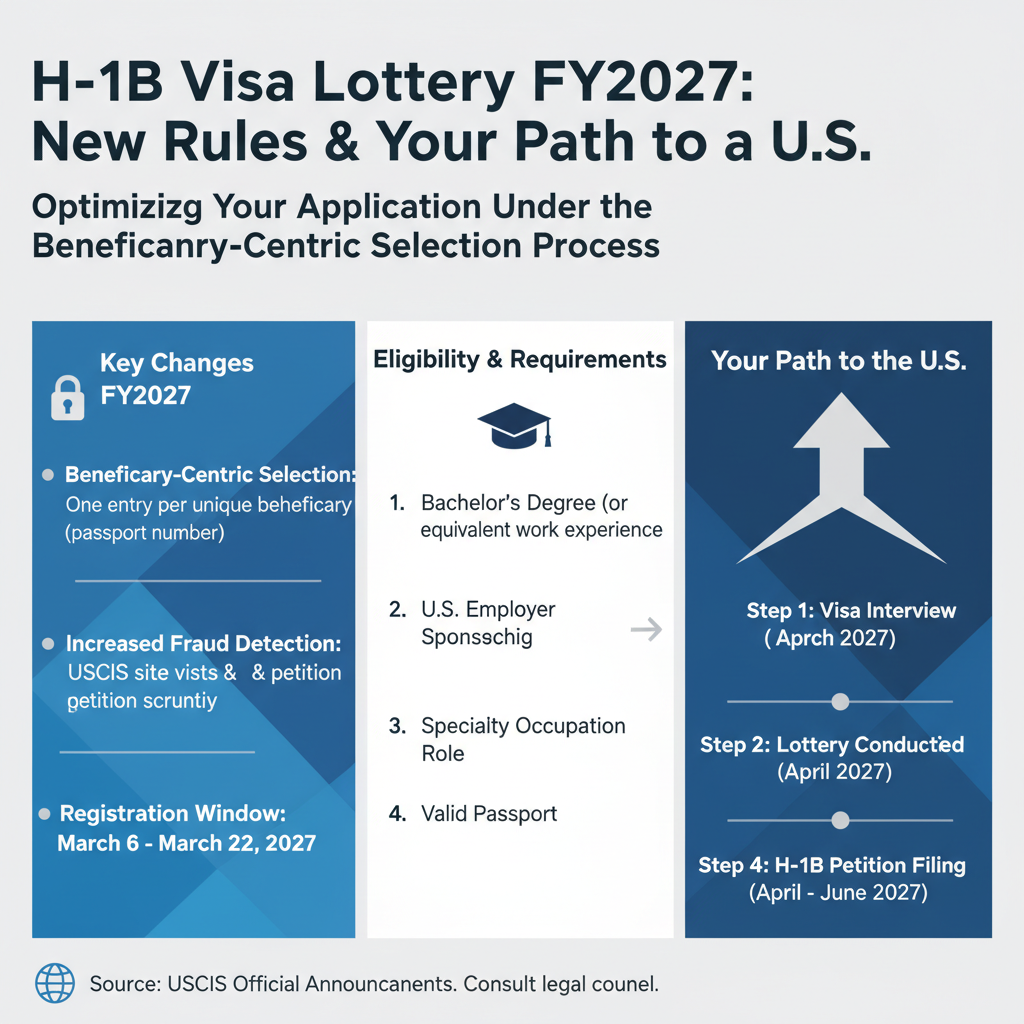
This comprehensive guide is informed by recent legal news regarding the H-1B Visa Lottery Changes for FY2027, highlighting crucial updates that will impact employers and foreign national professionals nationwide.
H-1B Visa Lottery Changes for FY2027 (Legal News)What This News Means for Immigrants in Orlando and Across Florida
The landscape of U.S. immigration law is constantly evolving, and few areas see as much fluctuation and demand as the H-1B visa program. As we approach the registration period for Fiscal Year 2027 (FY2027), significant changes to the H-1B visa lottery system are front and center. For immigrants and employers in Orlando, across Florida, and indeed nationwide, understanding these updates is not just beneficial—it's absolutely essential for a successful application.
Why this news is showing up now
The U.S. Citizenship and Immigration Services (USCIS) is tasked with managing the immense demand for H-1B visas. Given the annual cap on these visas, a lottery system has become a necessity. Over the years, this system has faced challenges, particularly concerning fraud and the integrity of the selection process. To address these issues and ensure a fairer, more efficient system, USCIS periodically implements regulatory changes. The news surfacing now, in early 2026, pertains to the rules that will govern the H-1B cap lottery for FY2027, which typically has its registration period in March 2026 for an October 1, 2026, start date. These changes often build upon previous iterations, like the beneficiary-centric selection process introduced for FY2025, solidifying the agency’s commitment to process integrity. USCIS aims to provide ample notice for employers and prospective beneficiaries to prepare, making these announcements timely and critical for planning.
How it can affect Florida residents
Florida, with its booming technology, healthcare, tourism, and aerospace industries, is a magnet for skilled foreign professionals. Cities like Orlando, Miami, and Tampa are hubs for companies that frequently sponsor H-1B visas. The changes to the H-1B lottery, particularly the shift to a beneficiary-centric selection process, have a direct and profound impact:
- For Employers in Orlando and Central Florida: Companies in the I-4 corridor, from tech startups to established theme park corporations and medical facilities, must adjust their H-1B sponsorship strategies. The new rules emphasize individual beneficiaries, requiring employers to ensure their candidates are uniquely qualified and that their registrations are accurate. This means greater scrutiny and a need for meticulous preparation from the outset.
- For Foreign National Professionals in Florida: If you are an international student graduating from a Florida university (e.g., UCF, UF, FIU) on an F-1 visa with Optional Practical Training (OPT), or a professional working in the state on another nonimmigrant visa, these changes directly impact your opportunity to secure an H-1B. The beneficiary-centric approach aims to level the playing field, ensuring that each eligible individual has a single, fair shot in the lottery, regardless of how many employers registered them. This reduces the advantage previously held by individuals who had multiple employers register on their behalf, a practice that USCIS sought to curb due to potential fraud.
- Reduced Fraud and Increased Fairness: The core intent of these changes is to deter fraudulent registrations and improve the integrity of the lottery. This should, in theory, lead to a fairer distribution of the limited H-1B visas among truly eligible candidates, which benefits legitimate employers and deserving foreign professionals in Florida.
Navigating these updated rules requires a deep understanding of the regulations and a proactive approach. Imigrar, based right here in Orlando, is uniquely positioned to guide both employers and employees through these complexities, ensuring compliance and maximizing chances of success.
Need Help? Our Orlando immigration team is ready to assist. Call +1 786-791-3106 for a free consultation, or message us online. Se Habla Español.
What H-1B Visa Lottery Changes for FY2027 Is (and Why It Matters)
The H-1B visa program is a cornerstone of the U.S. economy, enabling American employers to temporarily employ foreign workers in specialty occupations. These are professions that generally require a bachelor's degree or higher in a specific field. However, due to overwhelming demand, the number of H-1B petitions often far exceeds the annual statutory cap set by Congress, necessitating a lottery system. The "H-1B Visa Lottery Changes for FY2027" refers to the updated regulations that USCIS has implemented to refine how this lottery is conducted, primarily focusing on increasing fairness and reducing potential for fraud.
A plain-English definition
Think of the H-1B visa as a special work permit for highly skilled individuals. It allows U.S. companies to hire foreign professionals for jobs that require specific expertise, like software engineers, doctors, architects, or financial analysts. Each year, there's a limit, or "cap," on how many new H-1B visas can be issued. Because many more people want these visas than are available, USCIS runs a lottery to decide who gets a chance to apply. The "changes for FY2027" are simply new rules for how this lottery works. The biggest change, which was initially introduced for FY2025 and is now the established method for FY2027, is that the lottery selection is now based on the beneficiary (the foreign worker) rather than the petitioner (the employer). This means each individual only gets one chance in the lottery, even if multiple companies want to sponsor them. This is a significant shift designed to make the lottery more equitable and prevent companies from submitting multiple registrations for the same person to increase their odds, a practice USCIS deemed as undermining the lottery’s integrity.
Key terms you need to know
Navigating the H-1B process requires familiarity with specific terminology. Understanding these terms will help you grasp the nuances of the new lottery rules:
- H-1B Visa: A nonimmigrant visa that allows U.S. employers to temporarily employ foreign workers in specialty occupations.
- Specialty Occupation: An occupation that requires the theoretical and practical application of a body of highly specialized knowledge, and a bachelor's or higher degree in the specific specialty (or its equivalent) as a minimum for entry into the occupation in the United States.
- Beneficiary: The foreign national worker whom the employer intends to hire and for whom the H-1B visa is sought. Under the new rules, the lottery is centered around the beneficiary.
- Petitioner: The U.S. employer filing the H-1B petition on behalf of the beneficiary.
- H-1B Cap: The annual statutory limit on the number of H-1B visas issued. Congress currently sets the annual regular cap at 65,000, with an additional 20,000 visas reserved for those with a U.S. master’s degree or higher (the "master's cap exemption").
- Cap-Exempt: Certain employers, such as institutions of higher education, non-profit organizations affiliated with or related to institutions of higher education, and non-profit research organizations or governmental research organizations, are exempt from the annual H-1B cap.
- LCA (Labor Condition Application): Form ETA 9035. This form must be certified by the U.S. Department of Labor (DOL) before an H-1B petition can be filed with USCIS. It attests that the employer will pay the H-1B worker at least the prevailing wage or the actual wage paid to similarly qualified workers, whichever is higher, and provide working conditions that will not adversely affect other workers.
- Registration Period: The designated annual window during which prospective H-1B petitioners (employers) must electronically register their beneficiaries with USCIS for consideration in the lottery. For FY2027, this typically occurs in March 2026.
- Lottery Selection Process: The method USCIS uses to randomly select enough registrations to meet the annual H-1B cap. For FY2027, this is the beneficiary-centric selection process.
- Premium Processing: An optional service offered by USCIS that guarantees expedited processing of certain petitions, including H-1B, usually within 15 calendar days, for an additional fee. This is requested using Form I-907.
- Form I-129: The official "Petition for a Nonimmigrant Worker" filed by the employer with USCIS after a beneficiary's registration has been selected in the lottery.
- DHS (Department of Homeland Security): The federal department that oversees USCIS and U.S. immigration enforcement.
- USCIS (U.S. Citizenship and Immigration Services): The government agency responsible for adjudicating immigration benefits, including H-1B petitions. You can find official information on their USCIS official website.
These terms form the backbone of the H-1B process. Understanding them is your first step towards successfully navigating the application, especially with the latest changes in effect for FY2027.
Current Immigration Law: The Foundation
The H-1B visa program operates under strict federal regulations rooted in the Immigration and Nationality Act (INA). While the lottery process sees procedural changes, the underlying legal framework for the H-1B visa remains consistent. These foundational laws dictate who is eligible, what employers must do, and the overall structure of the program.
Federal requirements
The H-1B visa program is authorized by Section 101(a)(15)(H)(i)(b) of the Immigration and Nationality Act (INA). The annual cap on H-1B visas is specified in INA Section 214(g), and the detailed regulations governing the H-1B program are found in 8 CFR Part 214.2(h). The recent changes regarding the lottery process for FY2027 are amendments to these regulations, designed to enhance program integrity.
Key federal requirements for the H-1B program include:
- Employer Requirements:
- Must have a valid Employer Identification Number (EIN).
- Must offer a bona fide job in a specialty occupation.
- Must demonstrate the ability to pay the H-1B worker the higher of the actual wage or the prevailing wage for the occupation in the area of intended employment, as determined by the Department of Labor (DOL).
- Must file and receive certification for a Labor Condition Application (LCA), Form ETA 9035, from the DOL before filing the H-1B petition with USCIS.
- Employee Requirements:
- Must possess a bachelor's degree or its equivalent, or a higher degree required by the specialty occupation, from an accredited college or university.
- Alternatively, must hold an unrestricted state license, if required for the occupation, or have work experience equivalent to a bachelor's degree (determined by specific USCIS guidelines).
- The proposed employment must be in a specialty occupation.
- The H-1B Cap:
- The annual cap for regular H-1B visas is 65,000.
- An additional 20,000 visas are reserved for beneficiaries who have earned a U.S. master’s degree or higher.
- Certain employers (universities, non-profit research organizations) are cap-exempt, meaning their H-1B petitions are not subject to the annual cap.
- Key USCIS Forms:
- Form I-129, Petition for a Nonimmigrant Worker: The primary form filed by the employer on behalf of the beneficiary after selection in the lottery.
- Form I-907, Request for Premium Processing Service: An optional form to expedite the processing of Form I-129.
For the most current forms and detailed instructions, always refer to the USCIS Forms page on the official website.
Florida-specific considerations
While immigration law is federal and applies uniformly across the U.S., the practical implications of H-1B demand can vary by state. Florida's robust economy and diverse industries create unique dynamics for H-1B applicants and employers:
- High Demand in Key Sectors: Florida's growing tech sector, particularly in areas like Orlando and Tampa, generates significant demand for software developers, IT professionals, and engineers. The state’s extensive healthcare industry also relies heavily on foreign medical professionals. Aerospace, finance, and tourism sectors also contribute to the high number of H-1B petitions originating from Florida.
- Competitive Landscape: Due to this high demand, the H-1B lottery is intensely competitive for Florida employers and prospective employees. The beneficiary-centric selection process for FY2027 aims to ensure a fairer chance for individuals, but the sheer volume of applications means preparation and strategic planning are paramount.
- Local USCIS Presence: Although H-1B petitions are primarily processed by USCIS service centers (California Service Center, Vermont Service Center), the presence of the Orlando USCIS Field Office (Orlando Field Office) is relevant for other immigration matters that H-1B workers or their families might encounter, such as Adjustment of Status or naturalization applications later on. While the Orlando office doesn't handle H-1B adjudications, local counsel like Imigrar can provide invaluable support for all related immigration needs in Central Florida.
Understanding these federal requirements and how they play out in the Florida context is crucial. Working with an experienced immigration attorney who understands both the federal mandates and the local environment, such as Imigrar, can significantly enhance your chances of success.
Considering an H-1B for FY2027? The new rules demand precision. Let Imigrar guide you. Call +1 786-791-3106 for a free consultation. Se Habla Español.

How to Navigate the H-1B Visa Lottery Changes for FY2027: A Complete Step-by-Step Guide
The H-1B cap lottery for FY2027 incorporates the beneficiary-centric selection process, which fundamentally changes how registrations are handled. This step-by-step guide walks you through the revised process, from initial assessment to final visa stamping or status change, emphasizing critical points for the upcoming cycle.
1) Employer and Beneficiary Eligibility Assessment
Before any formal steps are taken, both the prospective employer (petitioner) and the foreign national (beneficiary) must confirm their eligibility under H-1B regulations. This is a foundational step that cannot be overlooked, especially with the increased scrutiny on fraud.
- For the Employer:
- Verify you have a valid Employer Identification Number (EIN).
- Confirm the job offered truly qualifies as a specialty occupation, requiring a specific bachelor's degree or higher.
- Assess your financial ability to pay the required wage to the H-1B worker.
- Required Documents for Employer Assessment: Detailed job description, company financial records, EIN confirmation.
- For the Beneficiary:
- Ensure your educational qualifications (bachelor's degree or higher in a relevant field) meet the specialty occupation requirements. If your degree is from outside the U.S., it must be evaluated by a credential evaluation service to determine its U.S. equivalent.
- If relying on work experience, ensure it can be proven to be equivalent to a bachelor's degree.
- Required Documents for Beneficiary Assessment: Resume/CV, all academic transcripts and diplomas (translated and evaluated if foreign), professional licenses (if applicable), passport biographical page.
Important: This initial assessment can prevent issues later in the process. An experienced immigration attorney can help confirm eligibility for both parties.
2) Labor Condition Application (LCA) Filing
Once eligibility is confirmed, the employer must file a


