

The reporting that sparked this guide: H-1B Visa Lottery Changes for FY2027 (Legal News)
What This News Means for Immigrants in Orlando and Across Florida
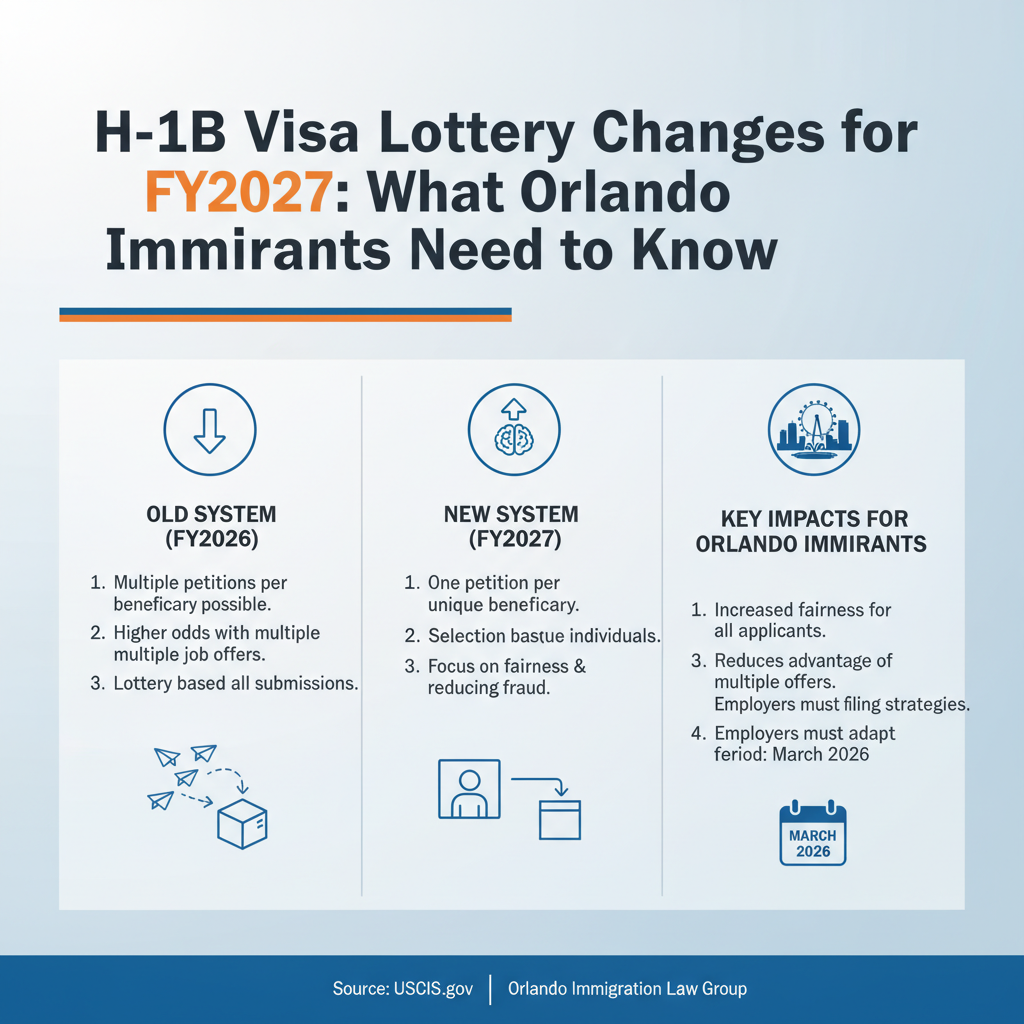
For countless skilled professionals and the innovative companies that seek to employ them, the H-1B visa program represents a critical pathway to opportunity in the United States. As an immigration law firm based in Orlando, Florida, Imigrar understands the immense importance of these visas – not just for individual careers, but for keeping families together and fostering economic growth across our state and nation. The recent news regarding significant changes to the H-1B visa lottery for Fiscal Year 2027 (FY2027) is not just a regulatory update; it's a game-changer with far-reaching implications.
Why this news is showing up now
Immigration law is dynamic, and the U.S. Citizenship and Immigration Services (USCIS) regularly implements updates to its processes to enhance integrity, efficiency, and fairness. The H-1B visa program, with its annual cap and overwhelming demand, has long been a focal point for such adjustments. The specific changes for FY2027, which primarily revolve around a new beneficiary-centric selection process, were initially proposed and finalized in late 2023 and early 2024, but their practical impact is now being fully realized as we approach and conclude the registration period for FY2027. Today, March 17, 2026, places us right at the heart of understanding the ramifications of these rules for the current and future H-1B cycles. The news circulating now isn't just about the announcement of the rules, but about their active implementation, the experiences of petitioners and beneficiaries during the recent registration, and the ongoing analysis of how these changes are shaping the landscape for skilled immigration.
These adjustments are a direct response to concerns about fraud and system abuse, particularly the practice of multiple registrations for the same beneficiary by different employers, or even by related entities attempting to increase selection odds. USCIS aims to create a more equitable system where every eligible beneficiary has a truly equal chance of selection, regardless of how many employers register them.
How it can affect Florida residents
Florida, particularly the Orlando metropolitan area and the I-4 corridor, is a rapidly expanding hub for technology, aerospace, healthcare, and tourism – sectors that heavily rely on skilled foreign talent. Companies in cities like Orlando, Tampa, and Miami frequently sponsor H-1B visas to fill critical roles that require specialized expertise. These new lottery rules will have a direct and significant impact on both these employers and the foreign national professionals residing or seeking to reside in Florida:
- For Employers: Florida businesses, from tech startups in Orange County to large corporations, must now adapt their H-1B sponsorship strategies. The previous incentive to have multiple related entities register a single beneficiary is gone. Employers must focus on legitimate job offers and ensure their registrations are accurate and compliant with the new anti-fraud measures. This could mean a shift in recruitment strategies and a greater emphasis on early planning.
- For Beneficiaries (Prospective H-1B Workers): If you are a foreign national living in Florida on another visa status (like F-1 OPT or L-1) and hoping to transition to H-1B, or if you are abroad but have a job offer in Florida, these changes are paramount. Your chances of selection are now truly tied to your individual eligibility, not to the number of registrations submitted on your behalf. This levels the playing field but also means careful vetting of potential employers and ensuring all your personal information is consistent across any registrations.
- Increased Scrutiny: USCIS has signaled a stronger focus on compliance and fraud detection. This means petitions, once selected, may face more rigorous review, impacting processing times and potentially requiring more Requests for Evidence (RFEs). For Florida residents, especially those in fast-paced industries, this necessitates meticulous preparation.
- Impact on Local Talent Pool: The H-1B program is vital for bringing specialized skills to Florida's economy. Changes to the lottery can influence the availability of this talent, potentially affecting innovation and growth in key sectors.
Navigating these new H-1B rules can be complex. Our Orlando immigration team at Imigrar is deeply familiar with the nuances of U.S. immigration law and the specific needs of Florida’s employers and skilled professionals. Call +1 786-791-3106 for a free consultation to discuss your situation, or message us online. Se Habla Español.
What H-1B Visa Lottery Changes for FY2027 Is (and Why It Matters)
The H-1B visa program allows U.S. employers to temporarily employ foreign workers in specialty occupations. These occupations generally require a bachelor's degree or higher in a specific specialty. Due to high demand, the number of H-1B petitions often exceeds the annual cap set by Congress, necessitating a lottery system. The changes for FY2027 are designed to fundamentally alter how this lottery operates, with significant implications for all stakeholders.
A plain-English definition
The H-1B visa is for skilled workers in "specialty occupations," meaning jobs that usually require at least a bachelor's degree in a specific field. Think IT professionals, engineers, doctors, architects, and scientists. There's an annual limit, or "cap," on how many H-1B visas can be issued each fiscal year (FY). Congress sets this cap at 65,000 visas, plus an additional 20,000 for those with a U.S. master's degree or higher (the "master's cap"). Because demand almost always far exceeds supply, USCIS uses a lottery to select which registrations can proceed to file a full H-1B petition.
The "changes for FY2027" refer to new rules for how this lottery is conducted. Previously, if multiple employers registered the same foreign national, each registration counted as a separate entry into the lottery, potentially increasing that individual's chances of selection. This led to concerns about abuse, with some employers submitting multiple registrations for the same person, sometimes without a genuine job offer, simply to game the system.
The new rule, effective for the FY2027 lottery (which began its registration period in March 2026), shifts to a beneficiary-centric selection process. This means that each unique foreign national (the "beneficiary") will now only be entered into the lottery once, regardless of how many different employers legitimately register them. If a beneficiary is selected, all employers who registered that individual will be notified, and any of them can then proceed to file an H-1B petition on their behalf. The goal is to make the lottery fairer, giving every eligible individual an equal shot at selection, rather than allowing those with multiple registrations to have a statistical advantage.
Key terms you need to know
- H-1B Visa: A nonimmigrant visa that allows U.S. employers to temporarily employ foreign workers in specialty occupations.
- Beneficiary: The foreign national worker who is the subject of the H-1B petition. Under the new rules, this is the central figure in the lottery selection.
- Petitioner: The U.S. employer filing the H-1B petition on behalf of the beneficiary.
- Cap-Subject H-1B: An H-1B petition that is subject to the annual congressional numerical limits (the "cap"). Most H-1B visas fall into this category.
- Cap-Exempt H-1B: Certain H-1B petitions are exempt from the annual cap, such as those filed by institutions of higher education, non-profit organizations affiliated with higher education, or governmental research organizations.
- H-1B Lottery (or Selection Process): The random selection process USCIS uses when the number of H-1B registrations exceeds the annual cap.
- Fiscal Year (FY): The U.S. government's fiscal year runs from October 1st to September 30th. For example, FY2027 begins on October 1, 2026. H-1B visas become available at the start of the fiscal year for which they are requested.
- H-1B Registration: An online process where employers submit basic information about the prospective H-1B worker and the job offer to USCIS. This registration is required to enter the H-1B lottery.
- Form I-129: The "Petition for a Nonimmigrant Worker" form, which is the actual H-1B petition filed by the employer after a registration has been selected in the lottery.
- Labor Condition Application (LCA): Form ETA-9035. A certification from the U.S. Department of Labor (DOL) that an employer has met specific requirements regarding wages and working conditions for H-1B workers. This must be certified before filing Form I-129.
- Specialty Occupation: An occupation that requires theoretical and practical application of a body of highly specialized knowledge, and a bachelor's or higher degree in the specific specialty (or its equivalent) as a minimum for entry into the occupation in the U.S.
- Master's Cap: The additional 20,000 H-1B visas reserved for beneficiaries who have earned a U.S. master's degree or higher.
Current Immigration Law: The Foundation
The H-1B visa program is governed by the Immigration and Nationality Act (INA) and regulations promulgated by USCIS. Understanding the legal framework is crucial for navigating the application process, especially with the new changes.
Federal requirements
The H-1B visa category is defined under INA § 101(a)(15)(H)(i)(b). The annual cap and the master's cap are established by INA § 214(g). To qualify for an H-1B visa, both the employer (petitioner) and the foreign national (beneficiary) must meet specific federal requirements:
For the Employer (Petitioner):
- Legitimate Job Offer: The employer must have a genuine offer of employment in a specialty occupation.
- Specialty Occupation: The job itself must qualify as a specialty occupation, meaning it requires a bachelor's degree or higher in a specific field as a minimum entry requirement.
- Wage Requirements: The employer must agree to pay the H-1B worker at least the prevailing wage for that occupation in the geographic area of employment, or the actual wage paid to other employees with similar experience and qualifications, whichever is higher. This is documented through the Labor Condition Application (LCA) (Form ETA-9035), certified by the Department of Labor.
- Employer-Employee Relationship: A valid employer-employee relationship must exist between the petitioner and the beneficiary.
For the Beneficiary (Foreign National):
- Education/Experience: The beneficiary must possess at least a bachelor's degree or its equivalent, or a license in a specialty occupation field, or work experience equivalent to a bachelor's degree.
- Qualifications for the Job: The beneficiary's qualifications must match the requirements of the specialty occupation.
- Intent: The H-1B is a nonimmigrant visa, generally implying temporary intent, though "dual intent" is permitted, meaning an H-1B holder can simultaneously pursue permanent residency.
The process generally involves the employer filing the LCA (Form ETA-9035) with the Department of Labor, followed by the H-1B registration with USCIS (if cap-subject), and then the filing of Form I-129, Petition for a Nonimmigrant Worker, with USCIS after selection. The beneficiary may then apply for an H-1B visa at a U.S. consulate abroad or, if already in the U.S., apply for a Change of Status.
For official information and forms, always refer to the USCIS official website.
Florida-specific considerations
While H-1B requirements are federal, the practical application and impact vary regionally. Florida's unique economic landscape plays a significant role:
- High-Demand Industries: Florida has burgeoning tech sectors in Orlando, Tampa, and South Florida, aerospace and aviation around Cape Canaveral, and robust healthcare and tourism industries statewide. These sectors frequently seek H-1B talent, leading to a competitive environment.
- University Connections: Universities like the University of Central Florida (UCF) in Orlando, the University of Florida, and the University of South Florida are major magnets for international students. Many of these students, especially those on F-1 visas with Optional Practical Training (OPT), seek H-1B sponsorship from Florida employers. The Orlando USCIS Field Office processes various immigration applications, and while H-1B petitions are typically processed at service centers, local field offices handle related matters like interviews for adjustment of status.
- Prevailing Wage Levels: The prevailing wage requirements for H-1B visas are region-specific. Employers in high-cost-of-living areas or areas with high demand for certain skills in Florida (e.g., software engineers in Orlando) may face higher prevailing wage determinations, impacting their costs.
- Local Legal Expertise: Given the competitive nature and the new rules, having an immigration law firm like Imigrar, with strong local roots in Orlando, can provide invaluable insight into regional employer practices and trends, while serving clients nationwide.
Reminder: The H-1B cap and lottery process are highly competitive. Even with the new beneficiary-centric selection, careful preparation and adherence to all regulations are paramount.
How to Navigate the New H-1B Lottery Rules: A Complete Step-by-Step Guide
The shift to a beneficiary-centric selection process for the H-1B lottery introduces a renewed focus on individual eligibility and employer compliance. Here’s a detailed guide for employers and beneficiaries preparing for future H-1B cap seasons, building on the experience of FY2027.
1) Understand the New Rules & Confirm Eligibility
Before any action, both the prospective H-1B worker (beneficiary) and the sponsoring employer (petitioner) must fully grasp the FY2027 lottery changes. The core of the new rule is that each unique beneficiary can only be selected once in the lottery, regardless of how many legitimate job offers and registrations they have. This is a critical fraud prevention measure.
- For the Beneficiary: Ensure you are only the subject of legitimate job offers from bona fide employers. Any attempt by employers (or related entities) to submit multiple registrations for you to increase your chances will be considered fraud by USCIS and could lead to denial of your petition and even criminal charges. Verify that any employer registering you has your correct and consistent biographical information.
- For the Employer: Confirm the job meets the "specialty occupation" definition. Ensure the beneficiary possesses the required qualifications (bachelor's degree or equivalent). Understand that if your beneficiary is selected, other employers who also registered them will also be notified of the selection. This means you might be competing for the beneficiary's services if they were selected through multiple registrations.
- Official Reference: Review the latest official guidance and final rules published on the USCIS official website regarding the H-1B program and lottery changes.
2) Employer Sponsorship and LCA Filing
The employer's role begins well before the lottery registration. This step is largely unchanged, but its importance is underscored by the increased scrutiny from USCIS.
- Job Offer & Prevailing Wage Determination: The employer must finalize a job offer, including salary and job duties. They must then determine the prevailing wage for that occupation in the specific geographic area of employment using the Department of Labor's Online Wage Library (OWC) or other acceptable sources.
- File Labor Condition Application (LCA): The employer must file Form ETA-9035, Labor Condition Application, with the U.S. Department of Labor (DOL). This form attests that the employer will pay the H-1B worker at least the prevailing wage or actual wage, whichever is higher, and that working conditions will not adversely affect U.S. workers.
- LCA Certification: The DOL typically certifies the LCA within 7 business days. A certified LCA is a mandatory prerequisite for H-1B registration and petition filing.
- Required Documents for LCA:
- Employer's Federal Employer Identification Number (FEIN)
- Employer's contact information and address
- Job title, duties, and proposed salary
- Worksite location(s)
- Prevailing wage source and wage level
- Beneficiary's name (if known, for certain LCA types)
3) H-1B Registration Period
This is the critical juncture for the lottery. For FY2027, the registration period typically runs for a few weeks in early March (e.g., March 6 to March 22, 2026). Employers submit electronic registrations for each prospective beneficiary.
- Create/Access USCIS Online Account: Employers (or their authorized legal representatives) must use a USCIS online account to submit registrations.
- Submit Electronic Registration: For each beneficiary, the employer provides basic information:
- Beneficiary's full legal name, date of birth, country of birth, country of citizenship, passport number.
- Whether the beneficiary has a U.S. master's or higher degree.
- Employer's name, address, and Federal Employer Identification Number (FEIN).
- Attorney/representative information (if applicable).
- Pay Registration Fee: A non-refundable fee (e.g., $10 for FY2027) must be paid for each registration.
- Important: Under the new rules, if multiple employers register the same beneficiary, all registrations must contain identical beneficiary information (name, date of birth, passport number, etc.) to be considered valid and linked to the single lottery entry for that beneficiary. Discrepancies could lead to rejection or fraud investigations.
4) Lottery Selection and Notification
After the registration period closes, USCIS conducts the random lottery selection. For FY2027, selections typically occur by late March or early April.
- Selection Process: USCIS first selects enough registrations to meet the master's cap, then selects from the remaining pool (including unselected master's degree holders) to meet the regular cap. Under the new rules, this selection is based on unique beneficiaries.
- Notification: USCIS notifies selected registrants (employers/attorneys) through their online accounts. The status will change from "Submitted" to "Selected." If a beneficiary was registered by multiple employers and selected, all employers who submitted a valid registration for that beneficiary will receive a "Selected" notification.
- What Happens Next: Only selected employers can proceed to file a full H-1B petition (Form I-129) on behalf of the selected beneficiary.
- Timeline Expectation: Selection notifications for FY2027 were typically issued by March 27, 2026. Employers then have a specific 90-day window to file the H-1B petition.
5) Petition Filing (Form I-129)
Once a registration is selected, the employer has a limited window to file the complete H-1B petition package with USCIS.
- Prepare and File Form I-129: The employer, with legal counsel, prepares and files Form I-129, Petition for a Nonimmigrant Worker, along with all supporting documentation.
- Required Documents for Form I-129 (examples):
- Certified LCA (Form ETA-9035)
- Copy of the H-1B registration selection notice
- Educational documents (degrees, transcripts, evaluations of foreign degrees)
- Beneficiary's resume/CV
- Copies of beneficiary's passport, visa, I-94 record (if in U.S.)
- Employer support letter detailing the job offer, specialty occupation nature, and beneficiary's qualifications
- Company documentation (articles of incorporation, financial statements, tax returns, office lease, etc.)
- Contracts or work assignments demonstrating specialty occupation work (especially for IT consulting firms)
- Evidence of valid employer-employee relationship
- All required USCIS forms and supplements (e.g., H-1B Data Collection and Filing Fee Exemption Supplement).
- Filing Fees: Include all applicable USCIS filing fees (base fee, ACWIA fee, fraud prevention and detection fee, public law 114-113 fee if applicable).
6) Premium Processing (Optional)
For an additional fee, employers can opt for premium processing to expedite the adjudication of the H-1B petition.
- File Form I-907: Submit Form I-907, Request for Premium Processing Service, along with the required fee (e.g., $2,805 as of early 2026).
- Expedited Adjudication: USCIS guarantees a response (approval, denial, Request for Evidence, or Notice of Intent to Deny) within 15 calendar days.
- Benefit: This is highly recommended for beneficiaries needing a quicker decision, especially those on F-1 OPT nearing its expiration, or those who need to start work by October 1st.
7) Visa Interview or Change of Status
Once the H-1B petition is approved, the final step depends on the beneficiary's current location.
- For Beneficiaries Outside the U.S.: They will undergo consular processing. This involves scheduling an interview at a U.S. embassy or consulate in their home country, attending the interview, and receiving the H-1B visa stamp in their passport.
- Required Documents for Interview: Original Form I-797 Approval Notice, DS-160 confirmation, passport, visa photos, employer letter, educational documents, employment verification.
- For Beneficiaries Inside the U.S. (Change of Status): If the petition was filed as a Change of Status (e.g., from F-1 to H-1B), and approved, the beneficiary's status automatically changes to H-1B on October 1st (for cap-subject petitions). They do not need to leave the U.S. for a visa stamp unless they travel internationally and need to re-enter.
- Important: Maintain lawful status until October 1st. If your previous status (e.g., OPT) expires before October 1st, you may be eligible for "Cap-Gap" extension.
Warning: The H-1B process is complex and requires meticulous attention to detail. Any errors can lead to delays, Requests for Evidence (RFEs), or even denial. Consulting with an experienced immigration attorney is highly advisable at every stage.
Don't navigate these H-1B changes alone. Imigrar's expert legal team in Orlando provides comprehensive support for H-1B petitions, from LCA to approval. Contact us for a free consultation at +1 786-791-3106. Se Habla Español.

Practical Steps You Can Take Today
Even if the FY2027 lottery registration period has closed, or if you are preparing for future H-1B cycles, there are crucial steps you can take now to enhance your chances of success.
Actionable Checklist:
- Understand the "Beneficiary-Centric" Model: If you are a beneficiary, ensure you have only one, accurate profile across all potential employer registrations. If you are an employer, focus on securing a strong, legitimate job offer and preparing a meticulous petition.
- Gather All Personal & Educational Documents: Collect certified copies of your academic transcripts, degrees, diplomas, professional licenses, passport, visa, I-94 records, and any foreign degree evaluations. Ensure all names and dates match across documents.
- Research Potential Employers (Beneficiaries): Identify reputable employers in your field, particularly those in Florida's growing tech, healthcare, and engineering sectors, who have a history of sponsoring H-1B visas. For Central Florida residents, focus on companies along the I-4 corridor.
- Verify Employer Legitimacy (Beneficiaries): Be wary of "employers" who promise H-1B sponsorship without a clear job description, proper interview process, or who ask you to pay for the registration/petition fees directly (which is generally illegal for cap-subject H-1B base fees).
- Review Your Resume/CV and Job Description: Ensure your qualifications align perfectly with the "specialty occupation" requirements of your prospective job. Work with your employer to refine the job description to clearly demonstrate it requires a bachelor's degree in a specific field.
- Consult with an Experienced Immigration Attorney: This is perhaps the most critical step. An attorney can assess your eligibility, advise employers on compliance, prepare the LCA, manage the registration process, and meticulously prepare the Form I-129 petition to minimize RFEs and denials.
- Stay Informed on USCIS Updates: Regularly check the USCIS official website for the latest news, policy changes, and processing times (USCIS Processing Times).
Document Preparation Guidance:
- Accuracy is Key: Ensure all names, dates of birth, passport numbers,


