


The landscape of U.S. immigration law is constantly evolving, and few areas generate as much attention and anxiety as the H-1B visa program. As an immigration law firm dedicated to helping individuals and families achieve their American dreams, Imigrar closely monitors all developments. Today, we're diving deep into the significant changes impacting the H-1B visa lottery for Fiscal Year 2027 (FY2027).
The reporting that sparked this guide
The U.S. Citizenship and Immigration Services (USCIS) has finalized new rules designed to enhance the integrity of the H-1B cap registration process and reduce fraud. These changes, particularly the shift to a beneficiary-centric selection model, have been a major topic in legal news and directly affect every employer and potential H-1B beneficiary hoping to secure one of these highly sought-after work visas.
You can follow the broader discussion and stay informed on immigration law developments through:
H-1B Visa Lottery Changes for FY2027 (Legal News)
What This News Means for Immigrants in Orlando and Across Florida
For individuals and businesses in Orlando, Central Florida, and throughout the Sunshine State, these H-1B lottery changes are not just bureaucratic adjustments; they represent a fundamental shift in strategy for securing talent and pursuing professional opportunities. Understanding these modifications is crucial for anyone planning to participate in the upcoming FY2027 H-1B cap season.
Why this news is showing up now
The H-1B visa program operates on a fiscal year basis, beginning October 1st. USCIS typically opens the registration period for the upcoming fiscal year in March of the preceding calendar year. Given that today is June 16, 2026, the FY2027 H-1B cap season is just around the corner. USCIS announced these critical changes well in advance to give employers and prospective beneficiaries ample time to understand and adapt. These rules are a culmination of USCIS's efforts to combat widespread fraud observed in previous lottery seasons, particularly the submission of multiple registrations for the same individual by related entities to unfairly inflate selection odds.
How it can affect Florida residents
Florida's economy is vibrant and diverse, with thriving sectors in technology, aerospace, healthcare, tourism, and engineering. Cities like Orlando, Tampa, and Miami are hubs for innovation and growth, attracting skilled professionals from around the globe. Many Florida-based companies rely on the H-1B program to fill critical specialty occupation roles that require specific expertise not readily available in the domestic workforce.
- For Employers: Florida companies, from burgeoning tech startups in the I-4 corridor to established healthcare systems in Orange County, will need to re-evaluate their H-1B sponsorship strategies. The new rules mean a greater emphasis on legitimate job offers and a reduced chance of gaming the system through multiple registrations. This could lead to more competitive recruitment practices and a higher bar for demonstrating a true employer-employee relationship.
- For Prospective Beneficiaries: Individuals living in or aspiring to work in Florida will find the playing field more level. While the overall odds of selection remain challenging due to high demand, the new "beneficiary-centric" approach ensures that each eligible individual has an equal chance, regardless of how many employers register them. This is particularly impactful for international students graduating from Florida universities or professionals already working in the state on other nonimmigrant visas (like F-1 OPT) who are seeking to transition to H-1B status.
The Orlando USCIS Field Office and local immigration attorneys will be key resources for navigating these changes. Imigrar, with its deep roots in Orlando, is uniquely positioned to assist both employers and beneficiaries throughout Florida.
Need Help? Our Orlando immigration team is ready to assist. Navigating the new H-1B lottery rules can be complex, but you don't have to do it alone. Call +1 786-791-3106 for a free consultation, or message us online. Se Habla Español.
What H-1B Visa Lottery Changes for FY2027 Is (and Why It Matters)
The H-1B visa is a nonimmigrant visa that allows U.S. employers to temporarily employ foreign workers in specialty occupations. These occupations generally require a bachelor's degree or higher in a specific field. Due to annual statutory limits (the "H-1B cap"), demand for these visas far outstrips supply, necessitating a lottery system for selection.
A plain-English definition
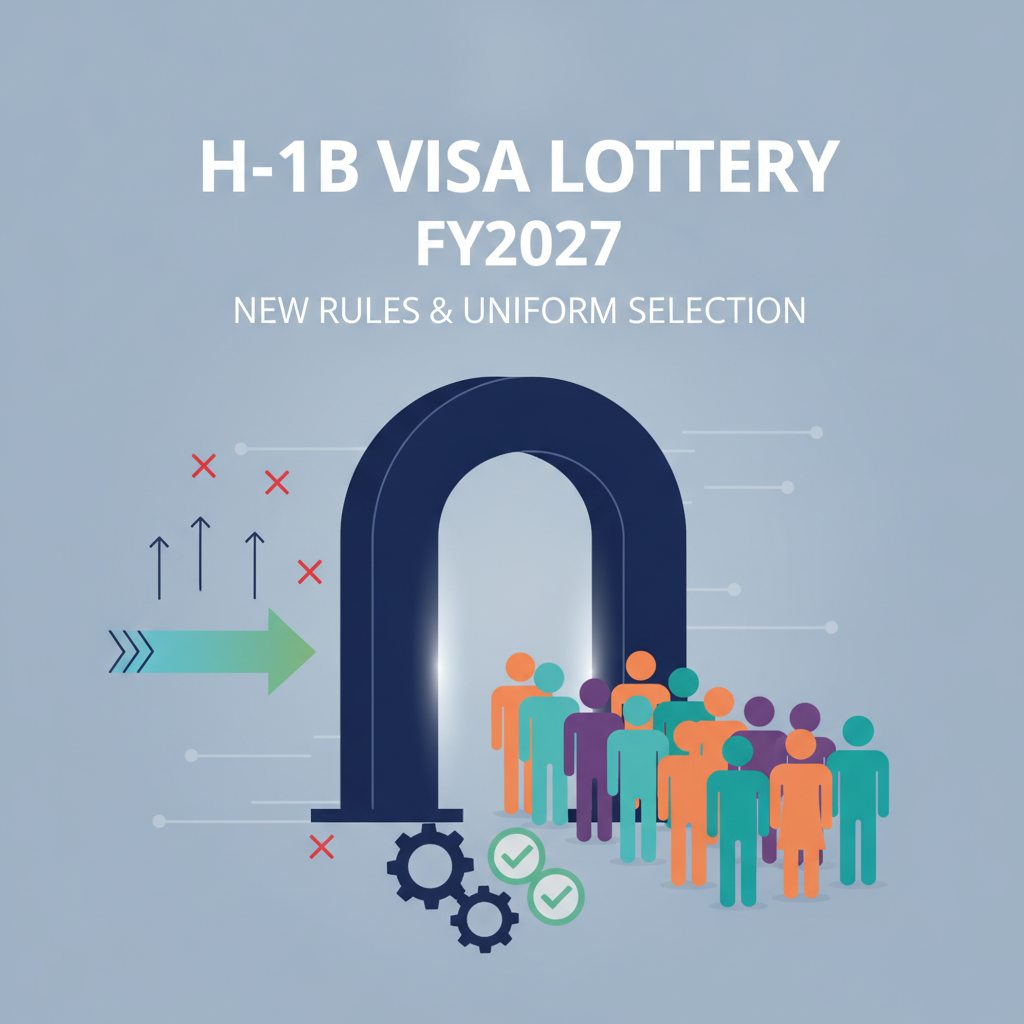
For FY2027, the H-1B visa lottery system has undergone significant revisions. Previously, if multiple employers registered the same foreign national (beneficiary), each registration had an equal chance of being selected, effectively increasing that individual's overall odds. The new rule changes this: USCIS will now select registrations based on unique beneficiaries, not on the number of registrations submitted on behalf of a beneficiary. This means that if a single foreign national has multiple registrations submitted by different employers, they will still only be entered into the lottery once. If selected, USCIS will then notify all employers who registered that specific beneficiary, and any of those employers can proceed with filing an H-1B petition.
Why it matters: This change is a game-changer. It aims to eliminate the unfair advantage gained by filing multiple registrations for the same individual, which was a tactic used by some employers to "game" the system. The goal is to make the lottery fairer, giving every eligible individual an equal chance at selection, regardless of how many employers are willing to register them. It levels the playing field for all applicants, especially those with only one employer willing to sponsor them.
Key terms you need to know
Understanding these terms is vital for navigating the H-1B process, especially with the new changes:
- H-1B Visa: A nonimmigrant visa that permits U.S. employers to temporarily employ foreign workers in specialty occupations.
- Specialty Occupation: An occupation that requires theoretical and practical application of a body of highly specialized knowledge, and a bachelor's or higher degree in the specific specialty (or its equivalent) as a minimum for entry into the occupation.
- H-1B Cap: The annual numerical limit on the number of H-1B visas issued. Congress currently sets the annual regular cap at 65,000 and an additional 20,000 for those with a U.S. master's degree or higher (the "master's cap").
- Cap-Subject: Refers to H-1B petitions that are subject to the annual numerical cap. Most H-1B petitions fall into this category.
- Cap-Exempt: Certain employers are exempt from the H-1B cap, such as institutions of higher education, related or affiliated nonprofit entities, nonprofit research organizations, and government research organizations.
- Beneficiary: The foreign national worker for whom the H-1B visa is being sought.
- Petitioner: The U.S. employer filing the H-1B petition on behalf of the beneficiary.
- H-1B Registration Period: The designated window, typically in March, during which prospective petitioners must electronically register beneficiaries for the H-1B lottery.
- Lottery Selection: The random process USCIS uses to select registrations when the number of eligible registrations exceeds the annual H-1B cap.
- Fiscal Year (FY): The U.S. government's accounting period, which runs from October 1st to September 30th. H-1B visas are granted for a specific fiscal year (e.g., FY2027 begins October 1, 2026).
- MyUSCIS Organizational Account: A new feature implemented by USCIS for the H-1B cap registration process, allowing employers to collaborate with their legal representatives and manage registrations more efficiently.
Current Immigration Law: The Foundation
The H-1B visa program is rooted in the Immigration and Nationality Act (INA), specifically Section 101(a)(15)(H)(i)(b), which defines the H-1B nonimmigrant classification. Further regulations governing the H-1B program are found in 8 U.S.C. § 1101 et seq. and the Code of Federal Regulations at 8 CFR 214.2(h).
The H-1B cap itself is mandated by Congress, and USCIS administers the program in accordance with these statutes and subsequent regulations. The new H-1B lottery rules for FY2027 were established under USCIS's authority to manage the cap-subject petition process, aiming to ensure fairness and prevent abuse.
For official information and detailed legal texts, always refer to the USCIS official website.
Federal requirements
To qualify for an H-1B visa, both the employer (petitioner) and the foreign national (beneficiary) must meet specific federal requirements:
- Specialty Occupation: The job must qualify as a specialty occupation, meaning it typically requires a bachelor's degree or higher in a specific field.
- Educational Attainment: The beneficiary must hold a bachelor's degree or its equivalent, or possess a license in a specialty occupation field, or have work experience equivalent to a bachelor's degree.
- Employer-Employee Relationship: A valid employer-employee relationship must exist between the petitioner and the beneficiary, as defined by USCIS.
- Prevailing Wage: The employer must pay the H-1B worker at least the prevailing wage for the occupational classification in the area of employment, or the actual wage paid to other employees with similar experience and qualifications, whichever is higher. This is often determined by the Department of Labor's (DOL) Labor Condition Application (LCA) process.
- H-1B Cap: Unless cap-exempt, the petition must be filed during the annual H-1B cap season and the beneficiary must be selected in the lottery.
Florida-specific considerations
While there are no specific Florida state laws governing the H-1B visa program (it is a federal immigration program), the impact on Florida's economy and workforce is significant. For employers in Orlando and across Florida, adhering to federal H-1B regulations is paramount. Florida's Department of Economic Opportunity can provide data on prevailing wages, though the primary source for H-1B purposes is the DOL's Foreign Labor Certification Data Center.
Businesses operating in Florida must ensure they comply with all federal labor laws, in addition to H-1B specific requirements, when employing foreign nationals. This includes proper record-keeping, adherence to wage requirements, and ensuring workplace safety. For Central Florida residents, understanding the local job market and identifying potential employers who regularly sponsor H-1B visas can be a strategic advantage.
The primary USCIS form involved in the H-1B process, after a successful registration and selection, is the Form I-129, Petition for a Nonimmigrant Worker.
Considering an H-1B Visa for FY2027? The new rules demand careful planning. Our team at Imigrar can guide you through every step, ensuring compliance and maximizing your chances of success. Call +1 786-791-3106 for a free consultation. Se Habla Español.
How to Navigate the H-1B Lottery Changes for FY2027: A Complete Step-by-Step Guide
The H-1B cap season is a multi-stage process. With the new FY2027 lottery changes, strategic preparation is more critical than ever. Here's a step-by-step guide to help you, whether you're an employer in Orlando or a prospective beneficiary nationwide.
1) Understand the New Lottery Rules and Eligibility
Before anything else, both petitioners and beneficiaries must grasp the core change: the beneficiary-centric selection process. This means that each unique beneficiary is entered into the lottery only once, regardless of how many employers register them. If selected, any employer who registered that beneficiary can file a petition. This emphasizes the legitimacy of each job offer.
Eligibility Check:
- For Beneficiaries: Do you meet the educational requirements for a specialty occupation (bachelor's degree or higher, or its equivalent)? Is your occupation truly a "specialty occupation"?
- For Employers: Can you demonstrate a valid employer-employee relationship? Can you pay the prevailing wage? Is the position a specialty occupation?
Required Documents (for initial assessment):
- Employer's legal business name and Employer Identification Number (EIN).
- Beneficiary's full legal name, date of birth, country of birth, country of citizenship, and passport number.
- Beneficiary's academic credentials (degrees, transcripts) and any professional licenses.
2) Employer Registration and Account Creation
The H-1B cap registration is an electronic process. Employers (or their authorized attorneys) must create or access a MyUSCIS organizational account to submit registrations. USCIS has enhanced these accounts to facilitate collaboration between attorneys and employers, and to strengthen integrity.
Actionable Steps:
- Create or Update MyUSCIS Account: Ensure your organizational account is set up and active well before the registration window opens.
- Add Legal Representation: If using an attorney (highly recommended), ensure they are properly linked to your organizational account.
- Gather Employer Information: Have all necessary company details readily available.
Required Documents/Information:
- Employer's legal name, mailing address, and EIN.
- Employer's authorized signatory information.
- Attorney G-28 (Notice of Entry of Appearance as Attorney or Accredited Representative) if applicable.
3) Prepare and Submit the H-1B Registration
The registration period typically runs for a few weeks in March. For FY2027, anticipate this window around March 2026. During this time, the employer submits a simple electronic registration for each beneficiary, providing basic identifying information for both the company and the foreign national.
Important: Each registration requires a $10 fee (this fee may change, always check the latest USCIS guidance). Under the new rules, while multiple employers can register the same beneficiary, this does *not* increase the beneficiary's chances of selection. USCIS will identify duplicate beneficiary registrations and only count one for the lottery.
Required Documents/Information:
- Beneficiary's full legal name, date of birth, country of birth, country of citizenship, and passport number.
- Employer's name, EIN, and address.
- Attorney information (if applicable).
- Confirmation of a legitimate job offer and intent to employ.
4) Await Lottery Results and Notification
USCIS conducts the lottery after the registration period closes. Typically, results are announced in late March or early April. Employers will be notified through their MyUSCIS organizational accounts whether their registrations were selected, not selected, or placed on a reserve list.
What to Expect:
- Selected: If selected, the employer receives a selection notice and a window to file the full H-1B petition.
- Not Selected: These registrations are not chosen in the initial lottery.
- Reserve List: USCIS may maintain a reserve list in case initial selections are not utilized or are later denied, allowing for subsequent selections.
Reminder: Selection in the lottery does not guarantee H-1B approval; it only grants the opportunity to file the detailed petition.
5) File the H-1B Petition (Form I-129) for Selected Beneficiaries
If your registration is selected, the employer has a specific filing window (typically 90 days from April 1st) to submit the complete Form I-129, Petition for a Nonimmigrant Worker, along with all supporting documentation and fees. This is the most complex and document-intensive phase.
Key Components of the Petition:
- Form I-129: The core petition form.
- Certified Labor Condition Application (LCA): Filed with the Department of Labor (DOL) and certified before filing the I-129. This confirms the prevailing wage and working conditions.
- Employer Support Letter: Explaining the job, the need for a foreign worker, and the specialty occupation nature.
- Beneficiary's Academic Credentials: Diplomas, transcripts, and foreign degree evaluations (if applicable).
- Experience Letters: Documenting prior work experience, especially if relying on experience in lieu of a degree.
- Employer's Business Documents: Articles of incorporation, financial statements, tax returns, and other evidence of a legitimate, active business.
- Contracts and Itineraries: Especially for third-party placement or consulting roles.
- Beneficiary's Resume, Passport, Visa, I-94: And other personal identifying documents.
Warning: The new rules are designed to prevent fraud. USCIS will scrutinize petitions carefully for evidence of a bona fide job offer and employer-employee relationship, especially if the beneficiary was registered by multiple entities.
6) Respond to RFEs or NOIDs (If Applicable)
It is common for USCIS to issue a Request for Evidence (RFE) or a Notice of Intent to Deny (NOID) if they require additional information or clarification to make a decision. A prompt and thorough response is critical.
Actionable Advice:
- Understand the RFE/NOID: Carefully read and understand exactly what USCIS is asking for.
- Gather Specific Evidence: Provide all requested documents and explanations.
- Consult Attorney: Your immigration attorney is invaluable at this stage for crafting a strong response.
Required Documents: This will vary based on the specific RFE or NOID, but typically involves more detailed evidence of the specialty occupation, beneficiary qualifications, employer-employee relationship, or financial viability.
7) Attend Interview and Visa Stamping (for those outside the U.S.)
If the beneficiary is outside the U.S., once the I-129 petition is approved (Form I-797 Approval Notice), they will need to apply for an H-1B visa stamp at a U.S. embassy or consulate abroad. This involves submitting a DS-160 online application and attending an interview.
Key Steps:
- DS-160 Application: Complete the online Nonimmigrant Visa Application.
- Schedule Interview: Book an appointment at a U.S. consulate in your home country.
- Prepare for Interview: Gather all supporting documents, including the I-797 approval notice, passport, educational certificates, and employment letters.
Required Documents:
- Valid passport.
- Form I-797 Approval Notice.
- DS-160 confirmation page.
- Visa interview appointment confirmation.
- Passport-style photographs.
- Original academic documents and professional licenses.
- Employer's offer letter and other supporting employment documents.
For those already in the U.S. on another nonimmigrant status (e.g., F-1 OPT), the approved H-1B petition often leads to a change of status, allowing them to begin H-1B employment on October 1st (or later, depending on the start date requested).
Practical Steps You Can Take Today for Your H-1B Application
The H-1B lottery changes for FY2027 demand proactive preparation. Here's a checklist of practical steps you can take right now to strengthen your position.
Actionable Checklist:
- Verify Eligibility: Both employers and beneficiaries should rigorously assess their eligibility under the H-1B requirements, especially concerning specialty occupation and educational qualifications.
- Gather Documents Early: Start compiling all necessary personal, educational, and employment documents. This includes transcripts, diplomas, foreign degree evaluations, resumes, and passport copies.
- Work with Experienced Counsel: Engage with an experienced immigration attorney, like those at Imigrar, as early as possible. They can help you understand the new rules, prepare accurate registrations, and strategize for the full petition.
- Ensure Employer Compliance: Employers must review their internal processes to ensure compliance with the new rules, especially regarding the legitimate employer-employee relationship and prevailing wage requirements.
- Understand the Beneficiary-Centric Model: If you are a beneficiary, communicate with all potential employers that while multiple registrations are allowed, only one entry per person is counted. Focus on securing a strong, bona fide job offer.
- Monitor USCIS Updates: Keep an eye on the USCIS official website for the latest announcements regarding the FY2027 registration period, fees, and any further clarifications.
Document preparation guidance
Accuracy and completeness are paramount. Any discrepancies or missing information can lead to delays, RFEs, or even denial.
- Accuracy: Ensure all names, dates, and numbers match exactly across all documents (e.g., passport, birth certificate, degrees).
- Completeness: Do not omit any requested information or documents.
- Translations: Any documents not in English must be accompanied by a certified English translation. The translator must certify that they are competent to translate and that the translation is accurate.
- Certifications: USCIS often requires certified copies of certain documents. Your attorney can advise on this.
- Digital Copies: Keep organized digital copies of all submitted documents.
Timeline expectations
While specific dates for FY2027 are pending, the general H-1B cap timeline typically follows this pattern:
- March 2026 (approx. 2-3 weeks): H-1B electronic registration period opens


