


The journey to obtaining a Green Card, also known as lawful permanent residency, is a pivotal moment for countless individuals and families seeking to build a life in the United States. While the application process itself involves extensive paperwork and careful adherence to regulations, one of the most crucial and often anxiety-inducing stages is the Green Card interview. This interview is a standard procedure designed to verify the information provided in your application and to ensure you meet all eligibility requirements for permanent residency.
At Imigrar, an immigration law firm based in Orlando, Florida, we understand the significance of this interview. Our mission, "Keep Families Together," drives us to provide clear, actionable guidance to help you navigate this critical step with confidence. Today, February 20, 2026, we're addressing the ongoing importance of meticulous preparation for your Green Card interview, reflecting current trends and legal considerations.
The reporting that sparked this guide
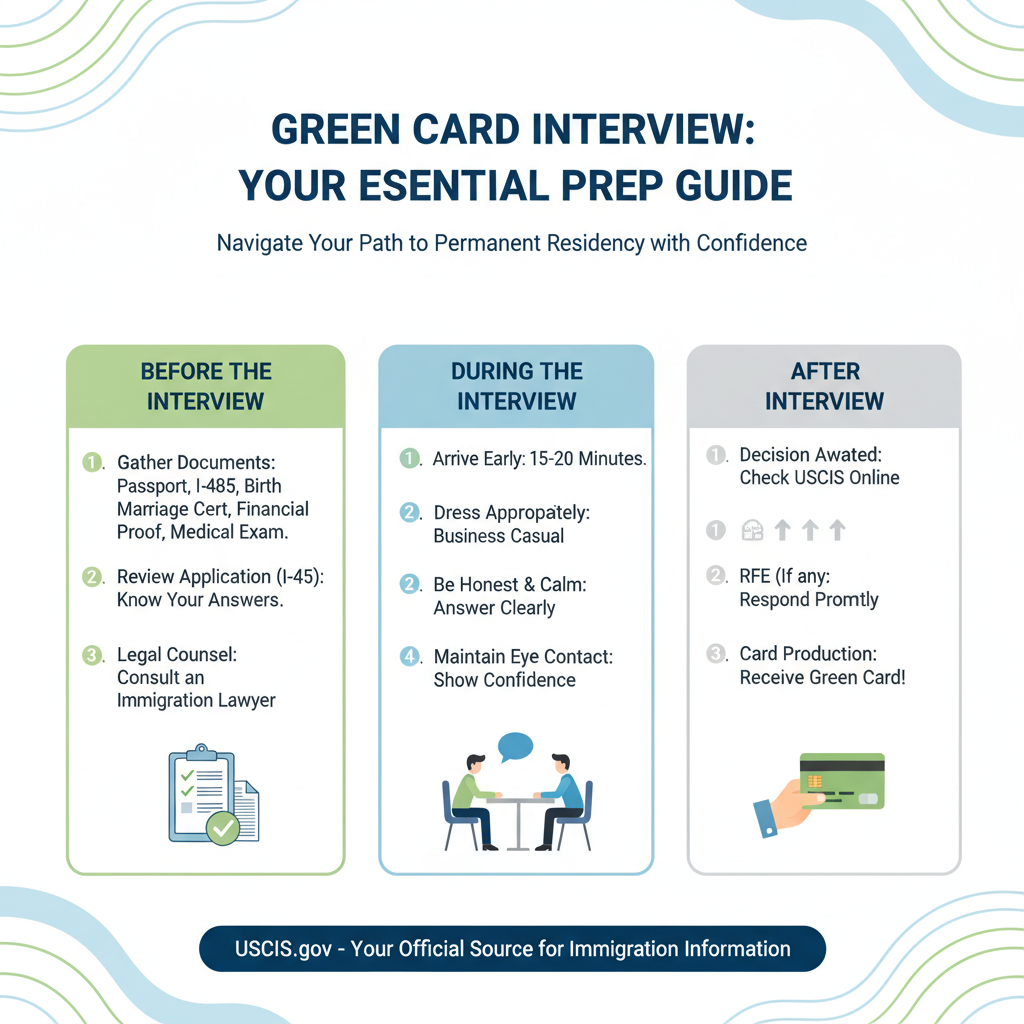
Recent discussions and trends in Green Card Interview Preparation Tips (Immigration Law) highlight the constant need for applicants to be thoroughly prepared. While the core requirements for a Green Card interview remain consistent, evolving USCIS policies, processing times, and the sheer volume of applications mean that a well-prepared applicant stands the best chance of a smooth and successful outcome. This renewed focus on interview readiness underscores the importance of understanding every detail of your case and presenting it clearly and accurately to immigration officers.
What This News Means for Immigrants in Orlando and Across Florida
For immigrants residing in Orlando, across Central Florida, and throughout the Sunshine State, the emphasis on Green Card interview preparation is particularly relevant. Florida is a vibrant melting pot, home to diverse immigrant communities, many of whom are pursuing their dreams of permanent residency. Understanding and preparing for your interview is not just a federal requirement; it's a personal imperative for securing your future.
Why this news is showing up now
The Green Card interview has always been a cornerstone of the immigration process, but its importance is frequently highlighted due to several factors:
- Increased Scrutiny: Immigration policies can shift, leading to periods of increased scrutiny on applications to prevent fraud and ensure compliance with eligibility criteria.
- Processing Updates: USCIS regularly updates its processing procedures and guidelines. While the fundamental purpose of the interview remains, the nuances of what officers focus on or how they conduct interviews can evolve.
- Applicant Anxiety: The interview is often the final hurdle before approval, naturally causing significant anxiety for applicants. News and legal updates often reflect this widespread concern, prompting a focus on preparation.
- Complex Cases: As immigration law becomes more intricate, many cases involve unique circumstances that demand a thorough interview to clarify all details.
This ongoing attention serves as a crucial reminder: the interview is not a mere formality; it's a substantive review of your eligibility.
How it can affect Florida residents
For individuals and families in Florida, particularly those in the Orlando area, robust interview preparation is key:
- Orlando USCIS Field Office: Most Green Card interviews for Central Florida residents are conducted at the Orlando USCIS Field Office. Familiarity with local procedures and expectations can be beneficial.
- Diverse Case Types: Florida's diverse population means a wide array of Green Card applications, including family-based petitions (spouses, parents, children), employment-based petitions, and asylum-based adjustments. Each type has specific interview considerations.
- High Volume: Florida is a populous state with a significant immigrant population, meaning USCIS field offices often handle a high volume of cases. Being exceptionally prepared can help your case proceed smoothly.
- Local Legal Support: Having access to experienced immigration attorneys in Orlando, like Imigrar, who understand both federal law and local USCIS practices, is invaluable for comprehensive preparation.
Need Expert Guidance for Your Green Card Interview? Don't face your interview alone. Our Orlando immigration team provides personalized preparation and support. Call +1 786-791-3106 for a free consultation, or message us online. Se Habla Español.
What Green Card Interview Preparation Is (and Why It Matters)
The Green Card interview is arguably the most personalized and scrutinized part of the Adjustment of Status or Consular Processing journey. It is where a USCIS officer (for Adjustment of Status) or a Consular Officer (for Consular Processing) meets with the applicant and, in most family-based cases, the petitioner, to review the application and supporting documents. The goal is to determine your eligibility for permanent residency and to ensure the information provided is truthful and accurate.
A plain-English definition
Simply put, a Green Card interview is a face-to-face meeting with a U.S. government official who will ask you questions about your application, your background, and your relationship (if applicable) to verify that you meet all the legal requirements to become a lawful permanent resident of the United States. It's an opportunity for you to present your case clearly and for the officer to address any concerns or discrepancies.
Why does it matter so much? Because the outcome of this interview directly determines whether you are granted a Green Card. A poorly prepared interview, or one where inconsistencies arise, can lead to delays, requests for additional evidence, or even denial of your application. Conversely, a well-prepared interview can lead to immediate approval.
Key terms you need to know
Navigating the immigration process requires understanding specific terminology. Here are some key terms related to your Green Card interview:
- Adjustment of Status (AOS): The process of applying for lawful permanent resident status (a Green Card) while physically present in the United States. Interviews for AOS typically occur at a USCIS Field Office.
- Consular Processing: The process of applying for an immigrant visa at a U.S. embassy or consulate abroad, for individuals who are outside the United States. Upon approval, they enter the U.S. as lawful permanent residents.
- Petitioner: The U.S. citizen or lawful permanent resident who files an immigrant petition (e.g., Form I-130) on behalf of a foreign national relative.
- Beneficiary: The foreign national seeking immigration benefits, such as a Green Card, through a petition filed by a U.S. citizen or lawful permanent resident.
- Affidavit of Support (Form I-864): A legally binding contract an individual signs to accept financial responsibility for the intending immigrant. This is crucial for family-based petitions.
- Request for Evidence (RFE): A letter from USCIS asking for additional documents or information to support your application. This can be issued before or after an interview.
- Notice of Intent to Deny (NOID): A letter from USCIS stating their intention to deny your application and giving you an opportunity to respond and provide additional evidence.
- Priority Date: The date USCIS receives your immigrant petition (e.g., Form I-130). This date is used to determine when an immigrant visa becomes available, especially for preference categories.
- Inadmissibility: Grounds under U.S. immigration law that make an individual ineligible to enter or remain in the United States, such as certain criminal convictions, health issues, or past immigration violations.
Current Immigration Law: The Foundation for Your Green Card Interview
The Green Card interview is conducted under the umbrella of the Immigration and Nationality Act (INA), the body of law governing immigration to the United States. Your eligibility for a Green Card is determined by specific sections of the INA, and the interview serves as a critical mechanism for USCIS to ensure compliance with these laws.
The primary legal framework for Green Card applications in the U.S. falls under Section 245 of the INA for Adjustment of Status, and Sections 201 and 203 of the INA for immigrant visa availability and preference categories. These laws dictate who is eligible, the types of evidence required, and the grounds for inadmissibility that could prevent someone from obtaining a Green Card.
For more detailed information on immigration laws, always refer to the USCIS official website.
Federal requirements
At the federal level, all Green Card applicants must meet specific requirements, which the interview helps to verify:
- Eligibility Category: You must qualify under an eligible Green Card category, such as family-sponsored (e.g., spouse of a U.S. citizen), employment-based, refugee/asylee, or diversity visa.
- Admissibility: You must be admissible to the United States. This means you must not fall under any grounds of inadmissibility, which can include certain criminal offenses, communicable diseases, past immigration violations, or public charge concerns. If a ground of inadmissibility applies, a waiver might be necessary.
- Bona Fide Relationship (for family-based cases): If applying through marriage, you must prove your marriage is legitimate and not entered into solely for immigration purposes. The interview will heavily focus on this aspect.
- Financial Support: The applicant must demonstrate they will not become a "public charge." This usually involves the petitioner or a joint sponsor filing an Affidavit of Support (Form I-864), demonstrating sufficient income and assets to support the applicant.
- Proper Documentation: All required forms must be filed correctly, including the immigrant petition (e.g., Form I-130, Petition for Alien Relative), the application to adjust status (Form I-485, Application to Register Permanent Residence or Adjust Status), and supporting evidence.
Florida-specific considerations
While federal law governs the fundamental requirements, local USCIS field offices like the one in Orlando may have specific procedural nuances or common areas of focus. For instance:
- Orlando USCIS Field Office Practices: Immigration officers at the Orlando Field Office are highly experienced with the diverse range of cases typical of Central Florida. They are adept at identifying inconsistencies in documentation or testimony, particularly in complex family-based petitions.
- Language Barriers: Given Florida's large Spanish-speaking population, the availability of interpreters (provided by USCIS or brought by the applicant if approved) is a common consideration. Imigrar proudly offers services in English and Spanish (Se Habla Español) to ensure no communication barriers hinder your case.
- Regional Documentation: While not legal requirements, officers may be familiar with specific types of local documentation (e.g., Florida driver's licenses, utility bills from Orange County) that serve as proof of residence or cohabitation.
Important: Always ensure you are working with the most current versions of USCIS forms. You can find them on the USCIS Forms page. Key forms for Green Card applications often include:
- Form I-130, Petition for Alien Relative
- Form I-485, Application to Register Permanent Residence or Adjust Status
- Form I-864, Affidavit of Support
- Form I-693, Report of Medical Examination and Vaccination Record
- Form I-765, Application for Employment Authorization (often filed concurrently)
- Form I-131, Application for Travel Document (often filed concurrently)
How to Prepare for Your Green Card Interview: A Complete Step-by-Step Guide
Preparing for your Green Card interview is a multi-faceted process that requires meticulous attention to detail, thorough organization, and a clear understanding of your case. This guide breaks down the essential steps to ensure you are fully ready for this crucial meeting.
1) Understand Your Case & Review Your Application
Before anything else, you must have an intimate understanding of every detail in your submitted application. The interview isn't just about new information; it's about verifying what you've already told USCIS.
- Review All Forms: Go through your entire application package – Form I-130, Form I-485, Form I-864, and any other supporting forms. Make sure you remember all the dates, addresses, and answers you provided.
- Know Your History: Be prepared to discuss your immigration history, travel history, employment history, and any criminal history (even minor infractions).
- Understand Your Eligibility: Clearly know the basis of your Green Card application (e.g., marriage to a U.S. citizen, parent of a U.S. citizen, employment sponsorship).
- Identify Potential Issues: If there are any complexities in your case (e.g., previous divorces, prior immigration violations, gaps in employment), anticipate how these might be questioned and prepare honest, concise explanations.
2) Gather and Organize All Documents
This is perhaps the most critical logistical step. You must bring originals and copies of every document you submitted, plus any new evidence that has become available since you filed your application. Organize them neatly in a folder or binder for easy access.
Required Documents Checklist:
- Interview Notice: The official letter from USCIS scheduling your interview.
- Identification:
- Valid passport (original and copy)
- Driver's license or state ID (especially for Florida residents)
- Birth certificate (original and certified translation, if applicable)
- Prior Immigration Documents:
- Form I-94 (Arrival/Departure Record)
- Any previous visa stamps, I-20s, EADs, or advance paroles.
- Notice of Approval for Form I-130 (if applicable).
- Medical Examination:
- Sealed Form I-693, Report of Medical Examination and Vaccination Record (if not already submitted or if expired). Do NOT open the sealed envelope.
- Financial Support Documents:
- Form I-864, Affidavit of Support (original, signed by petitioner/joint sponsor).
- Petitioner's/Joint Sponsor's most recent federal income tax returns (IRS transcripts preferred) and W-2s/1099s for the last three years.
- Proof of assets (bank statements, property deeds) if income is insufficient.
- Letter from employer confirming current employment and salary.
- Relationship Evidence (for family-based petitions, especially marriage-based):
- Original marriage certificate.
- Proof of joint residency: joint lease agreements, mortgage statements, utility bills (electricity, water, internet) in both names (especially for Orlando and Central Florida addresses).
- Proof of commingled finances: joint bank accounts, credit card statements, joint tax returns.
- Proof of shared responsibilities: joint insurance policies (health, auto, life), wills naming each other, joint loan documents.
- Photographs together (dating, engagement, wedding, family events, travel).
- Correspondence (emails, texts, social media posts) showing ongoing relationship.
- Children's birth certificates (if applicable).
- Affidavits from friends or family (third-party letters) attesting to the bona fide nature of the relationship.
- Evidence of any previous marriages ending in divorce or death (divorce decrees, death certificates).
- Police Records/Court Documents: If you have any arrests, citations, or convictions, bring certified copies of all court dispositions, even if charges were dismissed or expunged.
- Translations: Any document not in English must be accompanied by a certified English translation.
- Copies: Bring a complete set of photocopies of ALL documents you are submitting or presenting.
Reminder: For Central Florida residents, local utility bills, joint leases in Orlando, and Florida-issued IDs are strong pieces of evidence to bring.
3) Practice Answering Potential Questions
Anticipate the types of questions you might be asked. While you can't predict every question, you can prepare for common themes.
- Review Your Application: The officer will ask questions directly from your forms. Practice reciting dates, addresses, and details exactly as they appear on your application.
- Family Background: Be ready to discuss your parents, siblings, children, and their immigration status.
- Marriage-Based Questions: For spousal petitions, expect detailed questions about how you met, your proposal, wedding, daily life, finances, and future plans. These questions can be very personal.
- "Yes/No" Questions: Understand the questions on Form I-485 regarding criminal history, immigration violations, and other inadmissibility grounds. Be prepared to explain any "yes" answers honestly and clearly.
- Be Honest and Consistent: Always tell the truth. Inconsistencies between your testimony, your petitioner's testimony, and your submitted documents can raise red flags.
- Practice with Your Attorney: If you have legal counsel, conduct mock interviews with them. This is invaluable for building confidence and identifying weak areas.
4) Prepare for the Interview Day Logistics
The day of the interview requires practical preparation to ensure a stress-free experience.
- Dress Appropriately: Dress in clean, neat, and conservative attire, as you would for a job interview. This shows respect for the process.
- Arrive Early: Plan to arrive at the Orlando USCIS Field Office (or other designated location) at least 30-45 minutes before your scheduled appointment. This allows time for parking, security checks, and finding your way. Traffic on the I-4 corridor can be unpredictable, so factor that in.
- Know the Location: Familiarize yourself with the exact address of the USCIS office.
- Bring an Interpreter (if needed): If you do not speak English fluently, you may bring a fluent, disinterested party (not your attorney or petitioner/spouse) to interpret for you. USCIS may also provide an officer who speaks your language. Discuss this with your attorney beforehand.
- Bring Your Attorney: Having an experienced immigration attorney from Imigrar by your side can provide immense peace of mind. Your attorney can clarify questions, object to inappropriate ones, and ensure your rights are protected.
5) Know What to Expect During the Interview
Understanding the flow of the interview can help reduce anxiety.
- Oath: You and your petitioner (if applicable) will be sworn in to tell the truth.
- Review of Application: The officer will typically go through your application forms, asking questions to confirm the information.
- Questions about Your Life: Expect questions about your daily life, work, education, and how you met your spouse (if applicable). For family-based cases, the officer will delve deeply into the bona fides of the relationship.
- "Yes/No" Questions: The officer will review the "yes/no" questions on Form I-485 regarding criminal history, past immigration violations, public charge, etc. Be prepared to explain any "yes" answers.
- Submission of Documents: The officer will review your original documents and may keep copies. They may also ask for new evidence.
- Decision: Sometimes, a decision is made on the spot. More often, the officer will inform you that a decision will be mailed to you within a few weeks. They might also issue an RFE or NOID if more information is needed.
- Remain Calm and Polite: Answer truthfully, directly, and respectfully. If you don't understand a question, ask for clarification. Do not volunteer unnecessary information.
6) Follow Up After the Interview
Your responsibilities don't necessarily end when you leave the USCIS office.
- Respond to RFEs/NOIDs: If you receive a Request for Evidence or Notice of Intent to Deny, respond promptly and comprehensively with the requested information.
- Check Processing Times: You can monitor the USCIS Processing Times for the Orlando Field Office to get an idea of when to expect a decision.
- Consult Your Attorney: If you have any concerns or haven't heard back within the expected timeframe, contact your Imigrar attorney.
Overwhelmed by Documents? Let Imigrar guide you. We specialize in comprehensive Green Card interview preparation for clients nationwide, including Orlando and Central Florida. Call us at +1 786-791-3106 for a free consultation. Se Habla Español.

Practical Steps You Can Take Today for a Successful Interview
Even before you receive your interview notice, there are proactive steps you can take to strengthen your application and prepare for eventual success.
Actionable Checklist:
- Review Your Application Regularly: Even if you filed months ago, pull out your copies of Form I-130, Form I-485, and other documents. Read them thoroughly. Are there any discrepancies you've forgotten?
- Start Gathering Originals: Don't wait until the last minute. Locate all original birth certificates, marriage certificates, divorce decrees, passports, and other vital records. Store them safely.
- Collect Ongoing Relationship Evidence (for family-based cases): Continue to gather new evidence of your bona fide relationship. This could include recent joint utility bills for your Orlando home, new photos, joint credit card statements, or shared travel itineraries.
- Obtain Police Records: If you have any history with law enforcement, even minor, obtain certified copies of all court dispositions now. This can take time.
- Schedule Medical Exam (if needed): If you haven't submitted Form I-693 or if your previously submitted one is nearing its two-year validity period, schedule an appointment with a USCIS-approved civil surgeon. Make sure they seal the envelope for you.
- Practice English (if applicable): If English is not your first language and you plan to speak for yourself, practice discussing your life and application details in English.
- Consult an Attorney: Schedule a consultation with an experienced immigration attorney at Imigrar. Even if you filed your application yourself, an attorney can review your case, identify potential issues, and help you prepare thoroughly.
Document Preparation Guidance
- Originals vs. Copies: Always bring the original of every document, along with a high-quality photocopy. The officer will review the originals and usually keep the copies.
- Translations: For any document not in English (e.g., a birth certificate from your home country), you must provide both the original document (or certified copy) AND a certified English translation. The translation must be accompanied by a certification from the translator stating that they are competent to translate and that the translation is accurate.
- Organize, Organize, Organize: Use a binder with dividers or clearly labeled folders. This makes it easy for you and the officer to find specific documents quickly, showcasing your preparedness.
- Affidavits: If you are submitting affidavits from third parties (e.g., friends or family confirming your marriage), ensure they are notarized and include the affiant's full contact information.
Timeline Expectations
The timeline for receiving an interview notice and getting a decision can vary significantly based on the USCIS field office (e.g., Orlando Field Office), the type of Green Card, and current processing loads. Here's a general idea:
- Interview Scheduling: After filing Form I-485, it can take anywhere from 6 months to over 2 years to receive an interview notice, depending on the case type and field office backlogs. You can check average processing times on the USCIS Processing Times page.
- Notice Period: You typically receive your interview notice by mail several weeks to a month before the actual interview date.
- Decision Post-Interview: While some simple cases may receive an immediate decision, most applicants will receive a decision by mail within a few weeks to a few months. Sometimes, an RFE might be issued, which extends the timeline.
- Green Card Issuance: Once approved, the physical Green Card is usually mailed within 2-4 weeks after approval.
Warning: These timelines are estimates and can change. Always refer to official USCIS processing times for the most current information and consult with your attorney for personalized


