


The reporting that sparked this guide
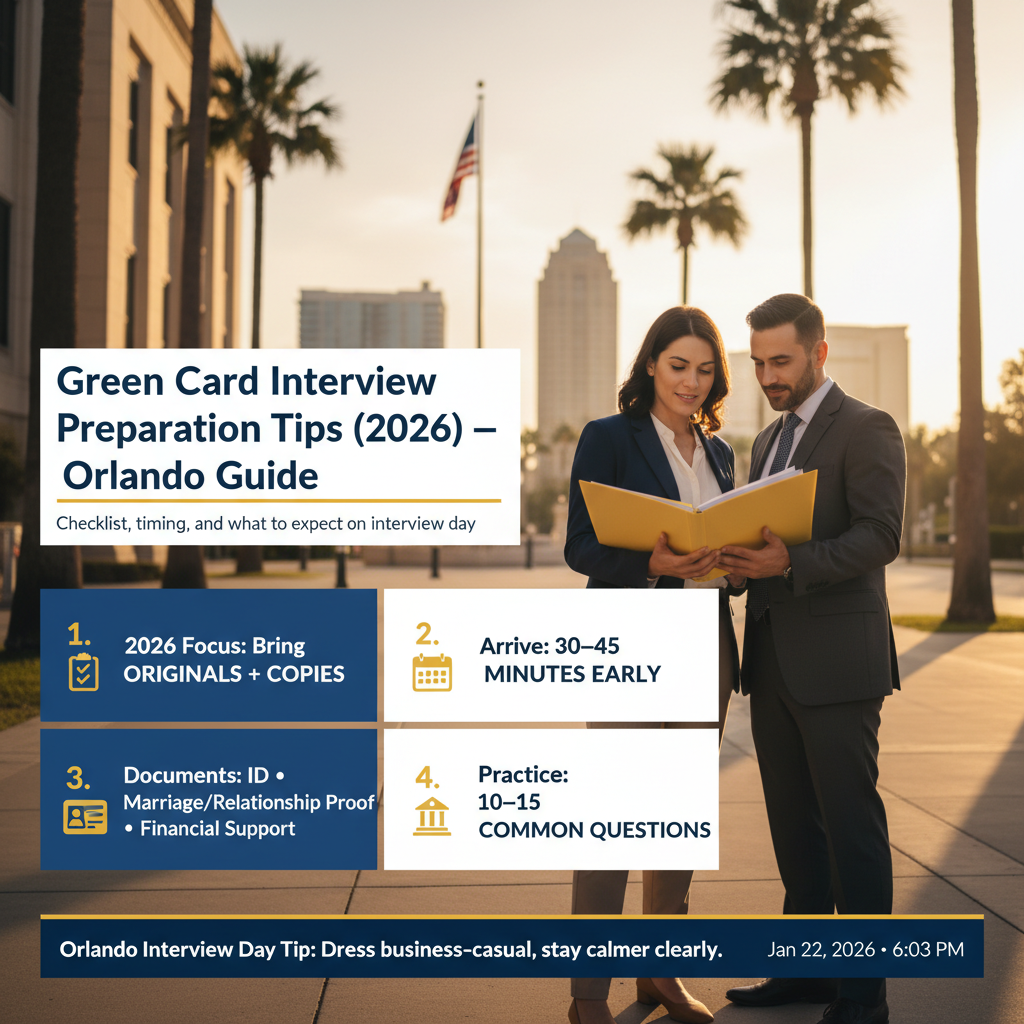
This article is inspired by ongoing coverage and trending discussions in immigration law news, including: Green Card Interview Preparation Tips (Immigration Law).
Need Help? Our Orlando immigration team is ready to assist. Call +1 786-791-3106 for a free consultation, or message us online. Se Habla Español.
What This News Means for Immigrants in Orlando and Across Florida
Why this news is showing up now
Green card interviews are trending again because many applicants are reaching the final stage of their cases after long waits, shifting processing patterns, and increased scrutiny in certain categories. When USCIS interview scheduling accelerates—even temporarily—more families suddenly need practical, last-mile guidance: what to bring, what to expect, and how to avoid a denial or delay.
At Imigrar, we also see a second reason: applicants are increasingly filing with more complex histories (prior visas, prior marriages, periods of unlawful presence, arrests that were dismissed, or travel on advance parole). Those facts don’t automatically prevent approval, but they can make the interview more important—and more stressful—without the right preparation.
Reminder: An interview notice is not a sign that something is wrong. For many cases—especially family-based Adjustment of Status—the interview is a normal step where USCIS confirms identity, eligibility, and whether the relationship is bona fide.
How it can affect Florida residents
Florida has a large immigrant population and a high volume of family-based filings. If your case is in Orlando, your interview may be scheduled at the Orlando USCIS Field Office. Central Florida residents along the I-4 corridor (including Orange County, Seminole, Osceola, Polk, Volusia, and Lake counties) often travel to Orlando for interviews, biometrics follow-ups, or case updates.
Practical impact for Florida residents includes:
- Scheduling logistics: heavy traffic on the I-4 corridor and limited parking time can create late arrivals—something you want to avoid.
- Document readiness: if you moved recently, you must update your address with USCIS quickly, or notices may go to the wrong place.
- Case complexity: Florida applicants may have mixed immigration histories (tourist entries, student visas, TPS, DACA, asylum filings), which can change what USCIS asks at the interview.
Important: If you miss your interview without properly rescheduling, USCIS can treat the application as abandoned, which can lead to denial and serious immigration consequences.
What Green Card Interview Preparation Tips Is (and Why It Matters)
A plain-English definition
“Green card interview preparation” means getting your case file, documents, and personal testimony ready so you can answer USCIS questions clearly and consistently. The officer’s job is to confirm:
- Who you are (identity and admissibility)
- How you qualify for a green card (family, employment, humanitarian category, etc.)
- Whether your forms and evidence match your real-life history
- Whether any legal issues apply (inadmissibility, prior immigration violations, misrepresentation, criminal issues)
Preparation matters because the interview is where small issues become big issues. A missing document, an unclear answer, or an inconsistency can trigger a Request for Evidence (RFE), a second interview, a Notice of Intent to Deny (NOID), or denial.
Key terms you need to know
- Adjustment of Status: Applying for a green card from inside the U.S., usually using Form I-485.
- Consular Processing: Applying for an immigrant visa abroad through the National Visa Center (NVC) and a U.S. consulate (see U.S. Department of State).
- Form I-130: Petition for Alien Relative—often the first step in a family-based case.
- Form I-485: Application to Register Permanent Residence or Adjust Status.
- Priority Date: Your place in line in certain categories. Immediate relatives of U.S. citizens typically don’t wait for a visa number, but preference categories do.
- RFE: Request for Evidence—USCIS asks for missing or additional proof.
- NOID: Notice of Intent to Deny—USCIS believes you may be ineligible and gives a chance to respond.
- Inadmissibility: Legal reasons someone may be barred from getting a green card (health, certain crimes, immigration violations, fraud/misrepresentation, public charge issues, etc.).
Warning: If you are unsure whether a past issue (like an arrest, prior removal order, or visa overstay) affects eligibility, do not guess during the interview. Get legal advice first.
Current Immigration Law: The Foundation
Green card interviews are governed by federal immigration law and USCIS regulations. Most family-based and many employment-based green cards rely on the Immigration and Nationality Act (INA) and related regulations in Title 8 of the Code of Federal Regulations.
Federal requirements
Common legal foundations include:
- INA § 245 (Adjustment of Status): sets who may adjust and the requirements/limitations.
- INA § 212 (Inadmissibility): lists grounds that can block approval.
- INA § 204 (Petitions): covers petition procedures, including family petitions.
- 8 CFR § 245 and related regulations: procedural rules for adjustment cases.
USCIS conducts interviews to verify eligibility and ensure the application is truthful and supported. USCIS guidance and forms are available on the USCIS official website and the USCIS Forms page.
For case timing, applicants should monitor: USCIS Processing Times.
Florida-specific considerations
Immigration law is federal, so the legal rules are the same in Florida as in other states. But Florida-specific realities can affect interview preparation:
- Field office practices: local offices may differ in how they queue interviews, what they emphasize, and whether they request updated medicals or additional relationship evidence.
- Address changes and mobility: many Central Florida residents move along the I-4 corridor; failing to update USCIS can cause missed notices.
- State records: Florida civil documents (marriage certificates, divorce decrees, court dispositions) must be certified and legible; some counties provide electronic records that USCIS may not accept unless properly certified.
Important: If your case involves immigration court (removal proceedings), you may also need to consider EOIR procedures. For official information, see the Executive Office for Immigration Review.
USCIS forms commonly tied to interview preparation include: Form I-130, Form I-485, Form I-864 (Affidavit of Support), Form I-693 (medical exam), and where applicable Form I-765/Form I-131.
Need Help? Our Orlando immigration team is ready to assist. Call +1 786-791-3106 for a free consultation, or message us online. Se Habla Español.
How to Prepare for Your Green Card Interview: A Complete Step-by-Step Guide
1) Confirm what type of green card interview you have (and what USCIS must decide)
Not all interviews are the same. Your preparation should match your category:
- Marriage-based (most common): USCIS evaluates whether the marriage is bona fide and whether the applicant is admissible.
- Other family-based: parent/child/sibling relationships and admissibility.
- Employment-based: job offer details (if required), eligibility, and admissibility.
- Humanitarian-based (asylee/refugee adjustment, VAWA, U visa, etc.): eligibility path plus admissibility and any waivers.
Read your interview notice carefully. If your notice lists specific items, treat that list as mandatory.
Required documents to gather for this step:
- USCIS interview notice (original)
- Government-issued photo IDs (passport, driver’s license/state ID)
- Copies of your filed forms, especially Form I-485 and (if applicable) Form I-130
- Any prior USCIS notices (biometrics, RFEs, approvals)
2) Build a “master file” that matches your forms line-by-line
USCIS officers often verify the facts exactly as written on your application. Your goal is to avoid surprises by reviewing your full filing packet and confirming that:
- All addresses and employment history are complete
- All dates match your documents (marriage date, entry date, prior divorce dates)
- Any “yes” answers to security/admissibility questions are supported with explanations and records
If you find an error, you may be able to correct it at the interview, but the best approach is to speak with counsel about the safest way to fix it.
Required documents to gather for this step:
- A complete copy of the filing packet submitted to USCIS (including exhibits)
- Passports (current and expired), all visa pages, entry stamps
- I-94 record (print it if available through CBP)
- Prior EAD/AP cards (if any)
- Prior immigration documents (approvals, denials, removal paperwork)
3) Collect updated civil documents and identity records
USCIS typically expects originals (or certified copies) of key civil documents at the interview, even if you already submitted copies. The officer may scan and return originals.
For Central Florida residents, ensure documents issued by Orange County or neighboring counties are certified and easy to read. If any document is in a foreign language, bring a proper English translation and certification.
Required documents to gather for this step:
- Birth certificates (petitioner and beneficiary, as applicable)
- Marriage certificate
- Divorce decrees/annulments/death certificates for all prior marriages (both spouses, if marriage-based)
- Legal name change documents (if any)
- Certified court dispositions for any arrests/citations (even if dismissed)
- Two passport-style photos (bring extras if unsure)
Warning: Do not assume a “case was dismissed” means you don’t need paperwork. USCIS often requires the final certified disposition.
4) Prepare financial sponsorship evidence (and fix I-864 issues before the interview)
Many family-based adjustment cases require a valid Affidavit of Support (Form I-864). A common reason for delay is missing or insufficient financial evidence.
If the petitioner’s income is not enough, you may need a joint sponsor or proof of qualifying assets. The interview is not the ideal time to discover you are short on income.
Required documents to gather for this step:
- Most recent federal tax return (and W-2/1099s) for petitioner and any joint sponsor
- Recent pay stubs (commonly last 1–3 months)
- Employment verification letter (job title, start date, salary)
- Proof of lawful status for joint sponsor (U.S. passport, birth certificate, green card)
- If using assets: bank statements, property appraisals, proof of ownership and liens
Important: If USCIS finds the Form I-864 deficient, you may receive an RFE after the interview, delaying the case.
5) Strengthen relationship evidence (especially for marriage-based cases)
In marriage cases, USCIS looks for evidence that you share a real life together—not just a wedding. The officer may ask for updated documents since filing.
Strong evidence usually shows: shared residence, shared finances, shared responsibilities, and social recognition of the relationship.
Required documents to gather for this step (choose what applies):
- Joint lease/mortgage and proof of current address (utility bills)
- Joint bank statements and credit card statements (showing both names and real use)
- Insurance policies (health, auto, renter’s/homeowner’s) listing both spouses
- Car titles/registrations, joint memberships
- Children’s birth certificates (if any)
- Photos across time (not only wedding day), with brief captions (date/place/people)
- Travel itineraries, hotel reservations, tickets
- Affidavits from friends/family (helpful, but usually secondary to objective records)
Reminder: Quality beats quantity. Bring a well-organized set of evidence from the filing date through the present.
6) Practice the interview: questions, demeanor, and “red-flag” topics
A prepared applicant is not someone who memorizes a script—it’s someone who can answer honestly, clearly, and consistently. Practice answering:
- Biographic questions (name, DOB, address, parents’ names)
- Entry and immigration history (how you entered, what status you had)
- Relationship timeline (how you met, dates, daily routines)
- The yes/no admissibility questions on Form I-485 (arrests, immigration violations, misrepresentation)
Warning: If there is any risk that USCIS could accuse you of fraud or misrepresentation, do not “wing it.” Get legal advice before the interview.
Required documents to gather for this step:
- A printed copy of your Form I-485 and any supplements
- A timeline sheet you create (entries, moves, jobs, relationship milestones)
- Any legal documents tied to “yes” answers (court records, immigration filings)
7) Plan the day-of logistics for the Orlando USCIS Field Office (or your assigned office)
If your case is in Orlando, plan for traffic, parking, security screening, and check-in procedures. Arrive early. Bring only what you need; security rules may restrict certain items.
Important: Bring your interview notice and ID in an easy-to-reach place. If you are late, you may not be admitted, and rescheduling can take months.
Required documents/items to gather for this step:
- Interview notice (original)
- Photo IDs for all attending (petitioner and beneficiary)
- Organized binder/folder with originals and copies
- Interpreter (if needed) or arrangements consistent with USCIS rules
- Pen and notepad
Need Help? Our Orlando immigration team is ready to assist. Call +1 786-791-3106 for a free consultation, or message us online. Se Habla Español.
Practical Steps You Can Take Today
The best interview outcomes usually come from steady preparation over several days (or weeks), not last-minute scrambling. Below is a practical checklist you can start today.
Actionable checklist
- Important: Print and reread your entire Form I-485 (and Form I-130 if family-based). Highlight any date you are not 100% sure about.
- Create a one-page timeline: entries/exits, addresses, jobs, relationship milestones, and major life events.
- Request certified court dispositions now if you have any criminal/citation history. Some records take time.
- Organize evidence into tabs: Identity, Civil Docs, Immigration History, Financials (Form I-864 support), Relationship Evidence, Medical (Form I-693), Other.
- Collect updated relationship evidence from the last 3–6 months (or since filing): bank statements, lease renewals, insurance renewals, photos, trips.
- Check whether your medical exam is valid and whether USCIS is likely to request an updated Form I-693.
- Check your case status and typical timelines using USCIS Processing Times.
Document preparation guidance (how to present it)
- Bring originals plus one copy of key documents.
- Use a clean binder or accordion folder; label sections clearly.
- Do not overwhelm the officer with hundreds of pages. Provide a curated set with a simple cover sheet listing what you brought.
- If something is missing, prepare a written plan to obtain it quickly (and talk to counsel about the best approach).
Timeline expectations
Timelines vary by category and field office. Many applicants receive a decision the same day, but it is also common to see:
- Approval within days or weeks after interview
- An RFE after interview (especially for Form I-864 or missing civil documents)
- “Case held for review” when the officer needs supervisor sign-off or additional background checks
Reminder: Some cases require additional review even when everything is strong. Staying organized and responding quickly helps reduce delays.
How Imigrar Helps Immigrants in Orlando
Imigrar is an immigration law firm based in Orlando, Florida, serving clients nationwide. Our mission is simple: Keep Families Together. We help clients prepare for green card interviews by focusing on what USCIS actually decides at the interview—eligibility, credibility, and documentation.
Our support can include:
- Case strategy review for family-based and other green card categories
- Document organization and evidence planning tailored to your facts
- Interview coaching and mock interviews (including “red flag” preparation)
- RFE/NOID responses and post-interview follow-up
- Coordination if your case intersects with immigration court or prior proceedings
Se Habla Español. We offer a free consultation—call us to discuss your situation and next steps.
Frequently Asked Questions
Q: Am I guaranteed a green card if I have an interview scheduled?
A: No. An interview means USCIS is ready to review and verify your eligibility. Many applicants are approved, but approval depends on admissibility, truthful answers, and sufficient documentation. Bring originals, ensure your Form I-485 information is accurate, and be prepared to explain any prior immigration issues or arrests with certified records.
Q: Can my immigration status be affected if the interview goes badly?
A: It can. A denial may leave you without pending status, and in some situations USCIS may issue a Notice to Appear (NTA) for removal proceedings. The risk depends on your current status, prior history, and the reason for denial. If you have unlawful presence, prior removal, or allegations of fraud, consult counsel before the interview.
Q: How long after the interview will I get a decision?
A: Some applicants receive an on-the-spot approval, while others see updates within days or weeks. If USCIS needs more evidence, you may receive an RFE. If additional review is required, the case may remain pending longer. You can monitor general timeframes on USCIS Processing Times, but interview-to-decision timing varies widely.
Q: What documents should I bring to the green card interview?
A: Bring your interview notice, passports, IDs, originals of civil documents (birth, marriage, divorce), copies of your filing (including Form I-130 and Form I-485), updated financial evidence for Form I-864, and updated relationship evidence if marriage-based. If you have any arrest history, bring certified dispositions. If any document is not in English, bring a certified translation.
Q: How much does it cost to prepare for a green card interview with a lawyer?
A: Legal fees vary based on complexity—straightforward cases may require limited preparation, while cases involving prior denials, criminal records, misrepresentation concerns, or complicated sponsorship may require more work. At Imigrar, we discuss fees transparently during your free consultation so you can choose the level of support that fits your case.
Q: What happens if my green card application is denied after the interview?
A: USCIS will issue a written decision explaining the reason. Next steps depend on the category and reason for denial: you may be able to file a motion to reopen/reconsider, refile, pursue consular processing, or seek relief in immigration court if placed in proceedings. If you receive a NOID, respond by the deadline with strong evidence and legal argument. Do not ignore a denial notice—timelines can be short.
Q: Do both spouses have to attend the interview for a marriage-based case?
A: Typically yes. USCIS usually requires the petitioner and beneficiary to attend together. If there is a serious reason someone cannot attend (medical emergency, etc.), you should follow the rescheduling instructions on the notice and keep documentation. Missing the interview without proper steps can lead to denial for abandonment.
Q: What if we are nervous and forget details during the interview?
A: Nervousness is normal. The goal is to answer truthfully and avoid guessing. If you don’t remember an exact date, say you don’t recall and provide an approximate range if appropriate. Reviewing your forms and making a timeline in advance helps reduce confusion and inconsistencies.
Common Mistakes (and How to Avoid Them)
Mistake #1: Showing up with disorganized documents (or missing originals)
USCIS interviews move quickly. If you cannot find documents when asked, the officer may conclude evidence is missing and issue an RFE or hold the case.
How to avoid it: Use a tabbed binder and bring originals plus copies. Put the interview notice, IDs, and passports in the front pocket for quick access.
Mistake #2: Inconsistencies between testimony and the forms
Even minor inconsistencies (addresses, dates, prior names, employment) can cause credibility concerns or additional review.
How to avoid it: Re-read Form I-485 line-by-line before the interview. Create a timeline and correct mistakes carefully (preferably with legal guidance).
Mistake #3: Underestimating “red-flag” issues (arrests, prior immigration violations, misrepresentation)
Applicants sometimes assume old issues “won’t matter” or that a dismissed case requires no paperwork. USCIS may see it differently.
How to avoid it: Obtain certified records and speak with counsel before the interview. If waivers may be needed, plan strategy early—do not wait until after a denial.
Need Help? Our Orlando immigration team is ready to assist. Call +1 786-791-3106 for a free consultation, or message us online. Se Habla Español.
Additional Official Resources (Use These While You Prepare)
- USCIS official website (forms, policies, interview guidance, updates)
- USCIS Forms (download current versions and instructions)
- USCIS Processing Times (field office and form estimates)
- U.S. Department of State (consular processing and immigrant visa steps)
- Executive Office for Immigration Review (immigration court information)

Closing: Get Interview-Ready with an Orlando Immigration Team
The green card interview is one of the most important moments in your immigration journey. With the right preparation—organized documents, consistent answers, and a clear plan for any complications—you can walk into the interview confident and ready.
If your case is in Orlando, if you live in Orange County, or if you’re anywhere along the I-4 corridor and want personalized guidance, Imigrar is here to help you protect your future and your family.
Need Help? Our Orlando immigration team is ready to assist. Call +1 786-791-3106 for a free consultation, or message us online. Se Habla Español.


